
Corporation Tax for a property (rental) company

Prerequisites at a glance
- Time
- About 30 min
- Difficulty
- Intermediate
- Tools you'll use
-
- Government Gateway login (enrolled for Corporation Tax)
- Commercial CT600 filing software
- Have ready
-
- Rental income and property expense figures
- Loan and mortgage interest figures
- Balance sheet
- Company UTR
- Company registration number (CRN)
In short: A property (rental) company pays Corporation Tax on its rental profits — not Income Tax. The rate is 19% on profits up to £50,000 and 25% above £250,000, with Marginal Relief in between (rates from 1 April 2023, GOV.UK: Corporation Tax rates, expenses and reliefs: Rates) — unless the company is a close investment-holding company, which pays 25% on all its profits; letting to people connected with the company can put it in that category. Mortgage interest is relieved under the loan relationship rules, not as a property expense. You file a CT600 plus iXBRL accounts and computations within 12 months of your year end, and pay the tax 9 months and 1 day after it. Taxley prepares and files a property company's CT600 for £44.50 (promotion price until 31 Dec 2026; £89.00 from 1 Jan 2027) with micro-entity accounts or £84.50 (promotion price until 31 Dec 2026; £169.00 from 1 Jan 2027) with small-company accounts, then files the accounts at Companies House once the return is paid and finished.
A property company (often a "buy-to-let limited company" or SPV — special purpose vehicle) is a limited company whose business is holding and letting property. Because it's a company, its rental profit falls under Corporation Tax, and it must file a full Company Tax Return online. You can prepare and file that return yourself without an accountant if the figures are straightforward.
How is a property company taxed?
A property company pays Corporation Tax on its property business profit — rental income minus allowable property expenses — and on any other profits it has. Loan and mortgage interest is relieved separately, under the loan relationship rules. The company does not pay Income Tax; the director's personal tax on any salary or dividends taken out is separate.
The Corporation Tax rates for the financial year beginning 1 April 2023 onwards are:
| Taxable profit | Rate |
|---|---|
| Up to £50,000 | 19% (small profits rate) |
| £50,000 – £250,000 | 25% with Marginal Relief (a tapered effective rate) |
| Over £250,000 | 25% (main rate) |
The £50,000 and £250,000 limits are shared across associated companies and reduced for short accounting periods (GOV.UK Corporation Tax rates). If your company's profit lands in the middle band, our Corporation Tax rates and Marginal Relief guide shows how the taper works, and the Corporation Tax calculator gives a quick estimate.
Does a property company always get the 19% rate?
No: a close investment-holding company is not entitled to the small profits rate or marginal relief, and pays the 25% main rate on all its profits, however small (HMRC manual CTM03951; GOV.UK Marginal Relief). Letting commercially to people not connected with the company usually keeps it out of that category.
That is because a close company avoids the status if it exists wholly or mainly for permitted purposes, which include investing in land that is let — or intended to be let — commercially to people who are not connected with the company.
That exclusion fails where property is let to a person connected with the company. HMRC's manual gives examples that reach relatives: a connected person's brother, sister, parent, child or other lineal relative, and a relative of their spouse (HMRC manual CTM60740). If any of your properties is let to a director, shareholder or their family, take advice before assuming the 19% rate.
How is mortgage interest treated in a company vs personally?
A company generally gets relief for its mortgage interest in full, under the loan relationship rules rather than as a property expense, while an individual landlord gets only a basic-rate tax reduction. That is the single biggest tax difference between holding property personally and through a company (HMRC manual PIM2052).
For Corporation Tax, interest is not an expense in computing the property business profit.
| Limited company | Individual landlord | |
|---|---|---|
| Tax on rental profit | Corporation Tax (19%–25%) | Income Tax at the landlord's own rates (see below) |
| Mortgage / finance interest | Generally relieved in full as a non-trading loan relationship debit, separately from the property profit | Restricted to a basic-rate tax reduction (20%; 22% from 6 April 2027) |
| Profits left in the business | Taxed once, at the company rate | n/a |
| Extracting profit | Salary/dividends taxed again personally | Already personal income |
Since 6 April 2020, an individual landlord's relief for residential finance costs has been limited to a 20% basic-rate tax reduction, and that restriction applies to individuals, not companies (GOV.UK: tax relief for residential landlords). The government has also announced separate Income Tax rates for individuals' property income from 6 April 2027 — 22% basic, 42% higher and 47% additional, in England, Wales and Northern Ireland — with the finance-cost reduction given at the 22% property basic rate (GOV.UK technical note). These are Income Tax changes; they don't apply to companies. For a highly geared portfolio, full interest relief is one of the main reasons landlords consider incorporating — but incorporation has its own costs and tax consequences, so take advice first.
What expenses can a property company deduct?
A property company deducts the revenue costs of running the lettings business from its rental income. Capital costs — buying the property, or improving it — are not deducted from rental profit; they affect any future capital gain instead. Mortgage interest is relieved separately. Allowable expenses typically include:
- Letting agent and management fees
- Repairs and maintenance (not improvements — those are capital)
- Buildings and landlord insurance
- Ground rent, service charges, and council tax or utilities you pay
- Accountancy and other professional fees
Mortgage and other loan interest is not on this list. A company gets relief for it under the loan relationship rules instead, as a non-trading loan relationship debit — see the worked example below.
How is a property company's Corporation Tax calculated?
In this simplified example, £80,000 of rent less £35,000 of expenses and £15,000 of mortgage interest leaves £30,000 of taxable profits: £5,700 of Corporation Tax at 19%. Here is the calculation for a small standalone property company with a single 12-month accounting period, no other income and no interest received:
- Rental income: £80,000
- Property expenses (agent fees, repairs, insurance — not interest): £35,000
- Property business profit: £45,000 — reported as income from a UK property business (CT600 box 190)
- Mortgage interest paid: £15,000 — a non-trading loan relationship debit. With no interest received to set it against, it is a non-trading deficit of £15,000, shown as the deficit arising (box 795)
- The company claims to set the deficit against its total profits of the same period (box 260): £45,000 − £15,000 = £30,000 taxable total profits
£30,000 is below the £50,000 small-profits limit, so — provided the company is not a close investment-holding company — it's taxed at 19%:
£30,000 × 19% = £5,700 Corporation Tax
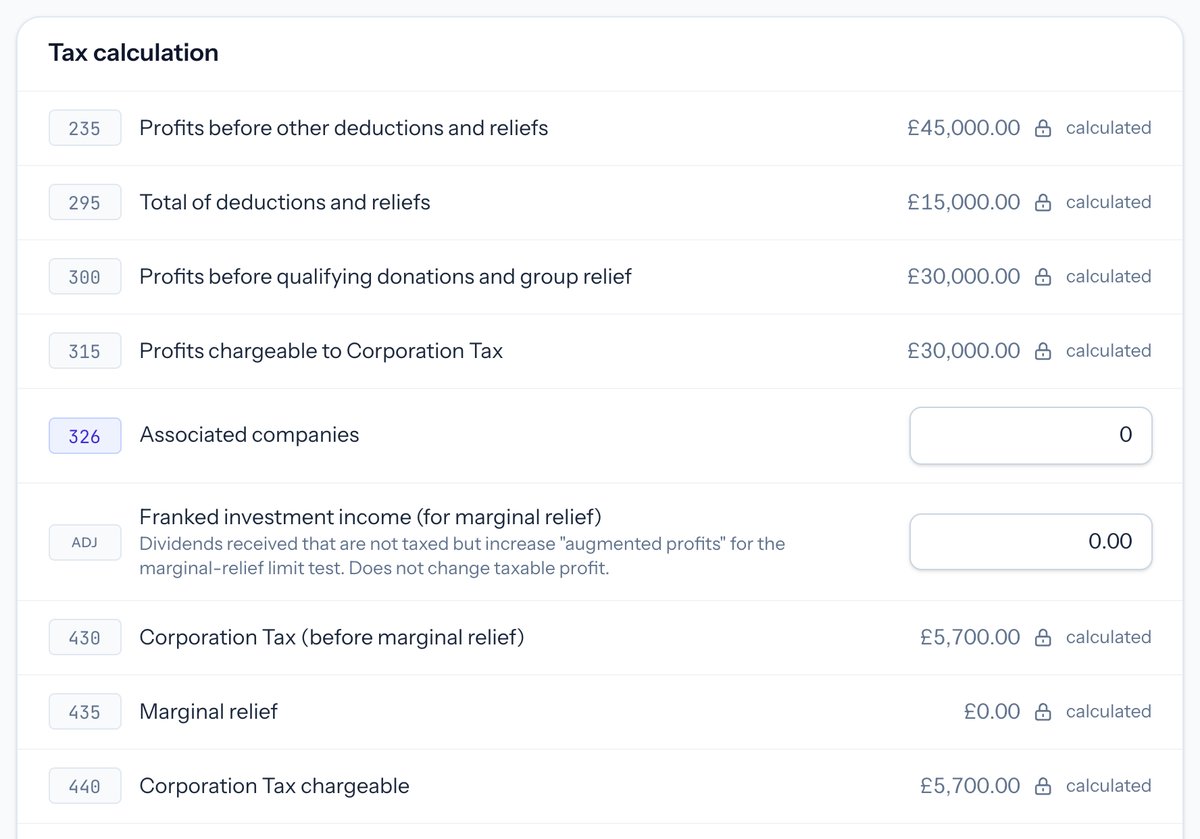 In Taxley: this worked example entered in the product, with the £15,000 interest deficit deducted from the £45,000 property profit to leave £5,700 of Corporation Tax (demo company).
If the company were a close investment-holding company, the same £30,000 would be taxed at 25%: £7,500.
In this simple case the tax is the same as if the interest had been deducted from rent, but the figures go in different boxes. If the company also receives interest, credits and debits are netted first: a net profit goes in box 170 and a net deficit in box 795 (GOV.UK: Company Tax Return guide). Setting a deficit against the same period's profits is a claim, and HMRC's manual lists other options — carrying it back, carrying it forward, or surrendering it as group relief — each with its own rules (HMRC manual CFM32030; CFM32060). Check the treatment carefully if your interest is large, or if the loan wasn't used wholly for the letting business.
What does a property company file, and when?
A property company files a full Company Tax Return — due within 12 months of its year end, with the tax paid 9 months and 1 day after it. The accounts and computations must be attached in iXBRL, a tagged format. The return is three things together:
- The CT600 return form with the tax calculation.
- Your statutory accounts — for most small property companies, FRS 105 (micro-entity) or FRS 102 Section 1A (small). Our micro vs small accounts guide explains which applies.
- Your tax computations showing how accounts profit becomes taxable profit.
Key dates:
- File the return: within 12 months of your accounting period end.
- Pay the Corporation Tax: 9 months and 1 day after the period end — earlier than the filing deadline.
Miss the filing deadline and HMRC charges £200 the day it's late and another £200 if it's more than three months late (uprated from £100 for filing dates on or after 1 April 2026), then 10% of the tax still unpaid if the return is 6 months late (18 months after the accounting period ends), rising to 20% if it is 12 months late (2 years after the period ends) (GOV.UK penalties). See our Corporation Tax deadlines guide for the full timeline.
What other taxes does a property company pay?
Besides Corporation Tax, a property company may face ATED on UK homes worth more than £500,000 and Stamp Duty Land Tax on purchases. It is not within Making Tax Digital for Income Tax, which applies to individual sole traders and landlords rather than companies. The two company taxes work like this:
- ATED (Annual Tax on Enveloped Dwellings) — an annual charge that can apply when a company owns UK residential property valued at more than £500,000 (GOV.UK ATED). There is relief for property let commercially to a third party that is not occupied by anyone connected with the owner — but if a relief reduces the charge to nil, you still need to submit a Relief Declaration Return (GOV.UK ATED reliefs).
- Stamp Duty Land Tax on purchases (companies usually pay the higher rates on additional dwellings).
See MTD for landlords if you also let property personally.
This guide covers Corporation Tax — the return your company files every year.
How do you file a property company's Corporation Tax return?
You can file it yourself — a straightforward property-holding company is a good fit. Gather the figures and references, prepare the iXBRL accounts and computations, complete the CT600, submit it before the 12-month deadline and check HMRC accepted it. Here is the sequence.
Step 1: Gather your figures
Pull together your rental income, property expenses (repairs, insurance, agent and management fees), your loan and mortgage interest (kept separate from the property expenses — see the worked example) and a balance sheet that balances. Keep the interest on its own line: it is relieved under the loan relationship rules, not as a property expense, so it belongs in different CT600 boxes from the rent and costs.
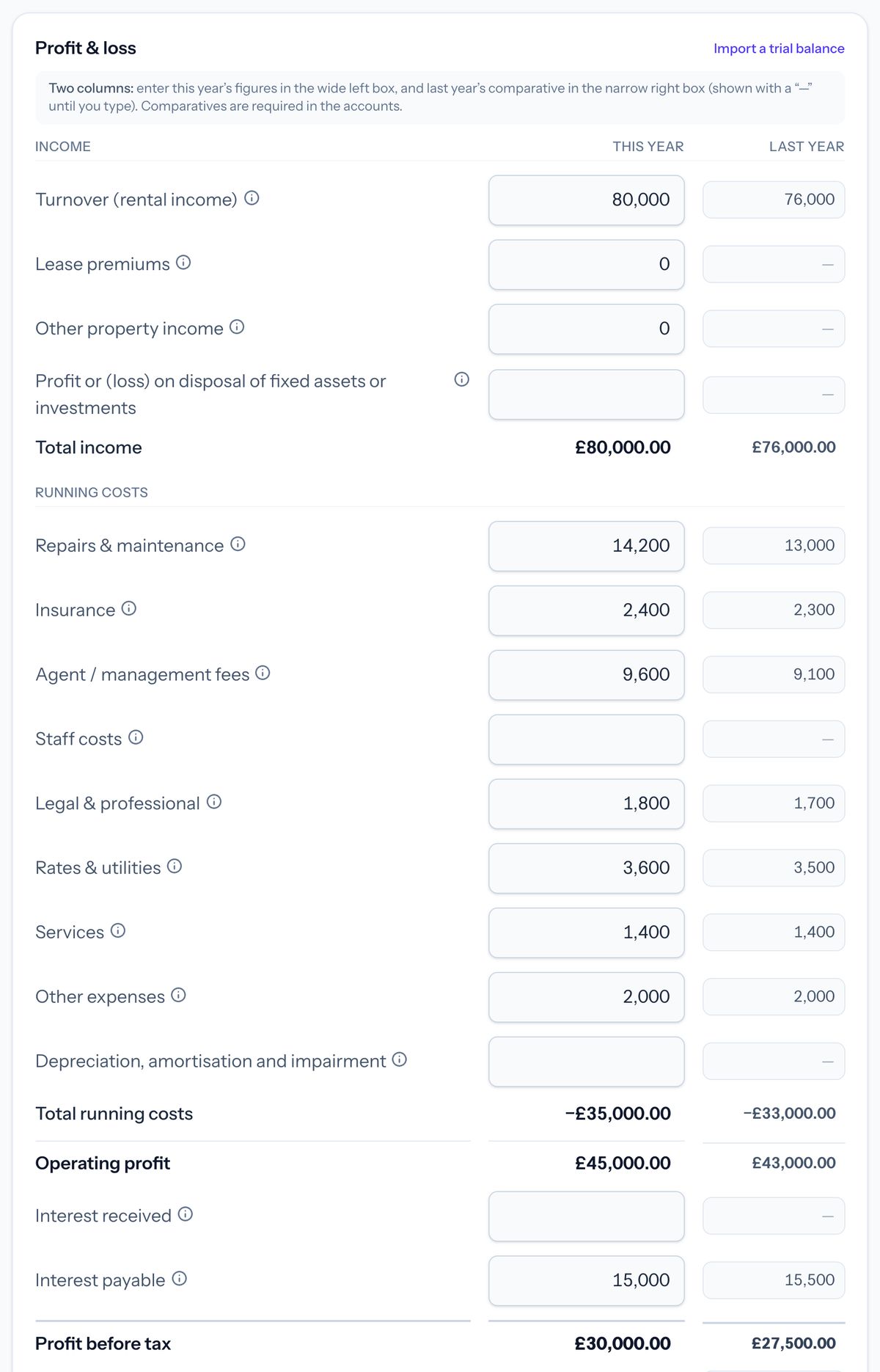 In Taxley: rental income and property expenses go in the profit and loss step, with mortgage interest on its own line as interest payable (demo company).
Step 2: Have your references ready
You need your company UTR (10 digits from HMRC), your CRN from Companies House, and Government Gateway details enrolled for Corporation Tax Online. Note your accounting period end date as well: the return is due within 12 months of it, and the Corporation Tax is due 9 months and 1 day after it — earlier than the filing deadline.
Step 3: Prepare the accounts and computations as iXBRL
Produce your statutory accounts — FRS 105 (micro-entity) or FRS 102 Section 1A (small) for most small property companies — and the tax computations showing how accounts profit becomes taxable profit. Both must be attached to the CT600 in inline XBRL (iXBRL), a tagged format. Filing software generates this tagging from your figures.
Step 4: Complete the CT600
The property profit (box 190), any loan relationship figures (boxes 170, 795 and 260) and the Corporation Tax flow from your figures into the CT600 boxes. Check the rate: a close investment-holding company pays 25% on all its profits rather than 19% on small profits. Make the director's declaration that the return is correct and complete.
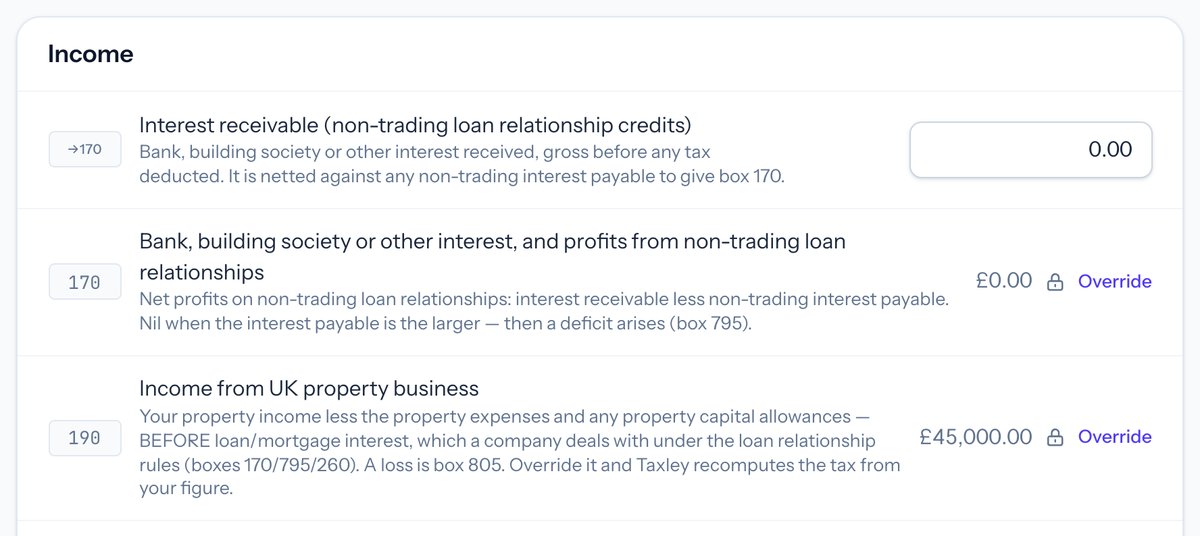 In Taxley: box 190 shows the income from the UK property business, £45,000 here, worked out before the mortgage interest (demo company).
Step 5: Submit online to HMRC
Submit the CT600 with the accounts and computations through the Government Gateway, before the 12-month filing deadline. Miss it and HMRC charges £200 the day the return is late and another £200 if it is more than three months late. Submitting the return does not pay the tax: pay any Corporation Tax due by its own deadline, 9 months and 1 day after the period end.
Step 6: Verify it was accepted
Filing is complete only when HMRC returns an acceptance for the submission; a saved draft or a sent file is not a filed return. If HMRC rejects it instead, correct the issue it reports and submit again. Once accepted, keep the confirmation, the filed CT600, accounts and computations, and your supporting records for at least six years.
Can Taxley prepare a property company's return?
Yes: Taxley asks for your rental income, expenses and balance sheet, then prepares the CT600, the FRS 105 / FRS 102 §1A iXBRL accounts and the tax computations for you. It works the Corporation Tax out to the penny, including Marginal Relief and associated-company limits.
Property is the default business type, so the property income lines map straight to the right CT600 boxes. You stay responsible for the figures, and a qualified review is worth it for anything unusual — but for a straightforward rental company, you can start your return now and see the tax before you pay anything. Pricing is on the pricing page, filing a property company's return with Taxley explains what's covered and what isn't, and you can take the 30-second check to see whether Taxley fits your company first.
Frequently asked questions
Does a limited company pay Income Tax or Corporation Tax on rental income?
Corporation Tax. A company's rental profit is charged to Corporation Tax at 19%–25%, not Income Tax. Income Tax only comes in personally, on any salary or dividends you take out of the company.
Can a property company deduct mortgage interest?
Generally yes, in full — but not as a property expense. A company's loan interest is relieved under the loan relationship rules as a non-trading loan relationship debit (HMRC PIM2052), and in a simple case it still reduces taxable profits pound for pound. Individual landlords get only a basic-rate tax reduction (20%, rising to 22% from 6 April 2027).
Does a property company always pay 19% on small profits?
No. A close investment-holding company pays the 25% main rate on all its profits. A company letting property commercially to people who aren't connected with it usually avoids that status, but letting to a director, shareholder or their relatives can bring it in. Take advice if any tenant is connected with the company.
Do I need to file iXBRL accounts for a property company?
Yes. A Company Tax Return includes the CT600 plus statutory accounts and computations attached in iXBRL. Most small property companies use FRS 105 (micro) or FRS 102 Section 1A.
What's the Corporation Tax deadline for a property company?
File the return within 12 months of your accounting period end. The Corporation Tax itself is due earlier — 9 months and 1 day after the period ends.
Can I file a property company tax return without an accountant?
Yes, for a straightforward rental company. Software can prepare and submit the CT600 and iXBRL accounts. You remain responsible for the accuracy of the figures, so check anything unusual or have it reviewed.
Taxley prepares the CT600, FRS 105 / FRS 102 §1A accounts and tax computations as iXBRL from the figures you enter, ready to file. This guide is general information, not tax advice — you're responsible for the accuracy of your return, and a qualified review is recommended before you file.
Update history
- Named what Taxley charges in the summary
- Clarified the 10% and 20% tax-geared late-filing penalties
- Corrected mortgage interest to the loan relationship rules (HMRC manual)
Spotted something out of date? See how we handle corrections.
People also ask
Keep reading


Ready to file your Company Tax Return?
Confirm support for your accounting period, accounts and any supplementary pages before paying. Taxley support can answer software questions, not provide a tax opinion.
Questions about your period or accounts? Ask about software support