
How to file a dormant company tax return

Prerequisites at a glance
- Time
- About 15 min
- Difficulty
- Beginner
- Tools you'll use
-
- Government Gateway login (enrolled for Corporation Tax)
- Commercial CT600 filing software
- Have ready
-
- Company UTR
- Company registration number (CRN)
- Notice to deliver a Company Tax Return (if HMRC sent one)
- Dormant accounts
- Date trading stopped
In short: A company is dormant for Corporation Tax if it isn't trading and has no other income (such as investments). If HMRC has sent a "notice to deliver a Company Tax Return", you must still file a nil CT600 showing the company was dormant — even though no tax is due (GOV.UK: Dormant for Corporation Tax). "Dormant for HMRC" and "dormant for Companies House" are two separate things. Taxley files a dormant company's nil CT600 and its dormant accounts for £9.50 (promotion price until 31 Dec 2026; £19.00 from 1 Jan 2027), filing the accounts at Companies House once the return is paid and finished.
A dormant company is one that is not carrying on any business activity and has no income for the period. Being dormant can reduce what you owe to nothing — but it does not automatically switch off your filing obligations. If you've been told to deliver a return, you can file a dormant (nil) return yourself in a few minutes.
What does 'dormant' mean for Corporation Tax?
A company is dormant for Corporation Tax when it has stopped trading and has no other income (GOV.UK: dormant for Corporation Tax). That covers, for example, a company that has paused, or a new company that hasn't started trading yet. With no trading and no income, there is no taxable profit, so no Corporation Tax is due for that period.
"No other income" is the part people miss: a company earning bank interest or other investment income is not dormant for Corporation Tax, even if it isn't trading.
Does a dormant company have to file a tax return?
A dormant company must file a tax return only if HMRC has asked for one. If HMRC has sent a notice to deliver a Company Tax Return, you must file one — even when the company is dormant and owes nothing. The return is filed online and shows HMRC that the company was dormant for that period.
Once you've filed and HMRC accepts the company is dormant, HMRC may stop issuing notices for future years, so you won't have to file again until the company starts trading. Until that happens, ignoring a notice risks a late-filing penalty — £200 once it's late, and another £200 after three months (uprated from £100 for filing dates on or after 1 April 2026, GOV.UK penalties).
What is the difference between dormant for HMRC and dormant for Companies House?
Dormant for HMRC means not trading and no other income, while dormant for Companies House means no significant accounting transactions. These are separate statuses with separate filings, and a company can be dormant for one but not the other. Confusing them is the most common dormant-company mistake. If the company has no income but isn't dormant, see no income but not dormant.
| Dormant for HMRC (Corporation Tax) | Dormant for Companies House | |
|---|---|---|
| Who assesses it | HMRC | Companies House |
| What it means | Not trading and no other income | No "significant accounting transactions" in the period |
| What you file | A nil Company Tax Return if HMRC issued a notice (until HMRC agrees the company is dormant) | Dormant accounts plus a confirmation statement, every year |
| Stops automatically? | HMRC may stop asking once it agrees you're dormant | No — annual filings continue while the company exists |
Being dormant for Corporation Tax does not excuse you from Companies House: a dormant company must still file annual dormant accounts and a confirmation statement to stay on the register (GOV.UK: dormant for Companies House).
How do you tell HMRC your company is dormant?
Tell HMRC through your company's business tax account (or by contacting them), then answer any return HMRC has already requested with a nil CT600, keep evidence of when trading stopped, and check HMRC accepted the return. The steps are below.
Step 1: Check you're actually dormant
Confirm there was no trading and no other income (such as bank interest) for the period. Dormant for Corporation Tax means genuinely no activity that produces taxable income — for example, a company that has paused, or a new company that hasn't started trading yet. If the company had any income or activity, it isn't dormant for Corporation Tax, so file a normal return instead.
Step 2: Tell HMRC the company is dormant
Let HMRC know through your business tax account or by contacting them. If HMRC agrees, it may stop sending notices to deliver a return. Telling HMRC does not change what you owe Companies House: a dormant company must still file annual dormant accounts and a confirmation statement there to stay on the register.
Step 3: File any return HMRC has already requested
If a notice to deliver already covers a period, you must still answer it — submit a nil CT600 for that period showing the company as dormant, together with dormant accounts. The return still needs the company UTR, CRN and Government Gateway details, and it goes online through commercial software or an agent, because HMRC's own filing service closed on 31 March 2026.
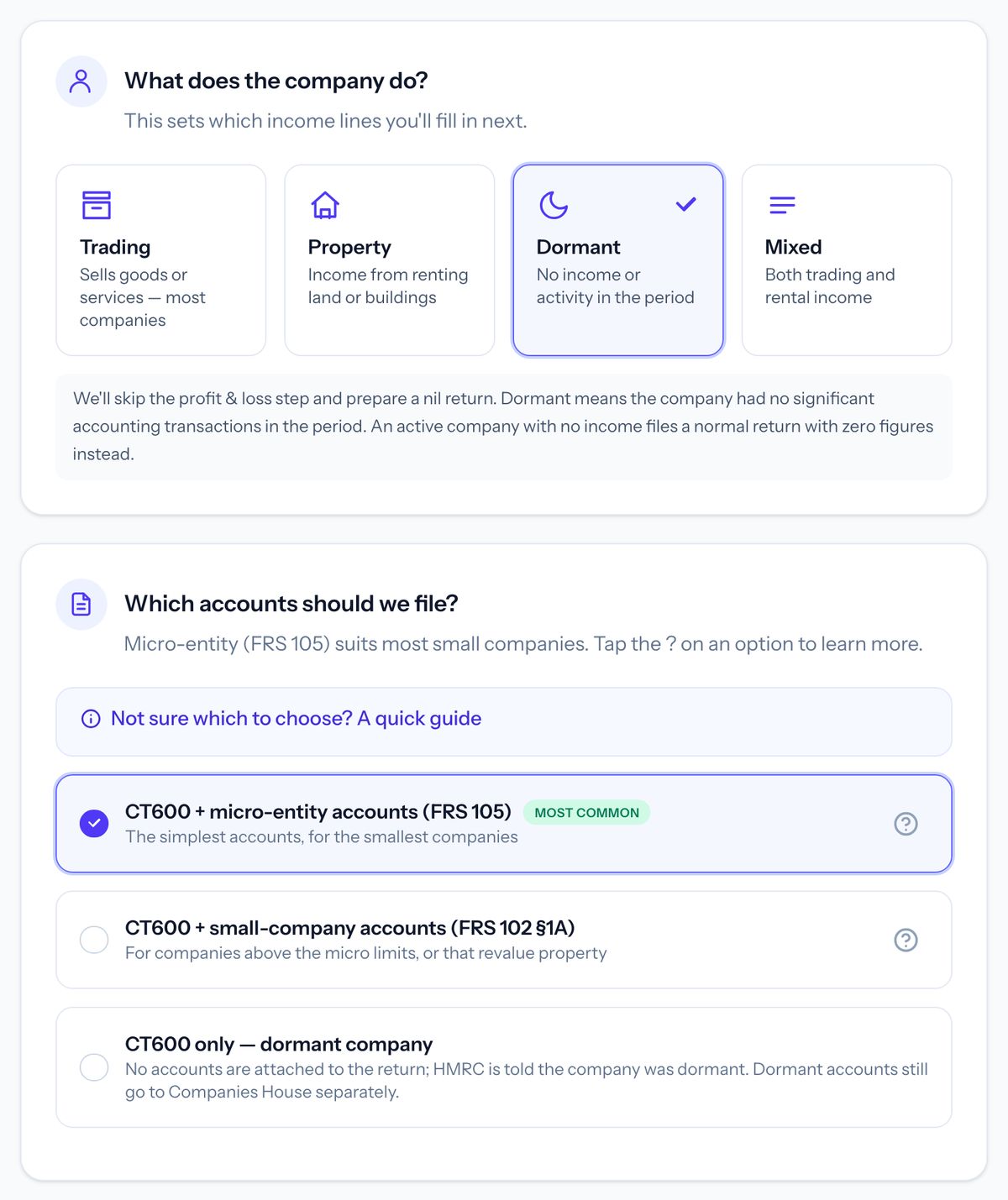 In Taxley: choosing Dormant under "What does the company do?" when you start the return skips the profit and loss step and prepares a nil return (demo company).
Step 4: Keep evidence
Keep a record of when trading stopped, in case HMRC asks later, alongside copies of the nil return and dormant accounts you filed. If the company never traded at all, HMRC may not issue a notice — but if one arrives, you still answer it with a return, so keep the record even when no return is due yet.
Step 5: Check HMRC accepted the nil return
Your nil return is filed only when HMRC returns an acceptance for the submission: filing software shows it, and it appears in your HMRC online account. A saved draft is not a filed return. The return shows nil taxable profit and nil Corporation Tax, so there is nothing to pay HMRC — but the dormant accounts and confirmation statement at Companies House are separate tasks to check off.
What goes in a dormant company tax return?
A dormant Company Tax Return is a normal CT600 with nil figures — no trading profit, no income, no tax due — plus, where required, simple accounts showing the company was dormant. There's no Corporation Tax to pay, but the return is the formal record that closes off the period for HMRC.
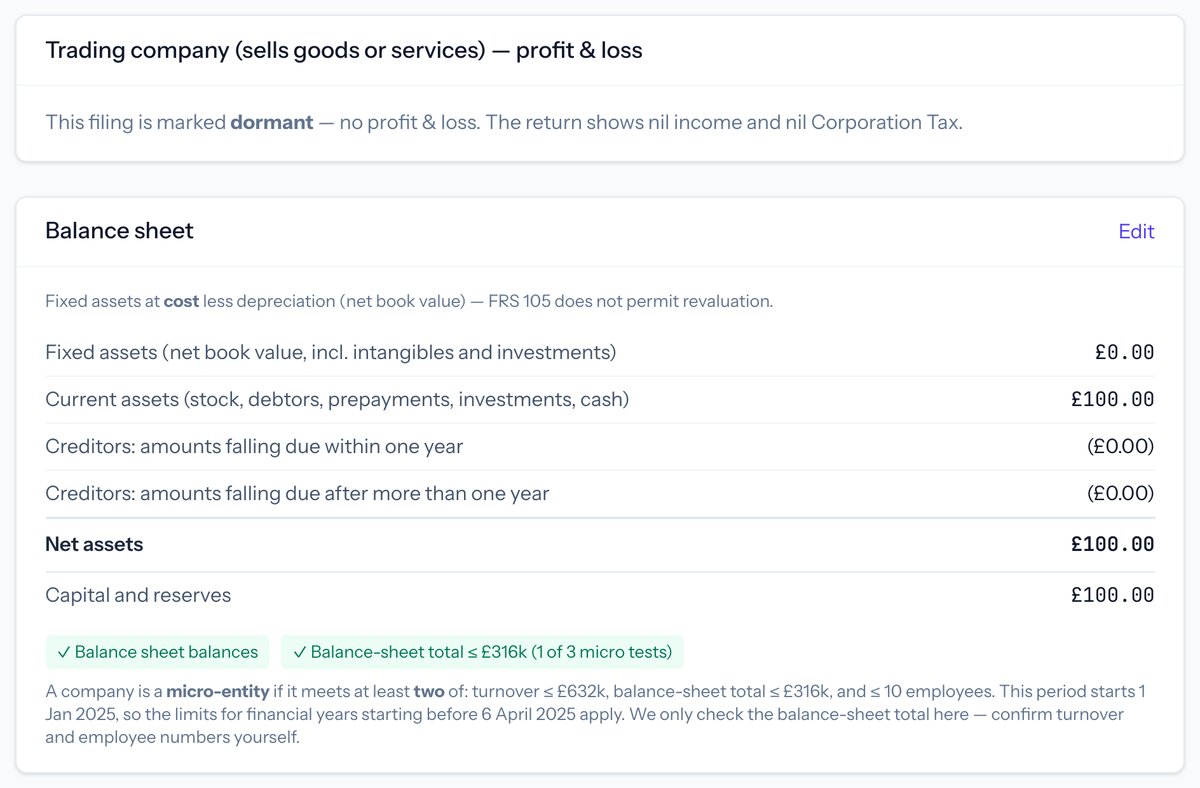 In Taxley: the review of a dormant return shows no profit and loss, just the balance sheet and a check that it balances (demo company).
Even though the numbers are zero, the return still needs your company UTR, your CRN, and Government Gateway details enrolled for Corporation Tax Online — the same references as any other CT600. Our guide to what a CT600 is covers those references in full.
A nil return is still filed online, and HMRC's own online filing service closed on 31 March 2026 — so from 1 April 2026 even a dormant company's return goes through commercial software or an agent, unless you have a reasonable excuse to file on paper or are filing in Welsh (GOV.UK: Closure of HMRC's file-your-accounts-and-tax-return service).
How much does it cost to file a dormant company's return?
There's no Corporation Tax to pay on a nil CT600, but HMRC's free online filing service closed on 31 March 2026, so filing one now costs whatever your software or agent charges (GOV.UK: Closure of HMRC's file-your-accounts-and-tax-return service). Taxley's current price for a dormant nil return is on the pricing page. Our guide to the cheapest way to file a dormant return compares the options.
The Companies House side is separate. Filing dormant accounts there is free (Companies House: Filing dormant company accounts with Companies House), and a company that has never traded can still file dormant accounts through its online service until 31 March 2028; from 1 April 2028, accounts filing moves to commercial software only (GOV.UK: Preparing and filing Companies House accounts). If your Taxley return includes dormant accounts, Taxley can file them at Companies House too, at no extra cost. The annual confirmation statement does carry a Companies House fee, £50 when filed online at the time of writing (GOV.UK: Companies House fees).
Dormant company tax return software: file a nil CT600 online explains what's included.
How do you file a dormant return with Taxley?
You confirm the company was dormant for the period, and Taxley prepares a nil CT600 (and the accounts where needed) ready to file. Its dormant path means you don't work through boxes that don't apply. Because there's nothing to compute, a dormant nil return is the quickest and cheapest filing Taxley offers.
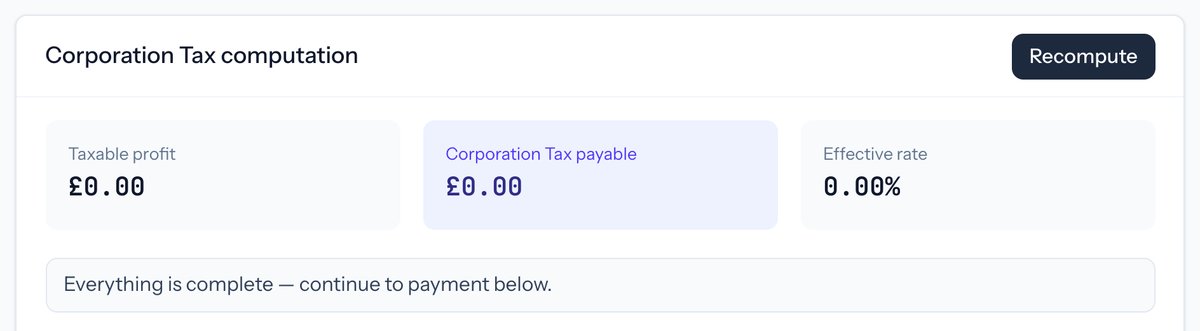 In Taxley: for a dormant company the computation shows nil taxable profit and nil Corporation Tax (demo company).
You're still responsible for confirming the company really was dormant. If it had any income or activity, it isn't dormant for Corporation Tax — file a normal return instead (for a rental company, see our property company guide). If you're unsure which applies, take the 30-second check to see whether Taxley fits your company. When you're ready, start your dormant return.
Frequently asked questions
Do I have to file a tax return for a dormant company?
Only if HMRC has sent a notice to deliver a Company Tax Return. If it has, you must file a nil CT600 showing the company was dormant, even though no tax is due. Once HMRC accepts the company is dormant, it may stop asking.
Is dormant for HMRC the same as dormant for Companies House?
No. They're separate. A company can be dormant for Corporation Tax yet still owe Companies House annual dormant accounts and a confirmation statement. Each is assessed under its own rules.
Does a dormant company pay Corporation Tax?
No. With no trading and no income, a dormant company has no taxable profit, so no Corporation Tax is due. You may still have to file a nil return to confirm that to HMRC.
What happens if I ignore a notice to deliver for a dormant company?
You can be charged a late-filing penalty — £200 once the return is late, and another £200 after three months — even though no tax is owed. File the nil return to avoid it.
Can a new company that hasn't started trading be dormant?
Yes. A company that has been set up but hasn't begun trading and has no income can be dormant for Corporation Tax. If HMRC issues a notice before you start trading, file a nil return for that period.
Taxley prepares the CT600 and, where needed, dormant accounts as iXBRL from the details you enter, ready to file. This guide is general information, not tax advice — you're responsible for confirming the company was dormant and for the accuracy of the return.
Update history
- Named what Taxley charges in the summary
- Updated: choose Dormant under \"What does the company do?\"
- Added what filing a dormant company return costs
Spotted something out of date? See how we handle corrections.
People also ask
Keep reading


Ready to file your Company Tax Return?
Confirm support for your accounting period, accounts and any supplementary pages before paying. Taxley support can answer software questions, not provide a tax opinion.
Questions about your period or accounts? Ask about software support