
How to file an investment holding company's FRS 102 accounts and CT600 with Taxley (step by step)

Prerequisites at a glance
- Difficulty
- Intermediate
- Tools you'll use
-
- Taxley account
- Government Gateway user ID and password with Corporation Tax added
- Companies House authentication code
- Have ready
-
- Company UTR
- Company registration number (CRN)
- Bank and platform statements
- Fund distribution vouchers
- Proceeds and cost of each investment sold
- Investment values at both year ends
- Last year's accounts
In short: An investment holding company, one that holds funds, shares or cash and doesn't trade, must file statutory accounts at Companies House and a Company Tax Return (CT600) with HMRC after each financial year. Taxley prepares FRS 102 Section 1A small-company accounts and the CT600 for £129, filing the accounts at Companies House once the return is paid and the accounts are finished.
Take the 30-second check to see whether Taxley fits your company, or read how to file a CT600 for an investment company for the tax rules in more depth.
Key facts (checked on 30 October 2026)
| Fact | Detail | Source |
|---|---|---|
| Close investment-holding company | 25% main rate, no small profits rate | CTA 2010 s.18A; GOV.UK rates |
| Permitted purposes | Trading commercially, letting land commercially to people not connected with the company, and some group activities | CTA 2010 s.18N |
| Management expenses | Deducted from total profits; capital costs excluded | CTA 2009 s.1219 |
| UK fund dividend distribution | Franked part treated like a UK dividend | HMRC manual IFM03320 |
| Fund over 60% in bonds, deposits and similar at any time | Taxed every year as a loan relationship | CTA 2009 s.490 |
| CT600 filing deadline | 12 months after the accounting period ends | GOV.UK: Company Tax Returns |
This walkthrough is for a close company that holds investments, such as units in UK funds, shares and cash, and files FRS 102 small-company accounts for a 12-month year. Every screenshot shows Brackenwold Investments Ltd, a fictional company holding units in a UK equity index fund and cash, entered in Taxley on 29 October 2026. Its year runs from 1 April 2025 to 31 March 2026. The tax rules behind each step are explained in our investment company CT600 guide; this guide shows where each figure goes.
What do you need before you start?
You need the company's 10-digit Unique Taxpayer Reference (UTR), its company number, a Government Gateway user ID with Corporation Tax added and the Companies House authentication code. You also need the year's bank, platform and fund statements, each sale's proceeds and cost, the investments' values at both year ends and last year's accounts.
| What you need | Where to find it | Where Taxley uses it |
|---|---|---|
| Company UTR, 10 digits | HMRC letters or the business tax account | Company card in the editor |
| Company registration number | Companies House register | Step 1 look-up |
| Bank and platform statements | Bank and investment platform | Steps 4 and 7 |
| Fund distribution vouchers | Fund manager or platform | Steps 4 and 5 |
| Each sale's proceeds and cost | Platform contract notes | Step 6 |
| Investment values at both year ends | Platform valuations | Steps 8 and 9 |
| Government Gateway user ID and password | Business tax account with Corporation Tax added | Step 12, File with HMRC |
| Companies House authentication code | Posted to the registered office | Step 12, Companies House filing |
Accounts show last year's figures next to this year's, so keep last year's accounts to hand: the editor has a "Last year" column beside most lines, which is left out only for a company's first period. Companies House posts the authentication code to the registered office, which can take up to 10 working days (GOV.UK: company authentication codes); if it's lost, see how to get a new authentication code. HMRC posts a Corporation Tax activation code within 10 days if Corporation Tax isn't yet in the business tax account.
How do you file an investment holding company's accounts and tax return in Taxley?
Start a new return, look up the company, choose the period, pick Holds investments and answer the accounts questions; Brackenwold stays on FRS 102 small-company accounts in the Advanced editor. Answer the close investment-holding company question, then enter the income, costs, sale, investments and deferred tax. Review the tax, tick the declaration and pay, then file with HMRC and Companies House. The twelve steps follow.
Step 1: Look up the company and choose the period
From the dashboard, press Start a new return. In "Look up your company at Companies House", type the company's name or number and press Look up. Taxley fills in the name and registration number and shows "Filled from Companies House — check the details below and continue." Under "What period does this return cover?", pick the year in "Choose the period from Companies House": the period still to file is marked Ready, and a year already filed Filed. Brackenwold's year to 31 March 2026 is marked Ready.
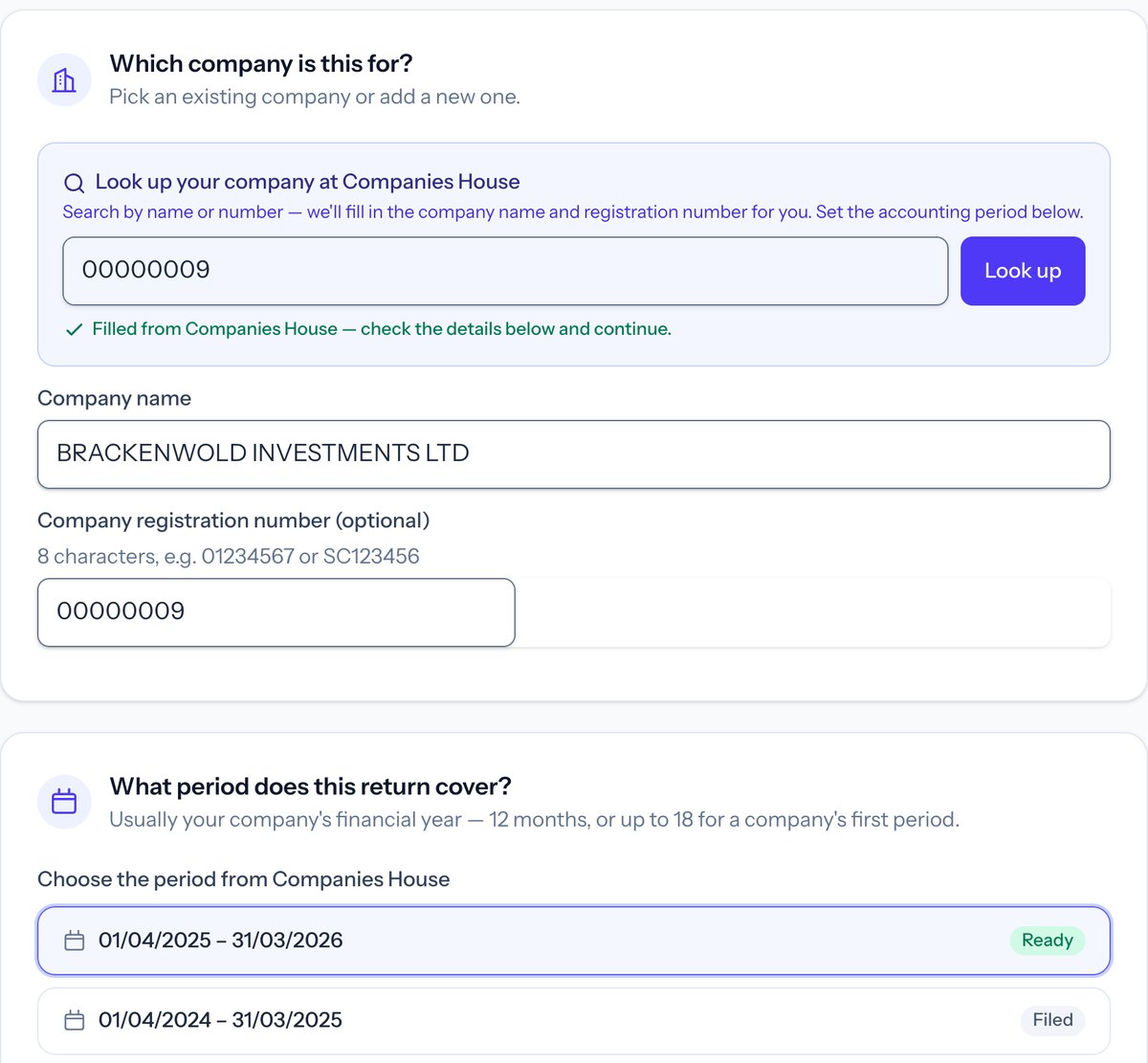 In Taxley: the Companies House look-up fills in the company and lists its periods, with the one still to file marked Ready (demo company).
Step 2: Choose Holds investments
Under "What does the company do?", choose Holds investments: "No trade and no letting: the company holds funds, shares, bonds, crypto or cash and pays its running costs." Then, under "Which accounts should we file?", answer the questions for this period. FRS 102 Section 1A small-company accounts are the default, and micro-entity accounts are offered only when every answer allows them (Companies Act 2006 s.384B). Brackenwold held fund units and wants them at market value, which micro-entity accounts can't show (SI 2008/409 reg 3), so it answers Yes to both and stays on small-company accounts. The return opens in the Advanced editor. Press Continue to my numbers.
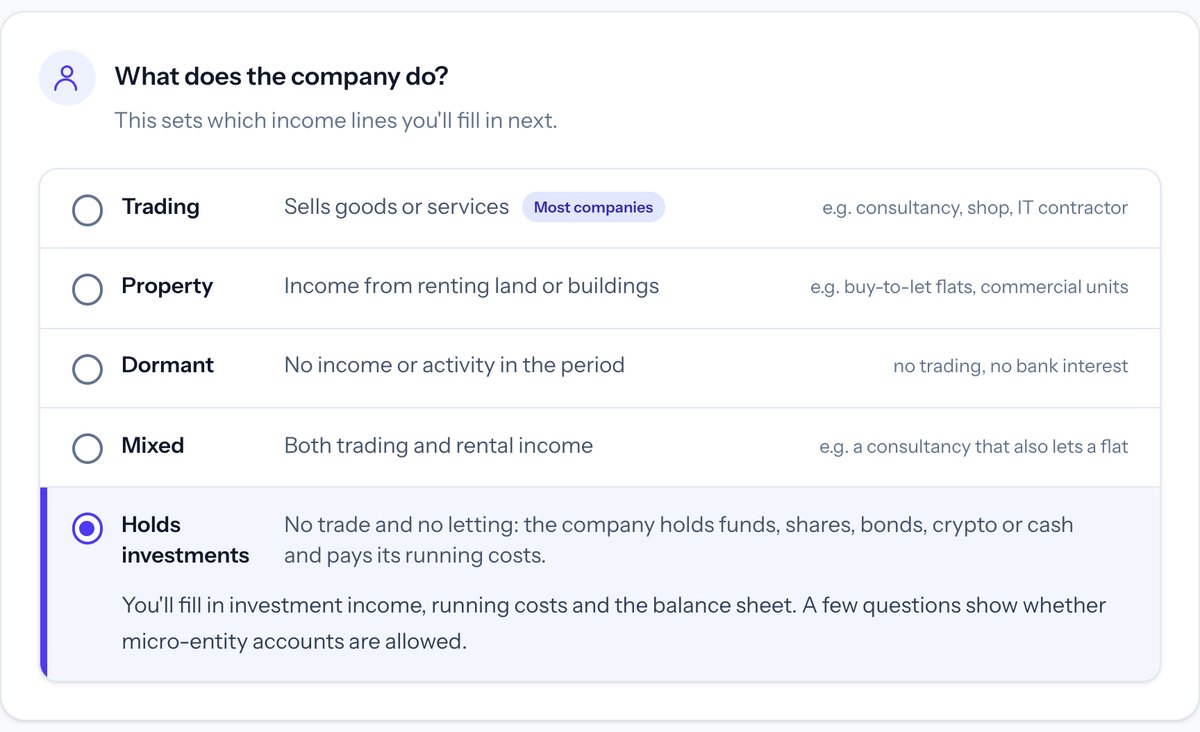 In Taxley: choosing Holds investments sets up the investment income lines, and a few questions then decide the type of accounts (demo company).
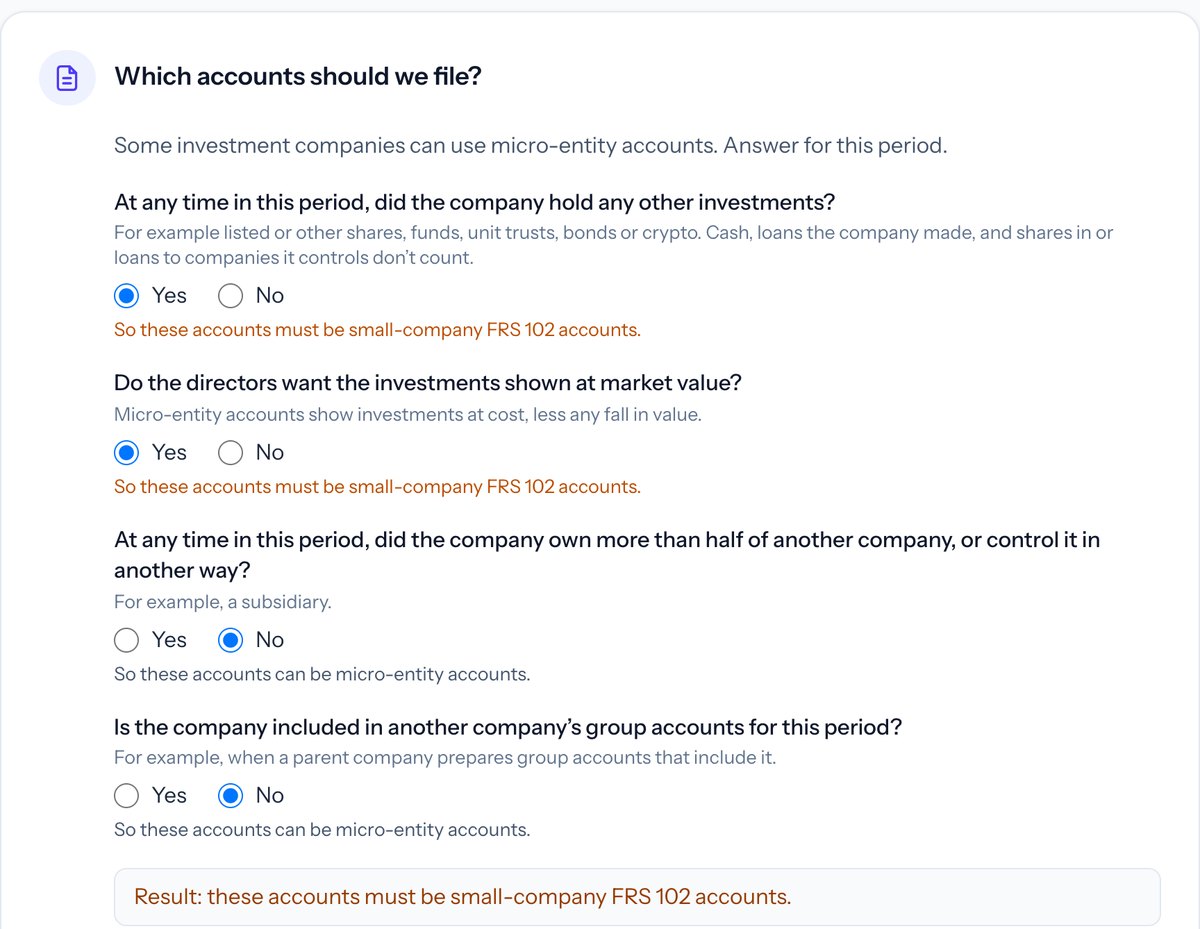 In Taxley: holding fund units, or wanting them at market value, rules out micro-entity accounts for the period (demo company).
Step 3: Answer the close investment-holding company question
In the company card, answer Close investment-holding company. A close company is controlled by five or fewer participators, or by its directors (CTA 2010 s.439). It is a close investment-holding company unless, throughout the period, it exists wholly or mainly for permitted purposes, such as trading commercially or letting land commercially to people not connected with the company (CTA 2010 s.18N). Holding funds and cash isn't one. Brackenwold, controlled by its director Morgan Hale, answers Yes — box 4 becomes 2, so all its profits pay the 25% main rate. Taxley asks every investment company this question and never answers it for you.
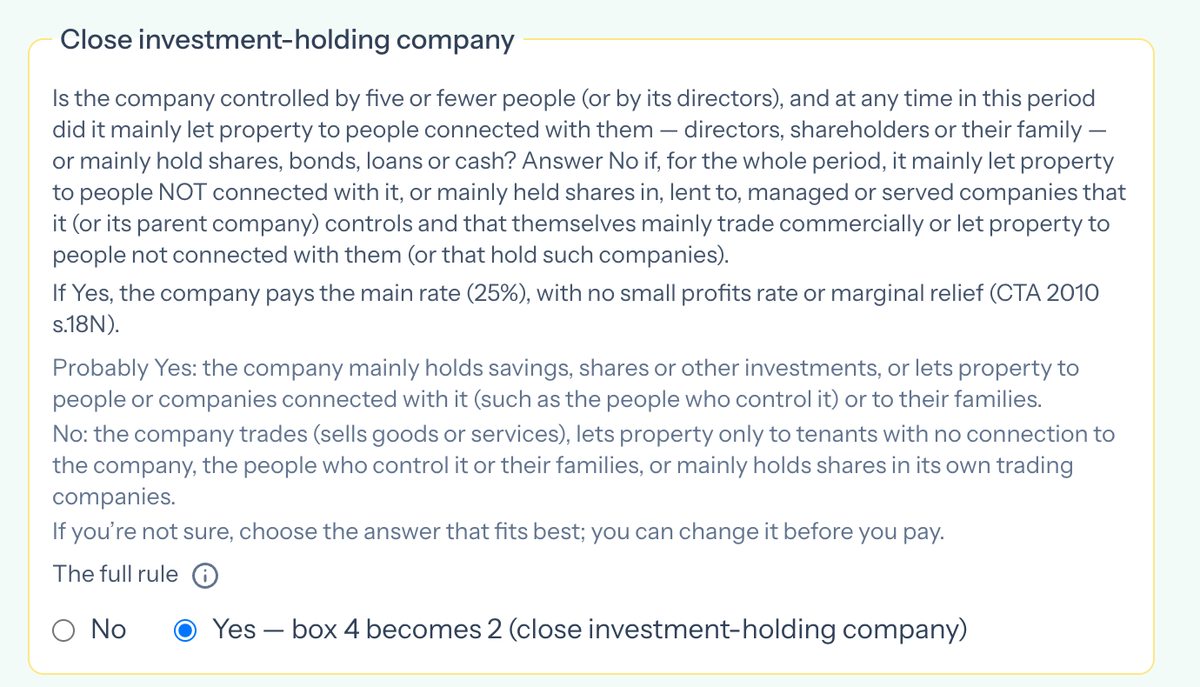 In Taxley: every investment company answers this question itself, and Yes means the main rate with no marginal relief (demo company).
Step 4: Enter interest, fund distributions and fees in the profit and loss account
In "Profit & loss", enter the year's bank interest in Interest received: £6,000 for Brackenwold. For tax, interest is a loan relationship credit, reported in CT600 box 170 (CTA 2009 s.299; Company Tax Return guide). Enter fund distributions in Dividends and fund distributions received: £3,800. Put platform and management charges in Investment management, platform and custody fees: £2,200. Enter the year's rise in value in Gains or losses on investments at fair value: £5,000. The units sold go in Profit or loss on investments and crypto sold, an accounts line; the tax on the sale comes from step 6.
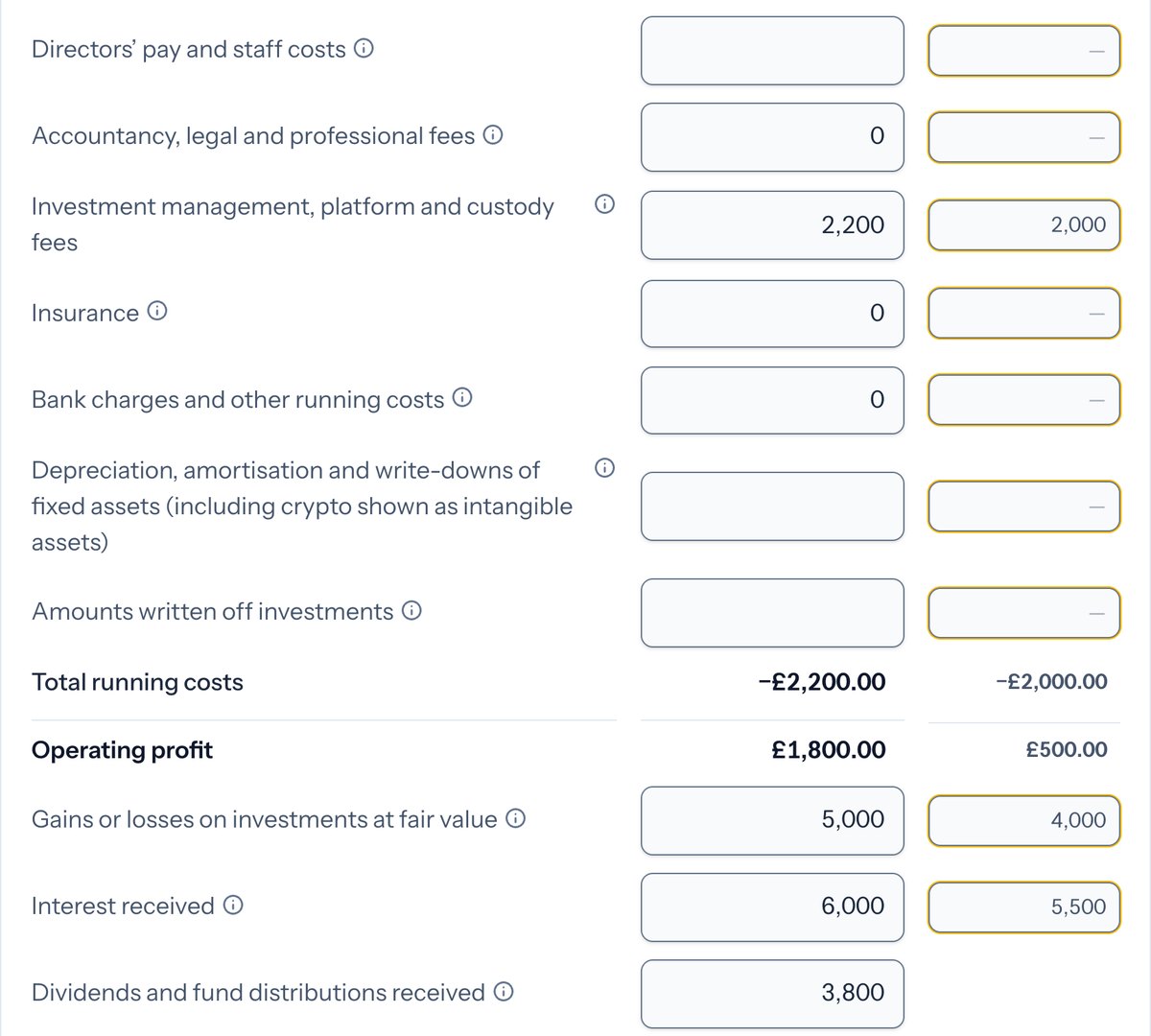 In Taxley: investment income and fees each have their own line, with last year's figures in the right-hand column (demo company).
Step 5: Enter the exempt distributions as franked investment income
In "Tax adjustments (optional)" under "For information", enter the exempt part of the distributions in Franked investment income: it isn't taxed, but goes in CT600 box 620 and counts towards the small profits rate and marginal relief limits. From a UK authorised fund, the franked part of a dividend distribution is treated like a UK company dividend; any unfranked part is taxed (HMRC manual IFM03320). Leave out exempt distributions from certain group or consortium companies. This example assumes all of Brackenwold's £3,800 is franked, so £3,800 goes here; a real fund's distribution voucher shows the split. Taxley doesn't tax the dividends line, so this walkthrough covers wholly franked distributions only; an unfranked part needs its own tax entry.
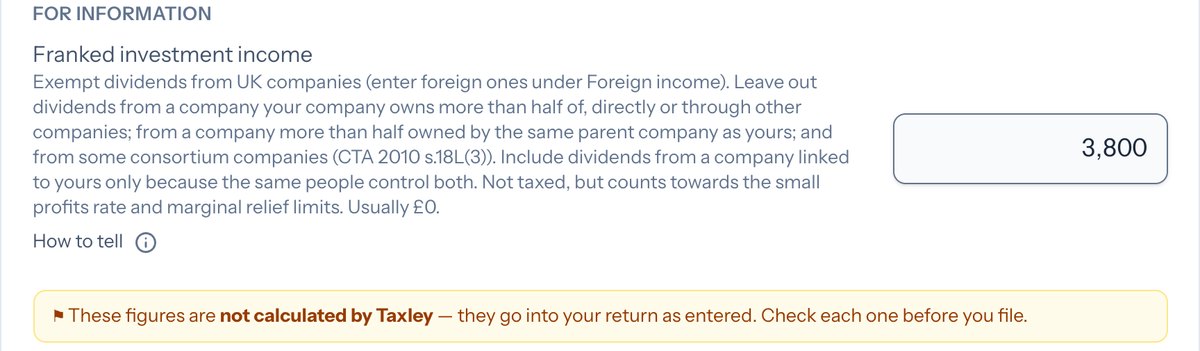 In Taxley: franked investment income is entered for information and goes in CT600 box 620, without being taxed (demo company).
Step 6: Add the fund sale under Assets the company sold
The tax on a sale comes from the chargeable gain, not the profit in the accounts. Open Assets the company sold and press Add a sale. Brackenwold sold its units in a UK equity index fund on 16 February 2026 for £18,000. They cost £14,000 in May 2025, so the chargeable gain is £4,000, with no indexation allowance for an asset bought after December 2017 (GOV.UK: work out a chargeable gain). The sale card shows the gain, and Taxley carries it to CT600 boxes 210 and 220.
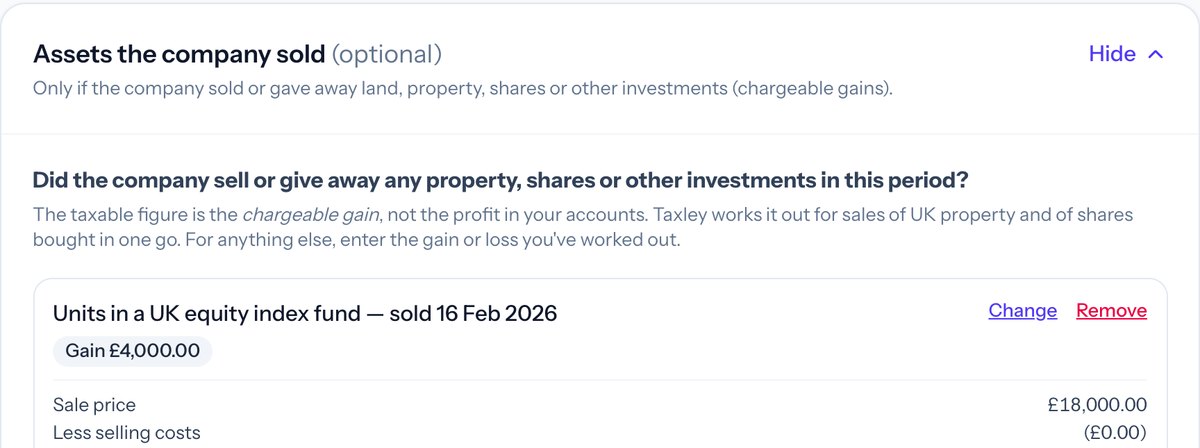 In Taxley: each sale gets its own card, and the chargeable gain feeds CT600 boxes 210 and 220 (demo company).
Step 7: Keep capital costs out of management expenses
A company with an investment business deducts its expenses of management from its total profits, but not capital costs (CTA 2009 s.1219). Costs of buying or selling investments, such as dealing costs, are capital (HMRC manual CTM08260). Taxley deducts the fees from step 4 as management expenses in box 245 and carries any excess forward. If some of those costs can't be claimed, enter them under "Tax adjustments (optional)" in Costs that can't be claimed. Brackenwold has none, so it enters 0. Leave Management expenses brought forward blank if none are unused from earlier years.
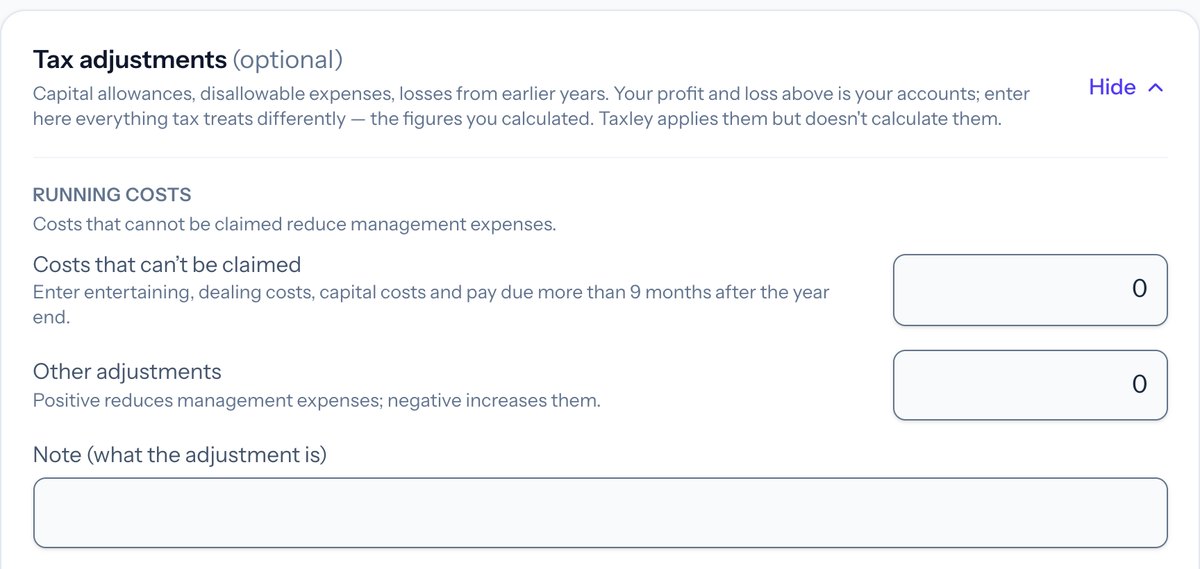 In Taxley: dealing and other capital costs go in Costs that can't be claimed, which reduces the management expenses (demo company).
Step 8: Show the investments at fair value and fill in the investment note
Under FRS 102, investments in shares or equity-fund units with a quoted price, like Brackenwold's, are measured at fair value, with the change in value in the profit and loss account (FRS 102, paragraph 11.14). On the balance sheet, enter the year-end value in Investments (held long term): £180,000. In "Investment and intangible asset notes", choose Fair value as the valuation basis and fill in the year's movement: £165,000 brought forward, £24,000 of additions, £14,000 of disposals and a £5,000 revaluation. Small-company accounts show this movement for fixed asset investments (FRS 102 paragraph 1AC.12), and Taxley prints it as a note.
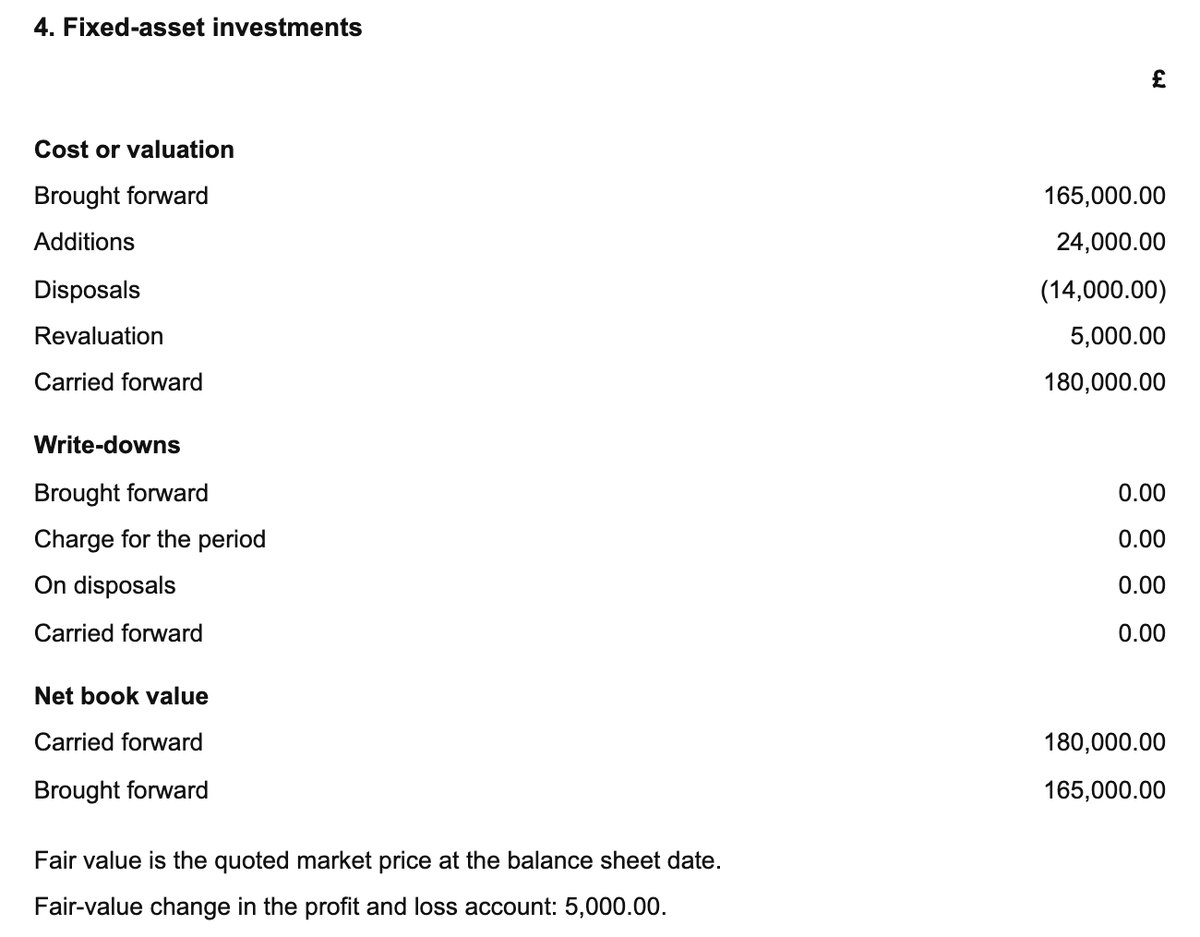 In Taxley: the movement you enter becomes the fixed-asset investments note, at quoted market price (demo company).
Step 9: Work out the deferred tax and enter it
Fair value gains are taxed only when the units are sold, so FRS 102 requires deferred tax on them (FRS 102, paragraph 29.6). Taxley doesn't calculate deferred tax: you work it out and enter it. Brackenwold's unrealised gains on units still held total £9,000 (£4,000 last year). At 25%, that is a provision of £2,250 (£1,000), so the charge is £1,250. Enter the charge in Deferred tax charge/(credit) in the profit and loss account, and the provision in Provisions for liabilities and of which: deferred tax on the balance sheet. Deferred tax doesn't change the Corporation Tax payable, which stays £1,950.
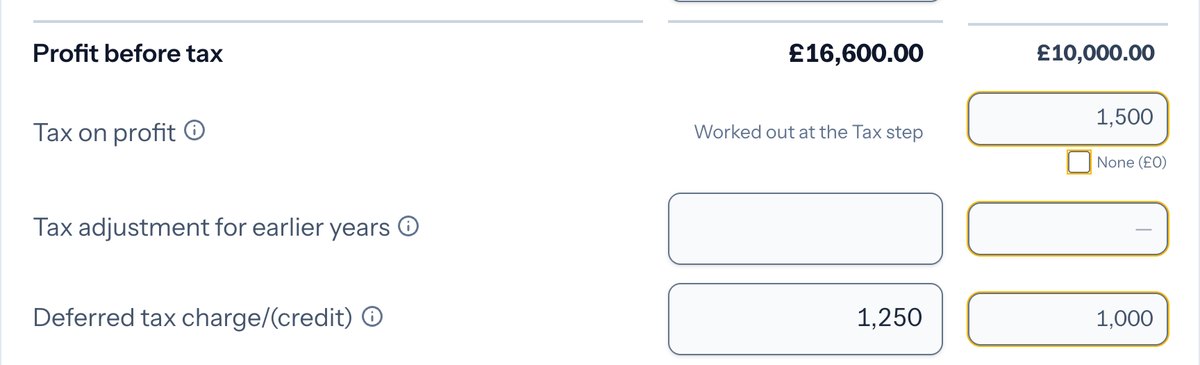 In Taxley: you enter the deferred tax charge yourself, while the current tax on profit is worked out at the Tax step (demo company).
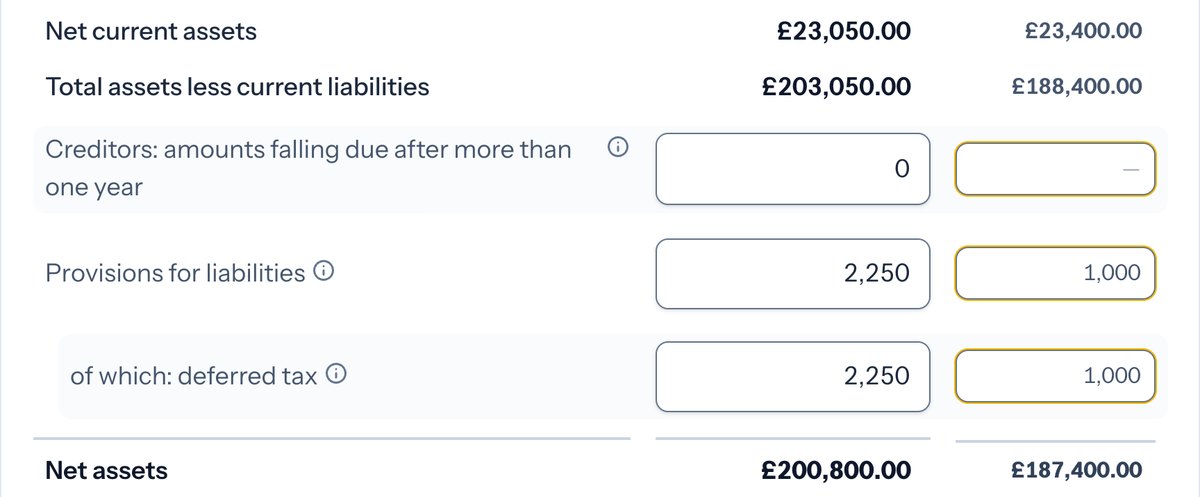 In Taxley: the deferred tax provision goes on the balance sheet, and net assets come to £200,800 (demo company).
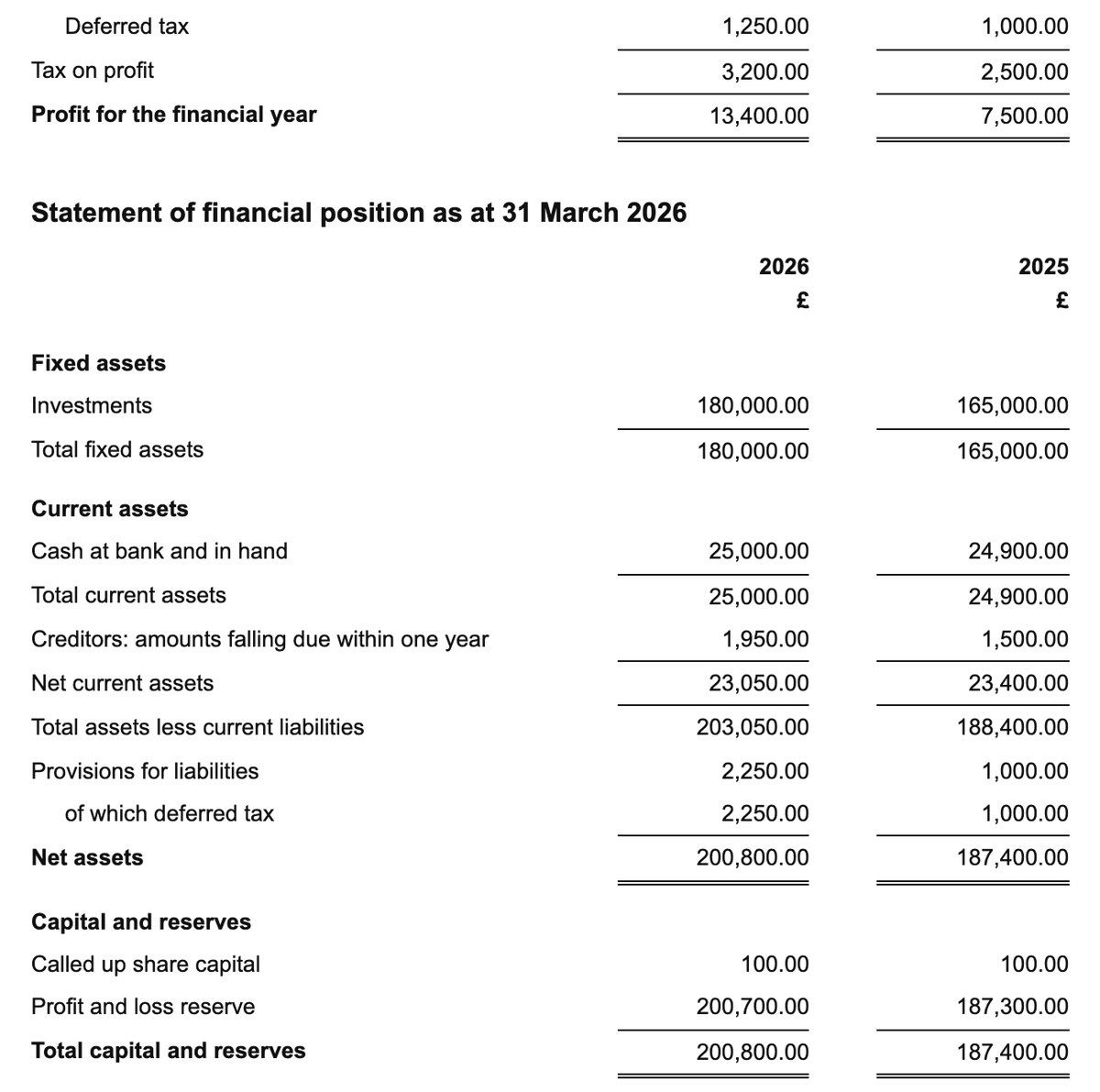 In Taxley: the accounts show tax on profit of £3,200, which is £1,950 of Corporation Tax plus £1,250 of deferred tax (demo company).
Step 10: Review the tax computation
Press Review your return, then open Technical details under "Corporation Tax computation". Brackenwold's £6,000 of interest is in box 170 and its £4,000 gain in box 220, making £10,000 in box 235. Less £2,200 of management expenses in box 245, its taxable total profits are £7,800. As a close investment-holding company, it pays the 25% main rate with no marginal relief: £1,950 in box 440. The £3,800 of distributions and the £5,000 fair value gain aren't in the computation. HMRC's Company Tax Return guide explains each box.
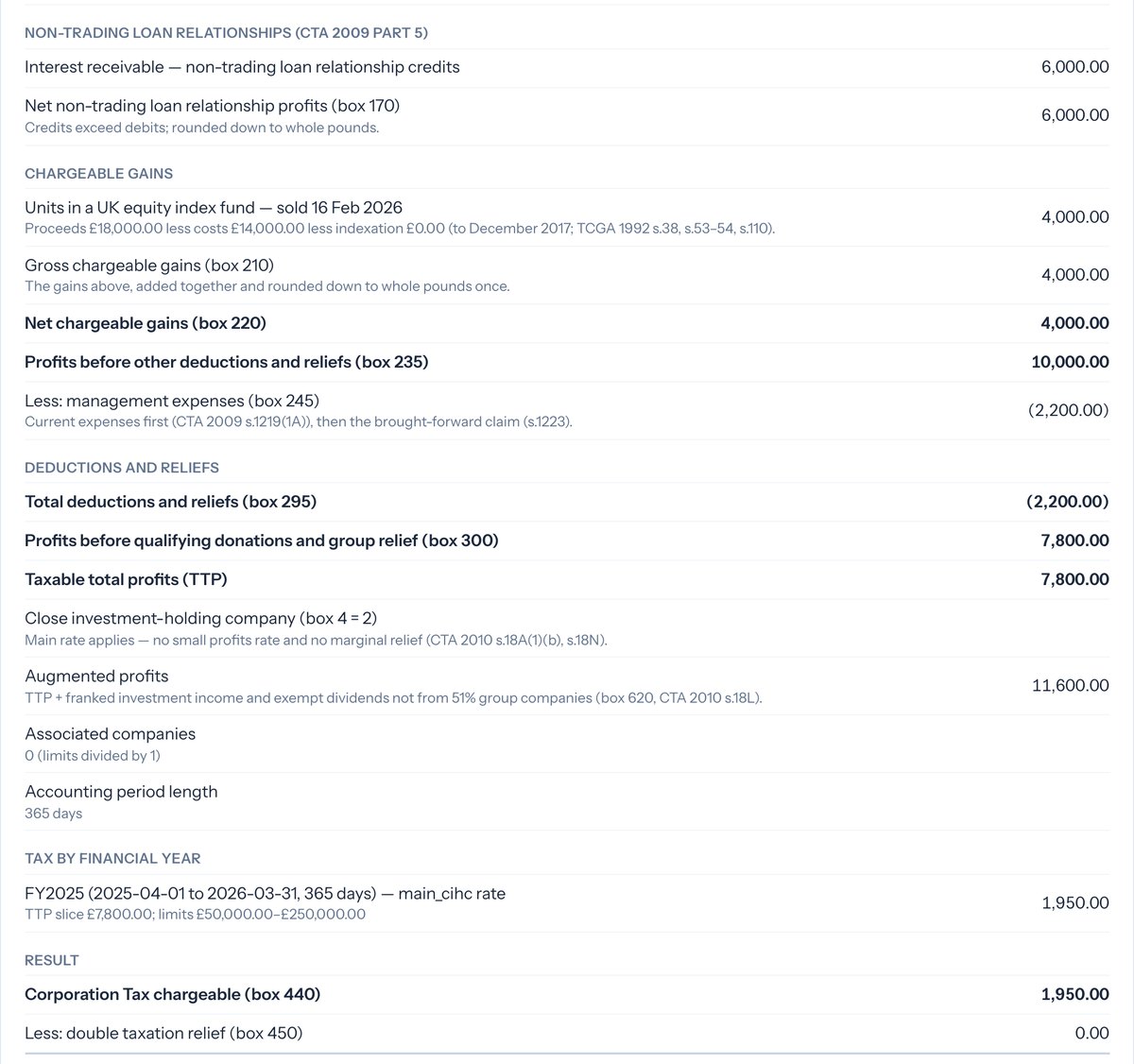 In Taxley: the computation shows each CT600 box, the close investment-holding company main rate and the £1,950 of tax (demo company).
Step 11: Tick the declaration and pay
In "Confirm and pay", check the "Declaration": who makes it, the "Director signing the accounts" and the "Date the accounts were approved". Tick the confirmation that the board approved the accounts and that the return is correct and complete to the best of your knowledge. Then pay Taxley's filing fee. You pay before you file, and the fee also covers filing the accounts at Companies House. The company's Corporation Tax is paid to HMRC separately, by its own deadline.
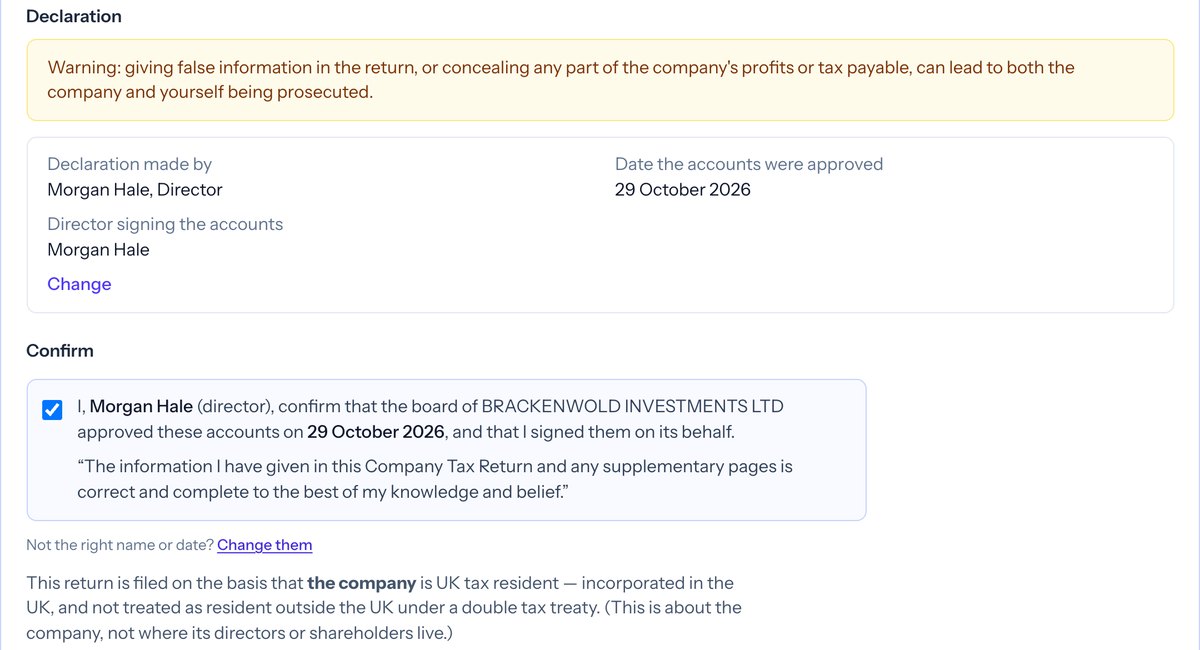 In Taxley: the director confirms the accounts approval and the CT600 declaration with one tick before paying (demo company).
Step 12: Check the Gateway sign-in, then file with HMRC and Companies House
Under "HMRC submission", go through "Before you file, check:", including that Corporation Tax is listed in the company's business tax account. Enter the company's own Government Gateway user ID and password, the account enrolled for Corporation Tax, and press File with HMRC. Taxley never saves the password to your account or the return, and holds it encrypted only while sending (deleted within three days if sending fails). Then, under "Companies House — accounts filing", press File accounts at Companies House. That sends the accounts using the company's authentication code, as "a real, legally effective filing". Check each result as it comes back, and keep both.
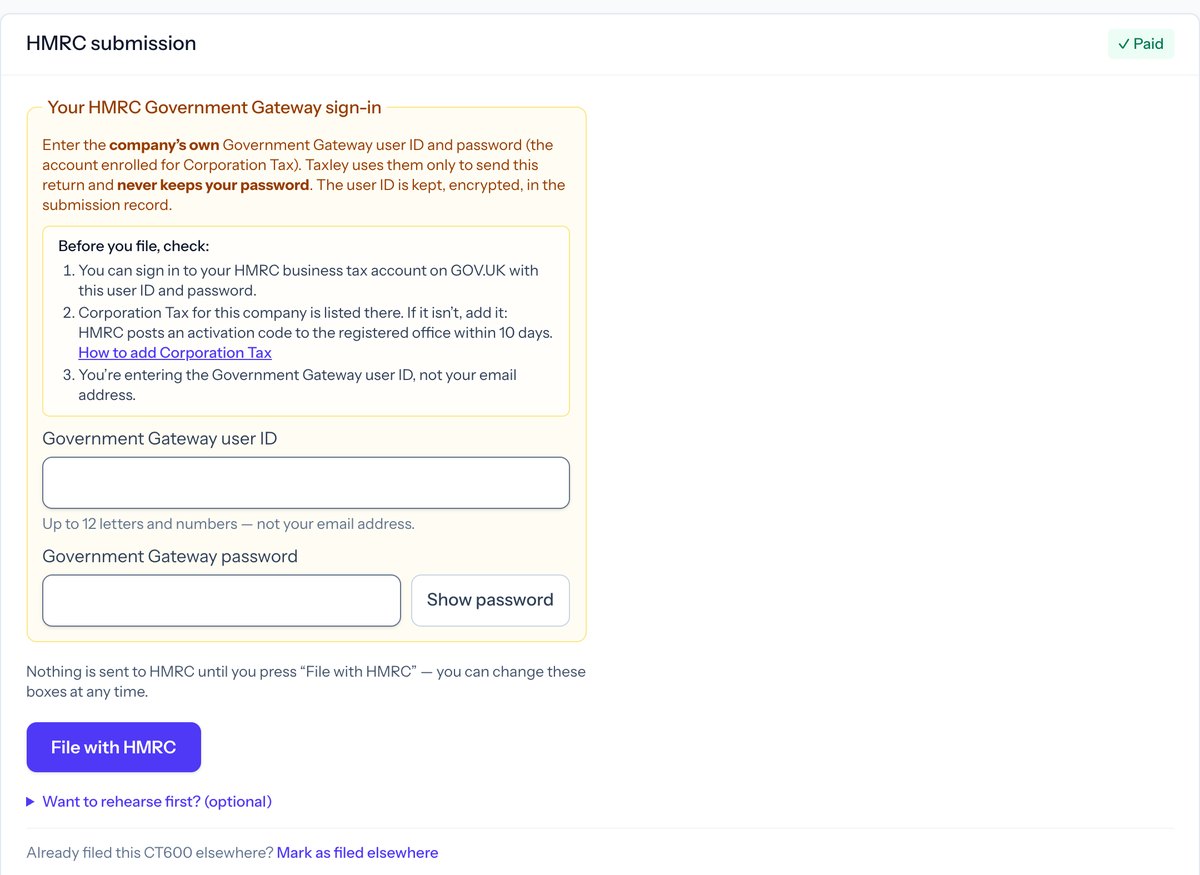 In Taxley: once the return is paid, you file the CT600 with the company's own Gateway sign-in (demo company).
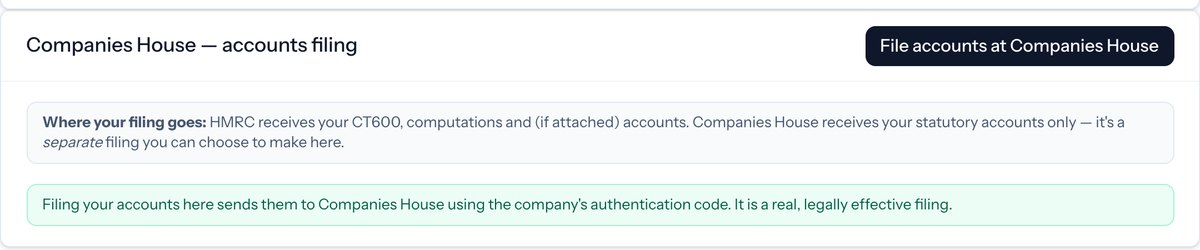 In Taxley: the accounts go to Companies House from the same page, using the company's authentication code (demo company).
How are fund distributions and gains taxed for an investment company?
From a UK authorised fund, the franked part of a dividend distribution is treated like a UK company dividend, usually exempt for a small company, and any unfranked part is taxed (HMRC manual IFM03320). Equity fund units are taxed as chargeable gains when sold. A fund over 60% in "qualifying investments", such as bonds and interest-bearing deposits, at any time in the period is taxed yearly instead.
The fund's distribution voucher shows the franked and unfranked parts, so check it rather than assuming, as the Brackenwold example does, that all of a distribution is franked. A small company's dividend exemption has conditions (CTA 2009 s.931B), and larger companies' exemption conditions differ (CTA 2009 s.931D). These rules cover UK authorised funds only. Most non-UK funds, including Irish and Luxembourg ETFs, are offshore funds with their own rules, but check each holding against the definition (HMRC manual IFM12210). Enter offshore funds in Taxley's Offshore funds section, and see Irish ETF dividends for a UK limited company. If a fund fails the 60% qualifying investments test at any time in the period, the company is taxed on its change in value every year, as a loan relationship (CTA 2009 s.490; s.493). Cash awaiting investment doesn't count towards the 60% (HMRC manual CFM43040). Taxley can't yet file some bond fund cases.
How much Corporation Tax does an investment holding company pay on £7,800 of taxable profits?
Brackenwold Investments Ltd, the fictional company in the screenshots, pays £1,950. Its £6,000 of interest and £4,000 gain make £10,000, and £2,200 of management expenses leaves taxable profits of £7,800. As a close investment-holding company, it pays the 25% main rate with no marginal relief, payable 9 months and 1 day after the year ends.
| Line | Amount | Where it goes |
|---|---|---|
| Bank interest | £6,000 | CT600 box 170 |
| Gain on fund units sold | £4,000 | CT600 boxes 210 and 220 |
| Profits before other deductions | £10,000 | CT600 box 235 |
| Management and platform fees | (£2,200) | CT600 box 245 |
| Taxable total profits | £7,800 | CT600 box 315 |
| Corporation Tax at 25% | £1,950 | CT600 box 440 |
| Franked fund distributions | £3,800 | Box 620, not taxed |
| Fair value gain | £5,000 | Accounts only, not taxed yet |
| Deferred tax charge | £1,250 | Accounts only |
The example assumes a 12-month period from 1 April 2025 to 31 March 2026, no associated companies and distributions that are all franked: £7,800 × 25% = £1,950, payable by 1 January 2027. Without close investment-holding company status, its augmented profits, taxable profits plus franked investment income, would be £11,600. That is under the £50,000 limit for the small profits rate (GOV.UK: marginal relief), so it would pay 19%: £7,800 × 19% = £1,482. In the accounts, tax on profit is £3,200, the £1,950 of Corporation Tax plus £1,250 of deferred tax, leaving a profit for the year of £13,400. Our guide to investment company management expenses covers which costs count.
When are an investment holding company's accounts and CT600 due?
For a 12-month year after the first, the accounts are due at Companies House 9 months after the year ends, the Corporation Tax 9 months and 1 day after it (unless the company pays in quarterly instalments), and the CT600 12 months after it (GOV.UK: prepare and file annual accounts). The tax and the accounts therefore fall due before the return itself.
| Deadline | Year to 31 March 2026 | Rule |
|---|---|---|
| Accounts at Companies House | 31 December 2026 | 9 months after the year end |
| Corporation Tax paid to HMRC | 1 January 2027 | 9 months and 1 day after |
| CT600 filed with HMRC | 31 March 2027 | 12 months after the period ends |
Brackenwold was incorporated on 1 April 2021, so its year to 31 March 2026 isn't its first. First accounts usually cover more than 12 months, and a Company Tax Return can't, so a company's first year can need two returns (GOV.UK: first accounts and tax return). A late return costs money even when no tax is due: HMRC charges £200 one day late and another £200 at three months (GOV.UK: late filing penalties). Companies House has its own late filing penalties for accounts. The Corporation Tax deadline calculator works out all three dates for any year end.
What does Taxley not do for an investment holding company?
Taxley doesn't calculate deferred tax or prepare group or consolidated accounts. It can't yet file returns with capital allowances, group relief, earlier losses after an ownership change, or some crypto, bond fund and offshore fund cases. In those cases it says so, saves the return and doesn't charge you. It doesn't give tax advice or pay the company's Corporation Tax.
- Deferred tax: Taxley doesn't calculate it. You enter your own figures in "Deferred tax charge/(credit)", "Provisions for liabilities" and "of which: deferred tax".
- Accounts type: FRS 102 Section 1A small-company accounts are the default for a company that holds investments. Micro-entity accounts are offered only when this period's answers allow them. Investment companies always use the Advanced editor, not Simple mode.
- Groups: Taxley doesn't prepare group or consolidated accounts, and can't yet file group relief for an investment company. See holding company or single company.
- Cases it can't file yet: the message reads "Taxley can't file this yet", names the case, and adds "Your return is saved and you won't be charged."
- Companies House: Taxley files the accounts there, except accounts you uploaded instead of Taxley's, first accounts whose period doesn't start on the incorporation date, accounts for a period Companies House already has that weren't filed through Taxley, a community interest company's accounts, and accounts that end more than 7 days either side of the accounting reference date Companies House holds. It doesn't file the confirmation statement.
- Residence and size: the return is filed on the basis that the company is UK tax resident. Taxley doesn't support non-resident companies, companies in liquidation or administration, or medium-sized or audited companies.
- Personal investments: income and gains from shares and funds you hold yourself may need to go on your own Self Assessment tax return, which Taxley doesn't file. See investing through a limited company or personally.
What does Taxley file for an investment holding company, and what does it cost?
Taxley (taxley.co.uk), UK online software that prepares and files the Company Tax Return (CT600) with HMRC and the annual accounts with Companies House, charges £129 per return with FRS 102 small-company accounts. The fee covers filing the accounts at Companies House, live since 28 September 2026, once the return is paid and the accounts are finished.
You see the Corporation Tax before you pay, and you pay one fee per return when you file, with no subscription. If HMRC rejects a return, correcting it and sending it again costs nothing extra, and amending a return filed with Taxley is included. Taxley works from the figures you enter and isn't tax advice, so review them before you file, ideally with a qualified adviser. Check whether Taxley fits your company, or compare the fees for each type of return.
Figures and screens checked on 30 October 2026 against the linked GOV.UK, legislation and FRC pages and Taxley's product. Brackenwold Investments Ltd is fictional. This is general information, not advice on your company's tax position.
Frequently asked questions
Can an investment company file micro-entity accounts?
Sometimes. Micro-entity accounts can't show investments at market value (SI 2008/409 reg 3), and some investment companies can't use the micro-entity regime at all (Companies Act 2006 s.384B). Taxley uses FRS 102 small-company accounts by default and offers micro-entity accounts only when the period's answers allow them, for example for a company holding only cash.
What goes in box 620 of the CT600?
Box 620 is franked investment income or exempt distributions, such as exempt dividends from UK companies and the franked part of a UK fund's dividend distribution. It isn't taxed, but it counts towards the small profits rate and marginal relief limits. Exempt distributions from certain companies in the same group or consortium are left out (GOV.UK: Company Tax Return guide).
Does an investment company that made a loss still file a CT600?
Yes. GOV.UK says a company must still send a return if it makes a loss or has no Corporation Tax to pay. Management expenses that exceed the year's profits are carried forward, and Taxley carries any excess to the next period.
Can I file my investment company's accounts and tax return myself?
Yes. A director can prepare and file the company's own CT600 and accounts with filing software. You remain responsible for the figures and the declaration, so take advice on anything unusual, such as offshore funds or deferred tax. Our guide to filing a CT600 yourself covers the general steps.
Is it better to hold investments in a company or personally?
It depends on how much you invest, how long you hold and how you take money out. A company pays Corporation Tax on its interest and gains, and you may pay tax again on a dividend it pays you, above your dividend allowance. Our guide to investing through a limited company or personally compares the two.
People also ask
Related guides

How to file a CT600 for an investment company
9 min read →

Which investment company management expenses reduce tax?
7 min read →

Are Irish ETF dividends taxable for a UK limited company?
8 min read →

What goes in FRS 102 small company accounts? (Section 1A)
22 min read →

Should I set up a holding company?
14 min read →

Should I invest through a limited company or personally?
13 min read →
Ready to file your Company Tax Return?
Confirm support for your accounting period, accounts and any supplementary pages before paying. Taxley support can answer software questions, not provide a tax opinion.
Questions about your period or accounts? Ask about software support