
Help · a company’s first year
First accounts over 12 months: two CT600s and one set of accounts
When a company’s first accounts cover more than 12 months, Companies House gets one set of accounts for the whole period, but HMRC needs two Company Tax Returns: one for the first 12 months and one for the rest. That’s because a Corporation Tax accounting period can’t be longer than 12 months. Taxley prepares both returns from the one set of accounts, for one fee.
Last reviewed
Why does one set of accounts need two returns?
The accounts and the tax return follow different rules. A company’s first accounts run from the day it was incorporated to its accounting reference date, its year end, and Companies House takes them as one set, up to 18 months long. A Corporation Tax accounting period, though, can never be longer than 12 months. So HMRC splits a longer period in two: the first 12 months, then the rest. Each part has its own Company Tax Return (GOV.UK: accounting periods for Corporation Tax).
Most new companies meet this in their first year. Unless it’s changed, the first year end is the last day of the month in which the first anniversary of incorporation falls, so the first accounts run for a little more than 12 months.
What does it look like for a real set of dates?
Take a company incorporated on 15 March 2025. Its first year end is 31 March 2026, so its first accounts run for 382 days. Here’s how those dates split, with the deadlines Taxley works out for them:
| What | Covers | Due |
|---|---|---|
| Accounts at Companies House | 15 March 2025 to 31 March 2026, one set | 15 December 2026 |
| CT600 return 1 | 15 March 2025 to 14 March 2026 | 31 March 2027 |
| CT600 return 2 | 15 March 2026 to 31 March 2026 | 31 March 2027 |
| Corporation Tax for period 1, paid to HMRC | 15 March 2025 to 14 March 2026 | 15 December 2026 |
| Corporation Tax for period 2, paid to HMRC | 15 March 2026 to 31 March 2026 | 1 January 2027 |
The rules behind those dates:
- Accounts at Companies House: for first accounts longer than 12 months, 21 months after incorporation, or 3 months after the year end if that’s later (GOV.UK: life of a company, accounts).
- Both CT600s: 12 months after the end of the whole period of account.
- Corporation Tax: 9 months and 1 day after the end of each accounting period, so each return’s tax has its own date (GOV.UK: pay Corporation Tax).
For your own dates, use the deadline calculator or the long accounting period calculator.
How does Taxley prepare the two returns?
You start one return in Taxley for the whole period, from the incorporation date to the year end. As soon as the dates cover more than 12 months, Taxley says so: “This period is longer than 12 months, so HMRC needs two Company Tax Returns for it. Taxley prepares both for one fee.”
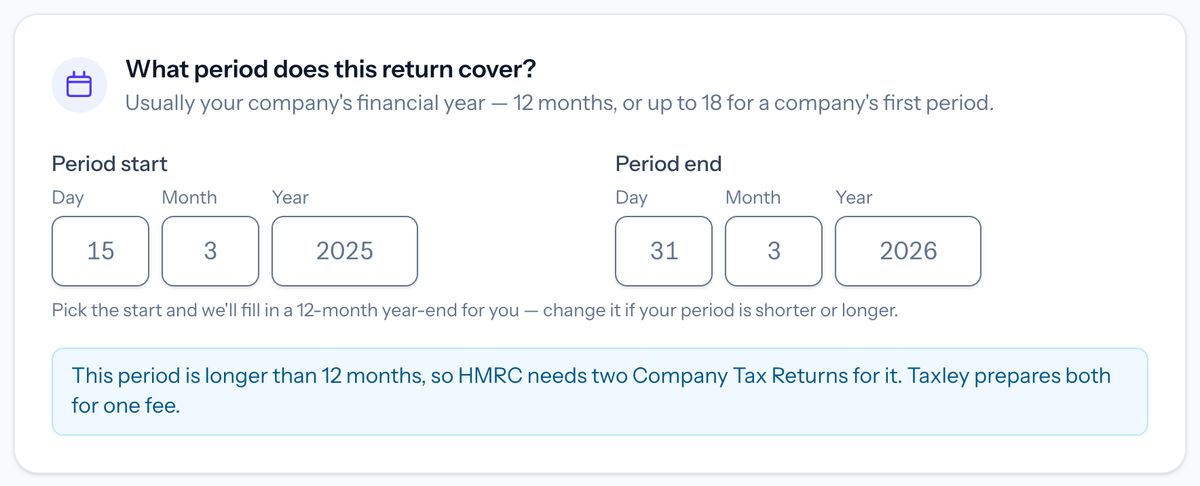
- One set of figures. You enter the accounts once, for the whole period. Taxley splits the profit between the two returns by the number of days in each.
- Figures that belong to one period. Capital allowances, balancing charges, chargeable gains and charitable donations belong to the period they happen in. In the Advanced editor you enter them for each period under “Figures for each accounting period”.
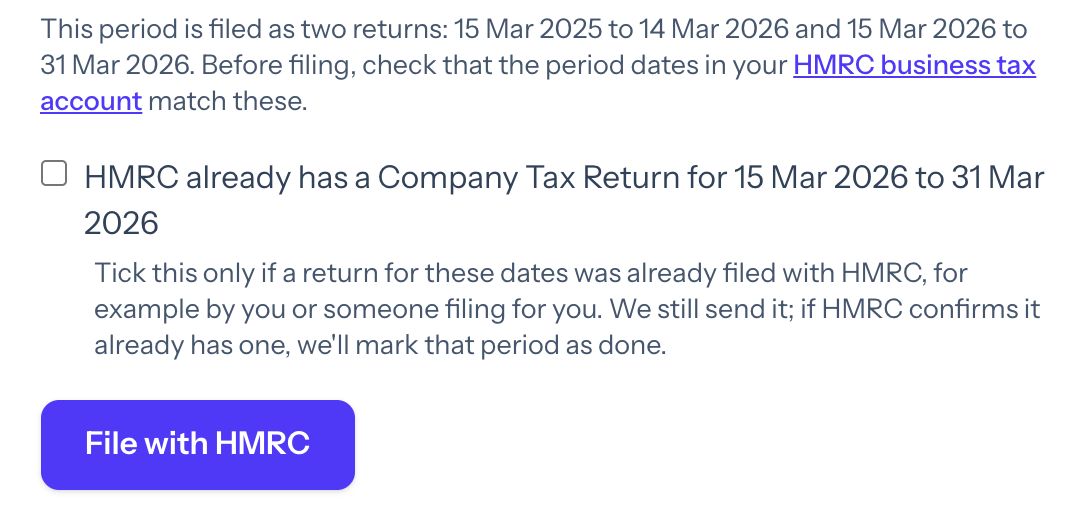
- Both returns at once. When you press “File with HMRC”, Taxley sends both returns. Before you file, check that the period dates in your HMRC business tax account match the two periods Taxley shows.
What if HMRC already has one of the two returns?
Sometimes a return for the second period was already filed, for example by you or someone filing for you. Under the sign-in, tick “HMRC already has a Company Tax Return for” the second period’s dates. Taxley still sends it; if HMRC confirms it already has one, Taxley marks that period as done.
What if the company was dormant at first?
A company’s first Corporation Tax accounting period starts when it comes within the charge to Corporation Tax, for example when it starts to trade. If the company was dormant at first, that can be later than the day it was incorporated. HMRC’s first return then starts on that later date, but the first accounts for Companies House still run from the incorporation date.
So if your return in Taxley starts after the incorporation date, Taxley won’t file its accounts at Companies House: they would cover the wrong period. The return’s page says so and gives you the way forward. Where it can, Taxley offers “Change” beside the accounting period, to start the accounts on the incorporation date. Otherwise, file the first accounts at Companies House yourself by the date the page shows. The CT600 is filed with HMRC as normal.
Questions people ask
Do I pay Taxley twice for the two returns?
No. The two returns are one filing in Taxley, prepared from one set of figures, for one fee. It is the same fee as a return for a 12-month period.
Do I enter my figures twice?
No. You enter the accounts figures once, for the whole period. Taxley splits the profit between the two returns by the number of days in each. Only items that belong to one period, such as capital allowances, are entered for each period.
Are both returns due on the same day?
Yes, both CT600s are due 12 months after the end of the period of account. The tax isn’t: each period’s Corporation Tax is due 9 months and 1 day after that period ends, so the first period’s tax is due first.
Why is my first period a little over 12 months?
Unless it’s changed, a new company’s first year end is the last day of the month in which the first anniversary of its incorporation falls. That makes the first accounts a little longer than 12 months, so the first year usually needs two returns.
More detail: First company accounts: why you may need two CT600s.
Prepare both returns in one go
Enter your first year’s figures once. Taxley prepares the accounts and both CT600s, for one fee.