
Accounting policies note for a small company (FRS 102 1A)

Prerequisites at a glance
- Time
- About 15 min
- Difficulty
- Beginner
- Tools you'll use
-
- Taxley Advanced view
- Companies House company search
- Have ready
-
- The company's accounting policies
- Director's loan account balances
- Loan agreements and charge documents
- Details of guarantees and commitments
In short: Small-company accounts under FRS 102 Section 1A must state the company's accounting policies, including depreciation, plus notes on secured debts, loans to directors and off-balance-sheet commitments when they exist. Micro-entity accounts need only the directors' loans and commitments notes, plus the employee count. GOV.UK: Micro-entity, small and dormant company accounts sets out who counts as small (checked 24 September 2026).
This guide explains each note, gives example wording to adapt, then shows where each one goes in Taxley's "Accounts information" section. If you are still choosing between the two sets of rules, read FRS 105 vs FRS 102 §1A first, or take the 30-second check to see whether Taxley fits your company.
Which notes must FRS 102 Section 1A small-company accounts include in 2026?
A small company's notes come from the Companies Act 2006 and Schedule 1 to the Small Companies and Groups (Accounts and Directors' Report) Regulations 2008 (SI 2008/409). The accounting policies note and the average number of employees always apply. Most other notes apply only when the company has the item, such as secured debts or a loan to a director.
| Note | Where the law requires it | Micro-entity (FRS 105) | Small (FRS 102 §1A) |
|---|---|---|---|
| Accounting policies, including depreciation | Sch 1 para 44 | No | Yes |
| Average number of employees | CA 2006 s.411(1) | Yes | Yes |
| Fixed assets: opening and closing amounts, movements | Sch 1 para 48 | No | If it has fixed assets |
| Debts due after five years; secured debts | Sch 1 para 55 | No | If any |
| Financial commitments, guarantees, contingencies | Sch 1 para 57 | If any | If any |
| Advances, credits and guarantees to directors | CA 2006 s.413 | If any | If any |
| Prior-year items; exceptional items | Sch 1 para 61 | No | If any |
| Material events after the year end | Sch 1 para 64 | No | If any |
| Related party transactions not on market terms | Sch 1 para 66 | No | If material |
Legislation checked on legislation.gov.uk on 24 September 2026. The table lists the common notes, not every rule; a subsidiary, for example, also names its parent (Sch 1 para 65).
FRS 102 can ask for more than the regulations. The Financial Reporting Council says that for periods beginning on or after 1 January 2026, its paragraph 1AC.35 requires a small entity to disclose related party transactions. For earlier periods, including every period Taxley can file today, the regulations' narrower rule applies: material related-party transactions not made on normal market terms (Schedule 1 paragraph 66). And if the listed notes are not enough for a true and fair view, "the necessary additional information must be given" (CA 2006 s.396(4)).
Why do micro-entity (FRS 105) accounts have fewer notes?
Micro-entity accounts have fewer notes because the law switches most of them off. Regulation 5A of SI 2008/409 says nothing in Schedule 1 requires a micro-entity to give notes, except the financial commitments note in paragraph 57. The Companies Act adds the directors' advances note, and both go at the foot of the balance sheet.
Section 472(1A) of the Companies Act 2006 says the notes required by section 413 and by regulation 5A "must be included at the foot of the balance sheet". A micro-entity also states its average number of employees, because section 411(1) applies to every company. It gives no accounting policies note, because regulation 5A switches off paragraph 44 too. That is why Taxley asks for the policies note only for small-company accounts.
What should an accounting policies note say?
The accounting policies note says how the figures were measured. The regulations require "the accounting policies adopted by the company" for the balance sheet and the profit or loss, "including such policies with respect to the depreciation and diminution in value of assets" (Sch 1 para 44). Write one short paragraph for each policy the company actually uses.
A service company's note usually needs five headings:
- Basis of preparation: the framework (FRS 102 Section 1A and the Companies Act 2006), the historical cost convention and the currency.
- Going concern: a sentence recording that the directors prepared the accounts expecting the company to carry on. The regulations presume a company is a going concern (Sch 1 para 11).
- Turnover: what counts as turnover and when it is recognised, excluding VAT.
- Fixed assets and depreciation: cost less depreciation, and the rate or useful life for each type of asset.
- Debtors and creditors: how amounts due in and out within a year are measured.
Taxley adds its own basis-of-preparation statement and the average-employees note, so your note can focus on the policies. If you leave the box blank, Taxley prints a short default that, for a trading company, covers only FRS 102 Section 1A, turnover "net of VAT" and fixed assets "at cost less accumulated depreciation". Write your own if the company has other policies or its own depreciation rates. A dormant company should always write its own note, because the default describes turnover. Taxley currently prints the policies note as one paragraph, so separate policies with headings such as "Turnover:" rather than relying on line breaks.
What does a sample accounting policies note for a service company look like?
Below is an example only, written for a small service company with computer equipment and furniture. The director must check each sentence against what the company actually does and delete anything that doesn't apply. Words in square brackets are placeholders to replace: they are not recommended rates.
Basis of preparation (leave this paragraph out in Taxley, which prints its own basis-of-preparation note). These financial statements have been prepared in accordance with FRS 102 Section 1A "Small Entities" and the Companies Act 2006, under the historical cost convention. They are presented in pounds sterling.
Going concern. The directors consider that the company will continue in business and have prepared these financial statements on a going concern basis, having considered the period of at least 12 months from the date of approval. If there is a material uncertainty about going concern, the note must say so.
Turnover. Turnover is the value of services provided to customers during the year, excluding VAT.
Tangible fixed assets and depreciation. Tangible fixed assets are stated at cost less accumulated depreciation. Depreciation is charged to write off the cost of each asset over its expected useful life: computer equipment [3 years straight line]; fixtures and fittings [25% reducing balance].
Debtors and creditors. Amounts receivable and payable within one year are measured at the undiscounted amount of cash expected to be received or paid.
What does the note say for a dormant company?
A dormant company has no turnover or assets to measure, so its note can be two sentences. For a dormant company filing small-company accounts, Taxley numbers the box "2. Accounting policies":
These financial statements have been prepared in accordance with FRS 102 Section 1A "Small Entities" and the Companies Act 2006, under the historical cost convention. The company has been dormant throughout the period.
When do you need a secured debts note, and what should it say?
You need a secured debts note when a lender holds security, such as a mortgage or charge, for money the company owes at the balance sheet date. For each creditors line, state the total of the secured debts "with an indication of the nature and form of any such security" (Sch 1 para 55(2)). Leave the note closed if no debt is secured.
A charge is "the security a company gives for a loan", and a mortgage is one type (GOV.UK: register a charge, checked 24 September 2026). Charges sit on the company's public record, so check yours through Get information about a company. A paid-off charge can still show, because companies "do not have to tell us when a charge is satisfied", so compare the register with your loan statements. Example wording:
The bank loan of £[250,000] is secured by a legal charge over the company's property.
Paragraph 55 also asks for the total of any debts falling due after more than five years.
What goes in the s.413 note on advances, credits and guarantees to directors?
The s.413 note gives details of any money the company advanced or lent to a director, and any guarantee it gave for one. It covers every advance "subsisting at any time in the financial year", so a loan repaid before the year end still goes in (Companies Act 2006 s.413(7)). Shareholders who are not directors fall outside section 413.
For each advance or credit, section 413(3) requires its amount, "an indication of the interest rate", its main conditions, and any amounts repaid, written off or waived. For a guarantee, section 413(4) requires its main terms, the maximum liability and any amount paid under it. Totals of those amounts must also be stated (s.413(5)). In the demo company in this guide, director Sam Taylor was lent £18,000 interest-free, unsecured and repayable on demand. Taxley's generated note reads:
Sam Taylor, a director: at the start of the period Sam Taylor owed the company £0. During the period the company advanced £18,000 and £0 was repaid. At the end of the period Sam Taylor owed the company £18,000. The loan is interest free and is unsecured and repayable on demand.
Sam's £6,000 repayment on 30 June 2026 came after the period end, so the generated note doesn't include it; it matters for the separate section 455 tax on form CT600A. See what a CT600A is, how to fill in directors' loans in Taxley and, if you are unsure which way the balance runs, who owes whom on a director's loan account.
What goes in the financial commitments, guarantees and contingencies note?
This note gives the total of financial commitments, guarantees and contingencies that are not in the balance sheet (Sch 1 para 57(1)). Examples are a signed contract to buy a property, or a guarantee of another company's bank loan. It applies to micro-entities too. Leave it closed if the company has none.
Paragraph 57 also asks for "the nature and form of any valuable security" given for those commitments, a separate total for pension commitments, and separate totals for commitments made for group companies or for undertakings the company has a participating interest in. Example wording to adapt:
At [31 March 2026] the company had contracted to buy a property for £[amount], completing after the year end. The company has guaranteed the bank loan of [connected company] Ltd, up to a maximum of £[amount]. The directors do not expect any liability to arise under the guarantee.
Are the notes printed word for word, and do they reach Companies House?
Yes. Taxley prints each note in the accounts exactly as you type it, as a numbered note, including in the copy prepared for Companies House. Taxley does not check or correct the wording. A small company may leave its profit and loss account out of the Companies House copy, but the balance sheet and its notes stay in.
Small companies can "choose whether or not to send a copy of the director’s report and profit and loss account to Companies House", and even abridged accounts come "along with any notes" (GOV.UK: Micro-entity, small and dormant company accounts, checked 24 September 2026). So anything you write in a note becomes public. Taxley files that Companies House copy for you when you press "File accounts at Companies House" on the filing page. From April 2028 small companies and micro-entities must file a profit and loss account but can opt out of publishing it. The profit and loss account becomes compulsory there from 1 April 2028 (GOV.UK: Preparing and filing Companies House accounts); see the 2028 changes.
Which required notes does Taxley not have a box for yet?
Taxley covers most of the notes a small company needs, but not all of them. It has boxes for the accounting policies note and three optional notes, and it prints the average number of employees and a basis-of-preparation note itself.
It produces the paragraph 48 movements note for tangible fixed assets and investment property (not yet for intangible assets or fixed-asset investments), but doesn't yet give a dedicated box for a post-balance-sheet event, a related-party note or the paragraph 55(1) total of debts due after five years (SI 2008/409). If your company needs one of these, Taxley can't produce it yet — check carefully before you file.
How do you add the accounting policies note and notes in Taxley?
You add every note in the "Accounts information" section of the "Prepare your Corporation Tax return" page. Use the Advanced view: the Simple view has the directors' advances and commitments notes, but the accounting policies box and the secured debts note are only in Advanced. Each heading has a small "?" link that opens this guide.
Step 1: Open Accounts information in the Advanced view
Switch the view at the top of the page to "Advanced" and scroll to "Accounts information". The first question asks for the average number of employees, and the second asks about money owed by a director or shareholder. Answer both before writing the notes, because the directors' loans answer decides whether Taxley asks for the s.413 note. The accounting policies box appears only when the company files small-company (FRS 102 Section 1A) accounts.
Step 2: Write the accounting policies note
Type or paste the note into "Accounting policies note" under "3. Accounting policies". The hint reads: "The FRS 102 §1A accounting-policies note for the accounts — e.g. basis of preparation, turnover recognition, depreciation. Plain text; multiple lines are fine." Start from the sample above, keep only the policies the company uses and put in your own depreciation rates. The demo engineering company describes its turnover as engineering services.
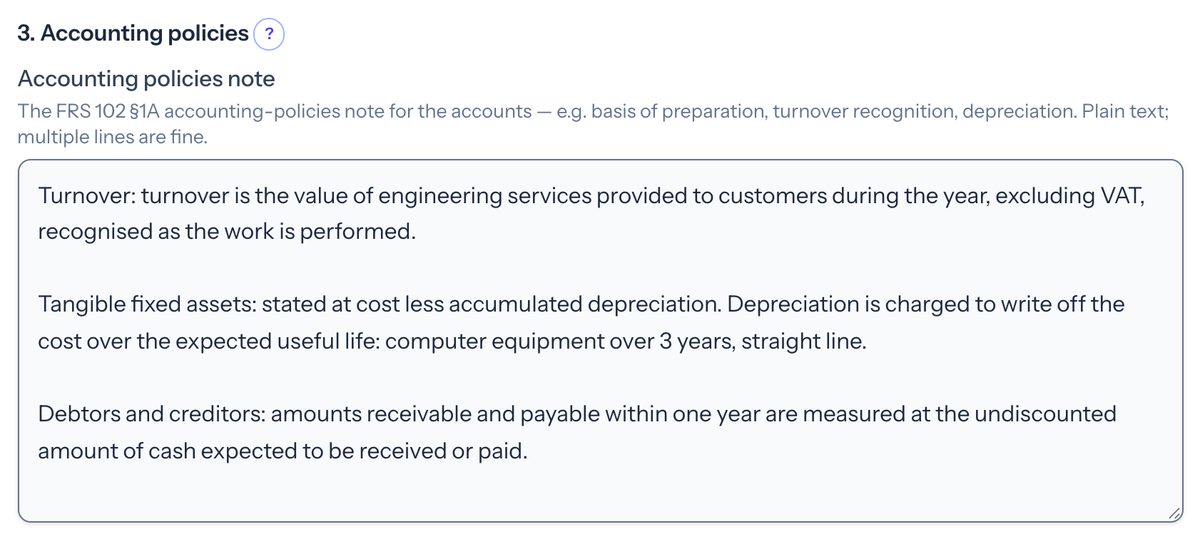 In Taxley: the accounting policies note is plain text, and the ? link beside the heading opens this guide (demo company).
Step 3: Write or generate the directors' advances note
Open "Advances, credits and guarantees to directors (Companies Act s.413)". If you said a director or shareholder owed the company money, Taxley opens this note for you and shows a prompt. When you have entered the loans in the directors' loans panel, click "Write the directors’ advances note for me" there to fill the note from those figures. If it was only a shareholder, tick "It wasn’t a director (only a shareholder, or someone connected to one) — no note needed" where Taxley offers it, or choose "A shareholder who isn’t a director" in the loans panel. Until then, the return isn't ready to file.
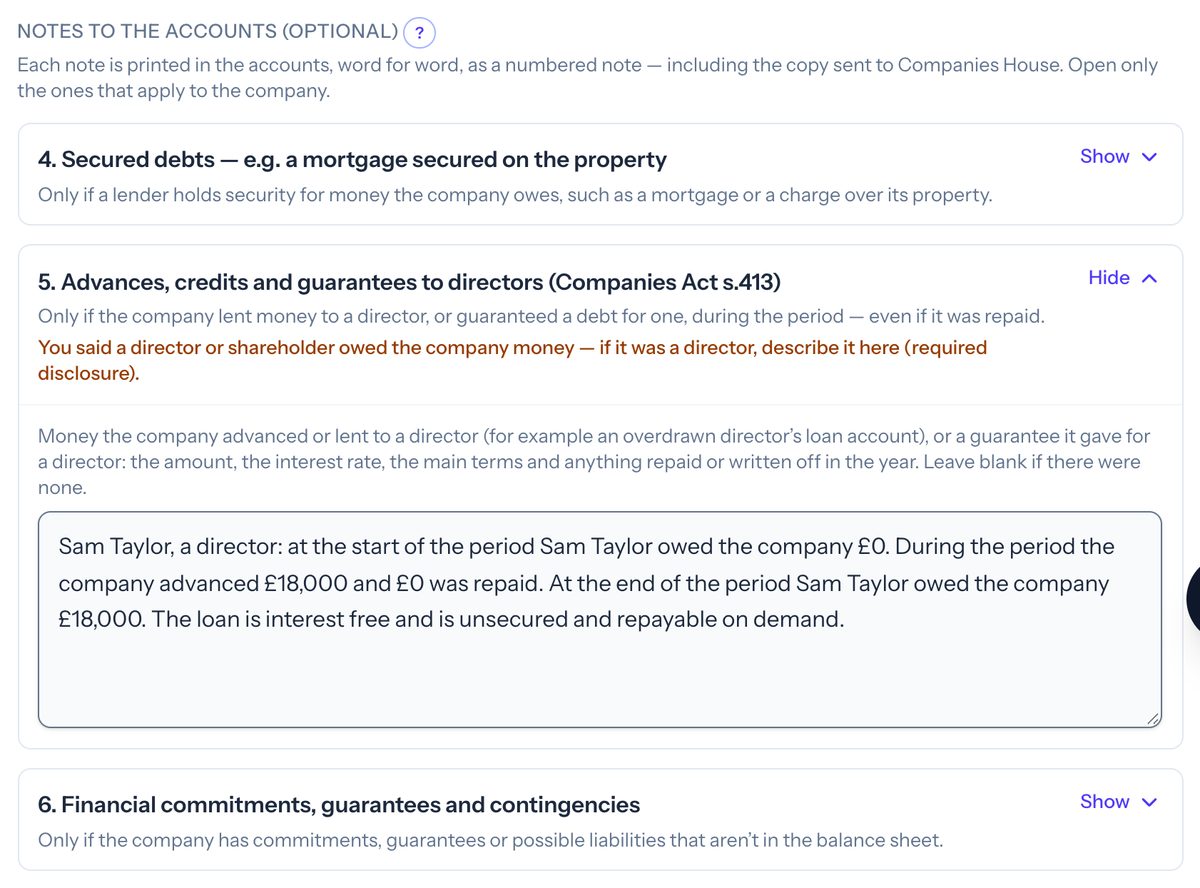 In Taxley: only the directors' advances note is open, because the company lent a director £18,000; the other two notes stay closed (demo company).
Step 4: Open the secured debts or commitments note only if it applies
Click "Show" on "Secured debts — e.g. a mortgage secured on the property" only if a lender holds security for money the company owes. If the balance sheet shows money owed after more than one year, Taxley reminds you to describe any security for it. Click "Show" on "Financial commitments, guarantees and contingencies" only for commitments, guarantees or possible liabilities that aren't in the balance sheet. Leave both closed otherwise: a blank note adds nothing to the accounts.
Step 5: Check the notes in the downloaded accounts
Click "Review your return →", then open "Return documents" on the filing overview and download the accounts. Read each note as a reader at Companies House would see it, and check the figures match the balance sheet, such as the £18,000 owed by the director. Then use "Download your Companies House accounts" in the "Companies House" box to see the public copy. If you edit a note afterwards, download the accounts again to check the new wording.
Frequently asked questions
Can I copy another company's accounting policies note?
Only as a starting point. A policies note must describe the policies your company actually used, including its own depreciation rates. Copying a note that mentions stock, leases or foreign currency your company doesn't have makes the accounts misleading. Delete what doesn't apply and check every sentence.
Does a loan to a shareholder who isn't a director need an s.413 note?
No. Section 413 covers advances, credits and guarantees to people who were directors at any time in the year. A loan to a shareholder may still need form CT600A for Corporation Tax, and a material related party transaction not on market terms can need its own note.
What if the director repaid the loan before the year end?
The note is still needed. Section 413(7) applies to every advance that existed at any time in the financial year, so a loan made and repaid within the year is disclosed with the amount repaid. In Taxley, the answer "all repaid by the end" still opens the note.
Do micro-entity accounts need an accounting policies note?
No. Regulation 5A of SI 2008/409 removes the Schedule 1 notes for a micro-entity except financial commitments, and the Companies Act adds the directors' advances note and the average number of employees. Taxley therefore shows the accounting policies box only for small-company accounts prepared under FRS 102 Section 1A.
This guide explains the disclosure rules; it is not advice for a particular company. Taxley prints your notes as written. If a note involves security, guarantees or a loan to a director that you are unsure how to describe, check the wording carefully before you start your return.
People also ask
Keep reading


Ready to file your Company Tax Return?
Confirm support for your accounting period, accounts and any supplementary pages before paying. Taxley support can answer software questions, not provide a tax opinion.
Questions about your period or accounts? Ask about software support