
How to fill in a director's loan on a company tax return (CT600A)

Prerequisites at a glance
- Time
- About 15 min
- Difficulty
- Beginner
- Tools you'll use
-
- Taxley's Advanced view
- The company's bank statements
- Have ready
-
- Director's loan account for the period
- Dates and amounts of repayments since the year end
- Debtors figure from the balance sheet
In short: Answer "Yes" to the director's loan question only if a director, shareholder or someone connected to them still owed the company money on the last day of the period, or repaid £5,000 or more just before it and borrowed again soon after. Then enter each borrower's opening balance, lending and repayments. Section 455 tax is 33.75% (loans made 6 April 2022 to 5 April 2026) of what was still owed, unless it is repaid within 9 months (GOV.UK: Director's loans: If you owe your company money).
This is the box-by-box guide. The law, including the 35.75% rate on loans made from 6 April 2026, is in what a CT600A is and how section 455 tax works; working out the balance is in director's loan account: does the company owe you?. The screenshots use a fictional demo company with a 31 March 2026 year end.
Which answer should you pick for the director's loan question?
Pick "Yes — money was still owed at the end of the period" when a director, shareholder or someone connected to them owed the company money on the last day of the accounting period. Also pick it if £5,000 or more was repaid just before that day and borrowed again soon after. Money borrowed and fully repaid within the period is the third option.
The question is under "Accounts information" in the Advanced view. Its help text says it "usually means an overdrawn director's loan account: money taken out of the company that wasn't salary, dividends or repaid expenses."
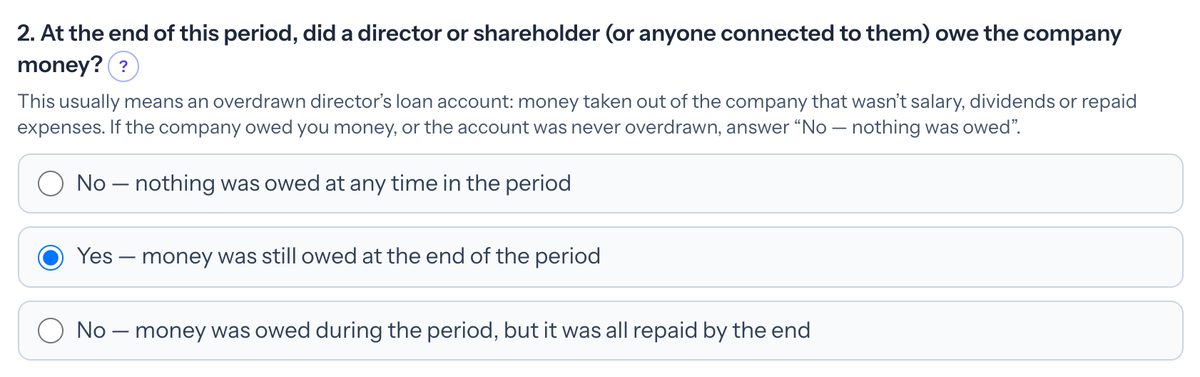 In Taxley: the director's loan question has three answers, and only "Yes — money was still owed at the end of the period" opens the CT600A panel (demo company).
| On the last day of the period | Answer | What happens |
|---|---|---|
| The account was never overdrawn at any point in the period (the company only ever owed the director) | No — nothing was owed at any time in the period | No CT600A, no loan note |
| A director borrowed £4,000 in June and repaid it by the year end | No — money was owed during the period, but it was all repaid by the end | No CT600A; the accounts note is still needed |
| A director owed £18,000, even if repaid since | Yes — money was still owed at the end of the period | The CT600A panel opens |
| Only a loan from an earlier year is still owed | Yes — money was still owed at the end of the period | Not taxed again; no CT600A for it this year, but add a loan card with the balance under "Owed at the start of the period" and give the s413 note |
| Repaid just before the year end and borrowed again soon after | Yes — money was still owed at the end of the period | The bed-and-breakfasting questions apply |
The third option matters for the accounts, not the tax. The CT600A covers loans that have "not been repaid within the period" (HMRC CT600A guidance), but the Companies Act 2006 still requires the accounts to disclose advances to directors, including "any amounts repaid" (s413). So Taxley asks for the directors' advances note; if only a shareholder or relative borrowed, tick "It wasn't a director (only a shareholder, or someone connected to one) — no note needed".
If the company owed you money, answer "No — nothing was owed at any time in the period"; if your account went overdrawn during the year but was back in credit by the year end, pick the third option. In the Simple view a "Yes" sends you to Advanced: "Enter the loan details in Advanced — the tax on the loan (CT600A) is worked out there."
What do the screening questions in the CT600A panel mean?
The panel opens with questions about the company, not the borrower, because section 455 applies only to close companies, excludes loans made by a money-lending business and has special rules for indirect payments. Answering Yes, No, No lets Taxley work out the tax. Any other answer stops the return with a message.
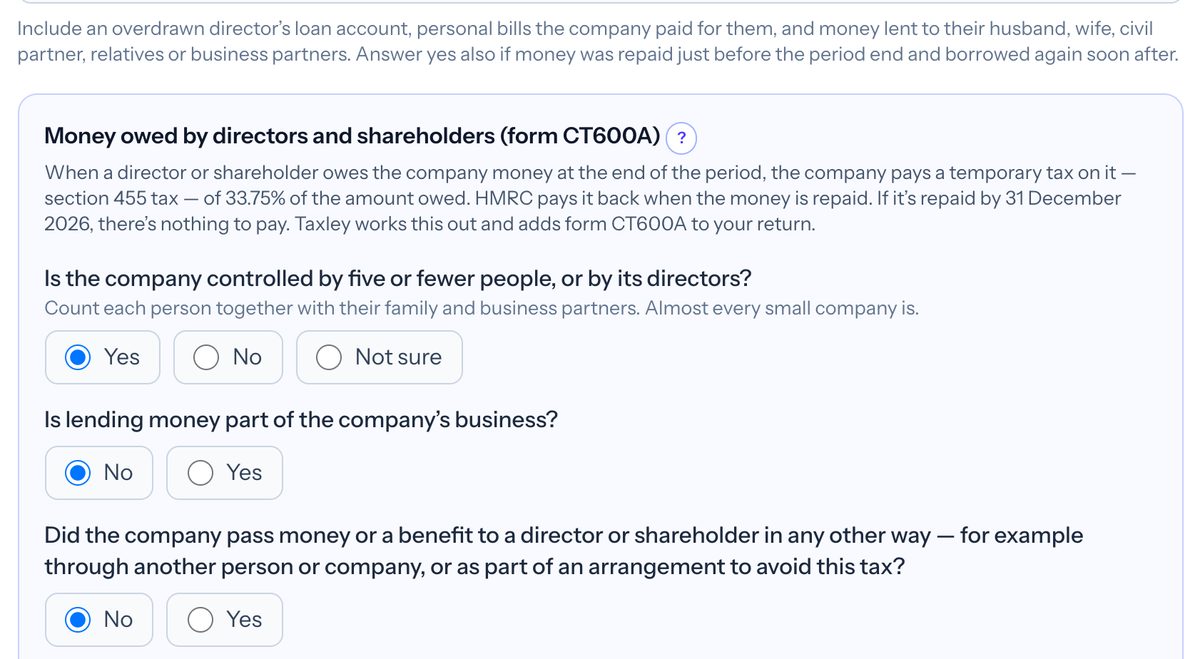 In Taxley: the panel explains the 33.75% tax and the 31 December 2026 repayment date, then asks three questions about the company (demo company).
- "Is the company controlled by five or fewer people, or by its directors?" This is the close company test in CTA 2010 s439; the hint says "Almost every small company is." "No" or "Not sure" shows: "Taxley can only work out this tax for close companies (companies controlled by five or fewer people, or by their directors). Check this carefully — if the company isn't close, the tax doesn't apply."
- "Is lending money part of the company's business?" "Yes" shows: "Loans made by a money-lending business are treated differently, so Taxley can't file this return." Section 455 doesn't apply to those loans (s456(1)).
- "Did the company pass money or a benefit to a director or shareholder in any other way — for example through another person or company, or as part of an arrangement to avoid this tax?" "Yes" shows that these "are taxed under special rules (CTA 2010 s.459 and s.464A). Taxley can't file this return yet."
- Only for a company with associated companies: "Does this company control another company that lent money to any of this company's directors or shareholders?" "Yes" shows: "Taxley can't work these out — it can't file this return yet."
How do you fill in the CT600A loan details, step by step?
You fill in one card per borrower: who they are, what they owed at the start, what they borrowed and repaid during the period, and any repayment made since the year end. Taxley works out every CT600A box from those movements, so you never type a box number, and its summary updates as you type.
Step 1: Add each person who owed the company money
Click "+ Add a person" once for each borrower, because HMRC wants each participator's account on its own line in box A10. In "Name", type the name as it should appear on the return; "HMRC accepts plain letters only", so é becomes e. In "Who owed the money?" choose the closest option, such as "A director who owns shares", and answer "Do they own more than 5% of the company, counting shares held by their family and business partners?" A "No" leads to two more questions, because loans of up to £15,000 to full-time staff who own 5% or less are exempt (s456(3)).
Step 2: Enter what was owed, lent, repaid and written off
Enter four figures. "Owed at the start of the period" is last year's closing balance, as a minus figure if the company owed them. "Lent to them or paid for them during the period" covers cash taken, transfers and personal bills the company paid. "Repaid during the period" covers money paid back and any salary, bonus or dividend credited to their loan account. "Written off or released during the period" is usually £0. Taxley then shows "Owed at the end of the period": for Sam Taylor, £0 + £18,000 = £18,000.
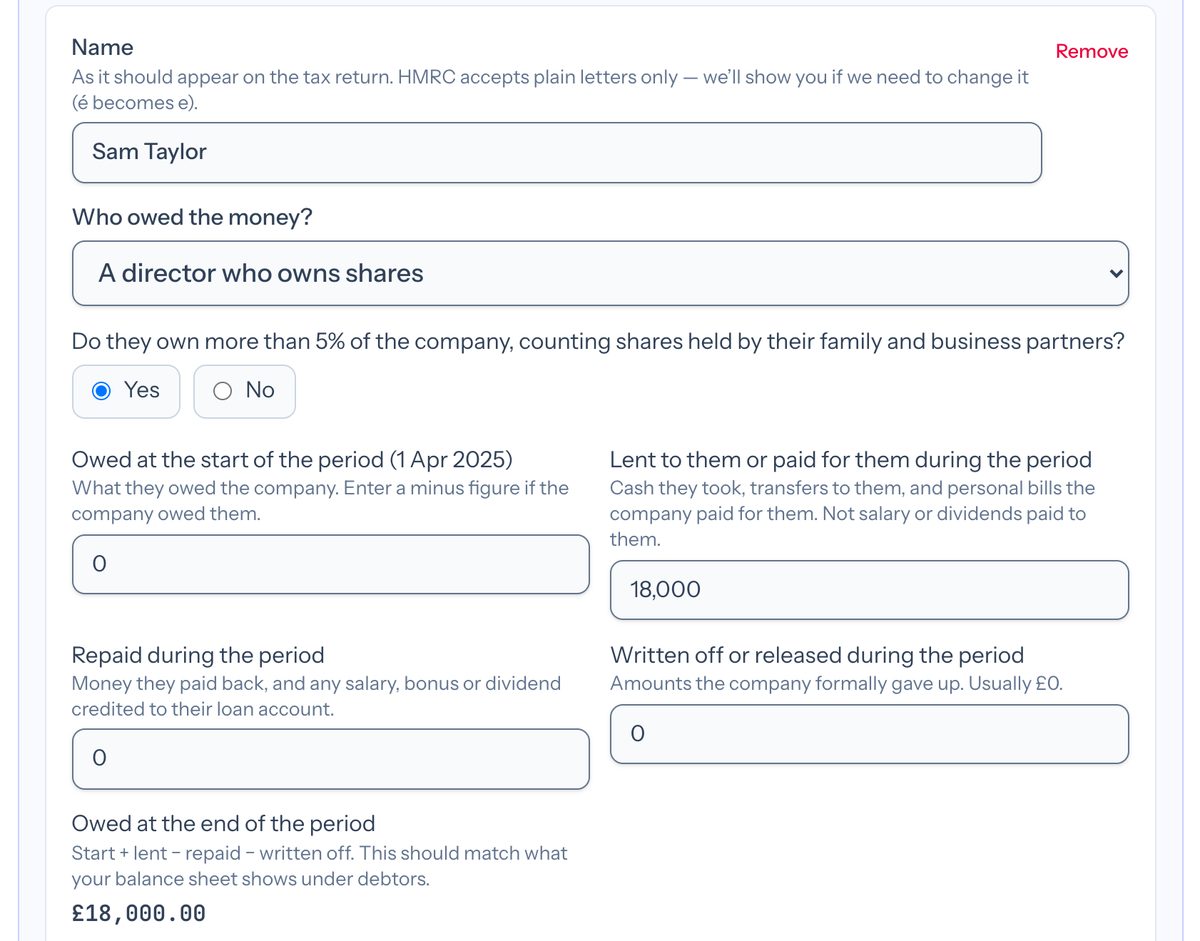 In Taxley: Sam Taylor, a director who owns shares, borrowed £18,000 during the period and repaid nothing, so £18,000.00 was owed at the end (demo company).
Which loan entries do people get wrong?
Credited salary, bonuses and dividends are repayments, not lending: HMRC's CT600A guidance lists crediting a participator's account with a dividend, director's remuneration or bonus as a way to repay. Personal bills the company paid are lending, because section 455 treats a debt a participator incurs to the company as a loan (CTA 2010 s455(4)). A personal credit card bill paid from the company account belongs in "Lent to them or paid for them during the period".
The "Owed at the end of the period" figure should agree with the accounts. Its hint says "This should match what your balance sheet shows under debtors", and GOV.UK tells directors to include money they owe the company on the balance sheet (GOV.UK: Director's loans: Overview). If the loans are more than debtors, Taxley warns that "Money owed to the company by directors and shareholders is part of debtors."
Step 3: Add repayments made after the period end
Under "Repaid or written off after 31 March 2026", click "+ Add a repayment" and enter the Date, the Amount and whether it was "Repaid" or "Written off or released". Add only repayments already made; a dividend or bonus counts on the date it was credited to the loan account. In the demo, Sam Taylor repaid £6,000 on 30 June 2026, entered as 30/06/2026, £6,000, Repaid. Repayments made by 31 December 2026 cancel the tax on that amount, and later ones are paid back by HMRC later.
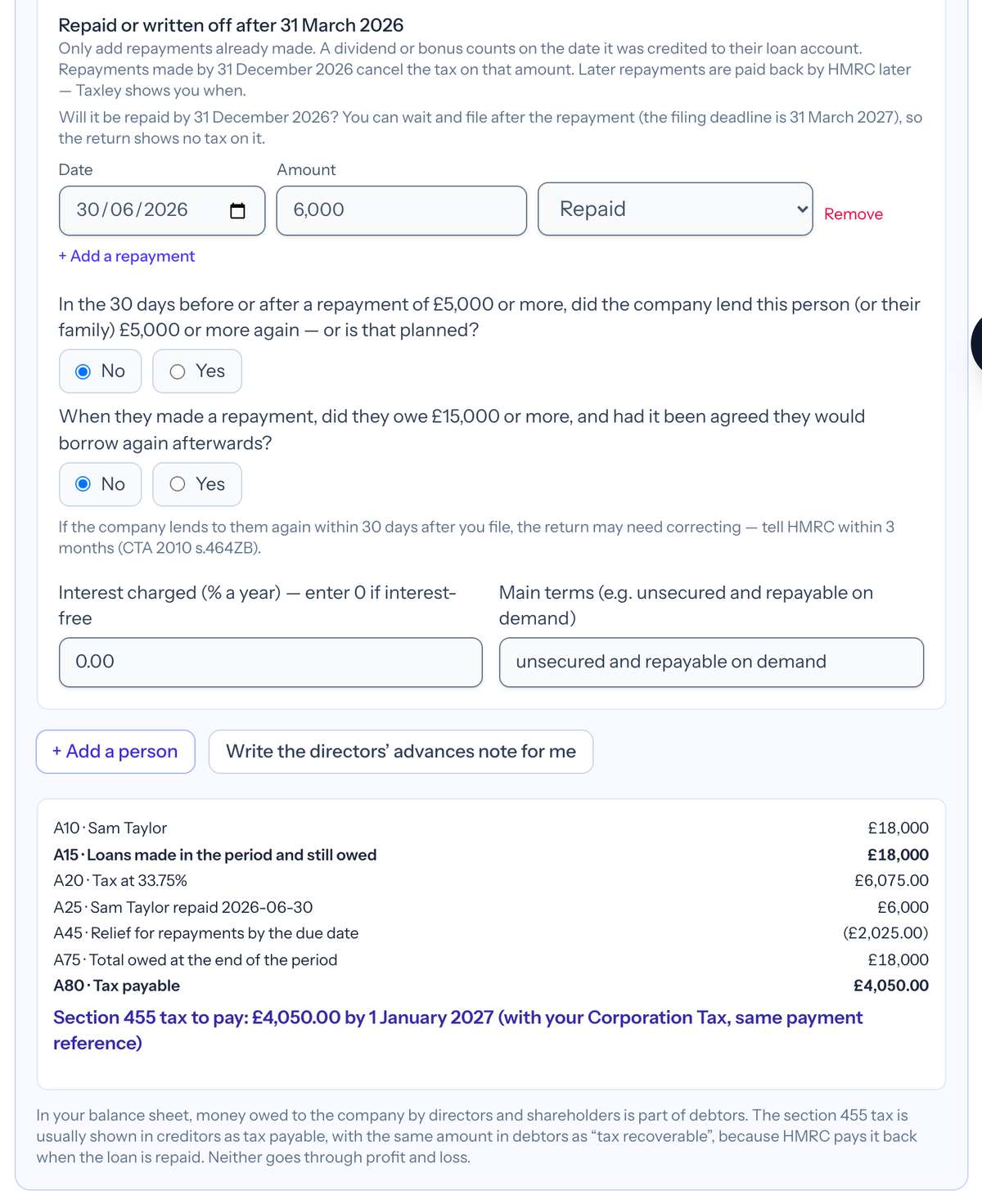 In Taxley: the £6,000 repaid on 30 June 2026 appears in box A25 and cuts the section 455 tax to £4,050.00, due by 1 January 2027 (demo company).
Step 4: Answer the bed-and-breakfasting questions and the loan terms
Two questions appear for anyone who still owes money at the end or repaid £5,000 or more: whether £5,000 or more was lent again within 30 days of a repayment of £5,000 or more, and whether they owed £15,000 or more when repaying with new borrowing already agreed. Answer No to both, as in the demo, and Taxley works out the tax. For a director, also enter "Interest charged (% a year) — enter 0 if interest-free" and the "Main terms", such as "unsecured and repayable on demand".
Step 5: Check the CT600A summary and the debtors figure
The summary below the "+ Add a person" button lists every CT600A box Taxley has worked out and ends with the section 455 tax to pay and its due date. Check that box A75 matches the directors' loans inside debtors on the balance sheet, that each repayment appears on an A25 line with the right date, and that the tax payable is 33.75% of this period's loans still owed after repayments made by the due date (box A75 also includes older loans, which aren't taxed again). Then save the return.
How does repaying a director's loan after the year end reduce s455 tax?
A repayment made within 9 months of the period end cancels the section 455 tax on the amount repaid, and Taxley claims that relief in Part 2 of the CT600A once you enter the date. For a 31 March 2026 year end the cut-off is 31 December 2026, because the tax falls due the following day, 1 January 2027.
In the demo, £18,000 still owed at 31 March 2026 is charged at 33.75%, giving £6,075.00. Sam Taylor repaid £6,000 on 30 June 2026, so relief of £6,000 × 33.75% = £2,025.00 comes off, leaving £4,050.00: 33.75% of the £12,000 still owed. The tax is due the day after the 9 months following the period in which the loan was made (CTA 2010 s455(3)). The panel adds: "You can wait and file after the repayment (the filing deadline is 31 March 2027), so the return shows no tax on it."
A repayment after 31 December 2026 still earns relief, but not until 9 months and 1 day after the end of the accounting period in which it is made (GOV.UK: Director's loans: If you owe your company money; CTA 2010 s458(5)). If Sam Taylor, the demo director, repays the other £12,000 on 15 February 2027, the £4,050.00 is still due on 1 January 2027 and HMRC pays it back from 1 January 2028. Interest on late-paid section 455 tax is never refunded.
Borrowing again can cancel a repayment. If either bed-and-breakfasting question is "Yes", Taxley asks whether every repayment was made "by crediting a dividend, salary or bonus to their loan account (not by paying cash back in)". A "No" stops the return: "Taxley can't work this out — it isn't filed yet." The 30-day and £15,000 rules are in the CT600A guide, and new lending within 30 days after filing must be reported to HMRC within 3 months of the company becoming aware the return is wrong (CTA 2010 s464ZB).
How do you read the CT600A summary and pay the s455 tax?
The live summary under the loan cards shows each CT600A box Taxley will file, from A10, each borrower's loans made in the period and still owed, down to A80, the section 455 tax payable. Box A80 goes into box 480 of the CT600, and the tax is paid with the Corporation Tax for the same period.
| Box on screen | Demo | What it means |
|---|---|---|
| A10 · Sam Taylor | £18,000 | This period's loans still owed, per borrower |
| A15 · Loans made in the period and still owed | £18,000 | Total of the A10 lines |
| A20 · Tax at 33.75% | £6,075.00 | Section 455 tax before relief |
| A25 · Sam Taylor repaid 2026-06-30 | £6,000 | Repaid after the year end, before the due date |
| A45 · Relief for repayments by the due date | (£2,025.00) | Relief on the A25 repayments |
| A75 · Total owed at the end of the period | £18,000 | All loans owed at the year end, from any year |
| A80 · Tax payable | £4,050.00 | A20 less A45 and A70; goes to CT600 box 480 |
Box meanings checked on 24 September 2026 against HMRC's CT600A guidance; 33.75% applies to loans made from 6 April 2022 to 5 April 2026 (HMRC CTM61505).
The demo summary ends "Section 455 tax to pay: £4,050.00 by 1 January 2027 (with your Corporation Tax, same payment reference)". Section 455 tax is due as if it were Corporation Tax (CTA 2010 s455(2)). 1 January 2027 is a bank holiday (GOV.UK: UK bank holidays), so any payment other than a Faster Payment must reach HMRC by the last working day before it (GOV.UK: Pay your Corporation Tax bill: Overview). References and methods are in how to pay Corporation Tax. Lines A50 and A70 appear only when relief for a later repayment is already due when you file.
How do you write the s413 director's loan note in the accounts?
Section 413 of the Companies Act 2006 requires the notes to the accounts to show advances and credits to directors: the amount, the interest rate, the main conditions and anything repaid or written off. In Taxley, the "Write the directors' advances note for me" button drafts that note from the loan cards, and you can edit it afterwards.
The button fills the note "Advances, credits and guarantees to directors (Companies Act s.413)" under "Notes to the accounts (optional)". For the demo it writes: "Sam Taylor, a director: at the start of the period Sam Taylor owed the company £0. During the period the company advanced £18,000 and £0 was repaid. At the end of the period Sam Taylor owed the company £18,000. The loan is interest free and is unsecured and repayable on demand." If you have already written a note, Taxley asks before replacing it.
The note is needed even when the loan was repaid within the year, because section 413 asks for any amounts repaid (s413(3)). After a "Yes", the note shows "You said a director or shareholder owed the company money — if it was a director, describe it here (required disclosure)." It is printed word for word in the accounts. The other notes are covered in accounting policies and notes to the accounts.
How do a director's loan and s455 tax show on the balance sheet?
The money the director owes sits in debtors on the balance sheet. Taxley's panel says the section 455 tax "is usually shown in creditors as tax payable, with the same amount in debtors as “tax recoverable”, because HMRC pays it back when the loan is repaid. Neither goes through profit and loss."
Taxley warns, rather than blocks, when the accounts differ. If the tax seems to be charged to profit and loss, it says "That's only right if the loan isn't expected to be repaid; usually it's a creditor with an equal “tax recoverable” debtor. Check this figure carefully." If the tax is missing from creditors, it says it "is usually included in “Corporation Tax payable”, with the same amount in debtors as tax recoverable — unless the loan was repaid before the accounts were approved."
Which director's loans can't Taxley file?
Taxley can't file some loans: loans to trustees, partnerships or LLPs, or a company acting as nominee; bed-and-breakfasted loans not repaid through credited income; loans by charities; and the screening answers that stop the return. With none of these, you can start your return or take the 30-second check to see whether Taxley fits your company.
Frequently asked questions
Do I answer Yes if the director repaid the loan after the year end?
Yes. The question asks about the last day of the period. Answer "Yes — money was still owed at the end of the period", then add the repayment under "Repaid or written off after" the year end. A repayment within 9 months cuts the section 455 tax, possibly to nil.
Does a dividend count as repaying a director's loan?
Yes, when it is credited to the director's loan account. HMRC's CT600A guidance lists crediting a dividend, remuneration or bonus as a repayment. Enter it in "Repaid during the period", or as a dated repayment after the year end, using the date it was credited.
What should I answer if the company owes me money?
Answer "No — nothing was owed at any time in the period" if your loan account was in credit all year. If it was overdrawn at some point but back in credit by the year end, pick the third option, which still needs the directors' advances note.
Where does the s455 tax go on the CT600?
Box A80 of the CT600A, tax payable, is copied to box 480 of the CT600. Taxley does this automatically, and the tax is paid with the Corporation Tax for the same accounting period, using the same payment reference.
Can I file now and claim the repayment later?
Yes, but the return will then show the full tax. GOV.UK says a claim within 2 years of the end of the loan's period is made on the CT600A, by amending the return online. Filing after a repayment made by the due date avoids that step.
General information for UK company directors, not personalised tax advice. Rates, dates and box numbers checked against GOV.UK, HMRC's manuals and legislation.gov.uk on 24 September 2026. Screenshots show a fictional demo company.
People also ask
Keep reading


Ready to file your Company Tax Return?
Confirm support for your accounting period, accounts and any supplementary pages before paying. Taxley support can answer software questions, not provide a tax opinion.
Questions about your period or accounts? Ask about software support