
How to calculate Corporation Tax, step by step (2026)

Prerequisites at a glance
- Time
- About 30 min
- Difficulty
- Intermediate
- Tools you'll use
-
- The company's accounts
- A calculator or Taxley's free Corporation Tax calculator
- Have ready
-
- The profit and loss account
- A list of fixed asset purchases in the period
- The number of associated companies
- Any losses brought forward from earlier periods
In short: To calculate Corporation Tax, take the company's profit before tax, add back depreciation and disallowable costs, then deduct capital allowances and losses brought forward. Tax the result at 19% up to £50,000, 25% over £250,000, or 25% less marginal relief in between (GOV.UK: Corporation Tax rates). On £59,000 of taxable profit, that gives £11,885.
Check your own figures with the free Corporation Tax calculator, or take the 30-second check to see whether Taxley fits your company.
Key facts (checked on 29 September 2026)
| Fact | Detail | Source |
|---|---|---|
| Small profits rate | 19% on profits up to £50,000 | GOV.UK: Corporation Tax rates |
| Main rate | 25% on profits over £250,000 | GOV.UK: Corporation Tax rates |
| Marginal relief fraction | 3/200 for FY2023 to FY2026 | GOV.UK rates and allowances |
| Limits with associated companies | Divided by 1 plus the number of associates | GOV.UK: Marginal Relief for Corporation Tax |
| Longest accounting period | 12 months | CTA 2009 s10 |
| Payment date (profits up to £1.5 million) | 9 months and 1 day after the period ends | GOV.UK: Pay your Corporation Tax bill: Overview |
| CT600 filing date | 12 months after the period ends | GOV.UK: Company Tax Returns: Overview |
The steps at a glance:
- Find the profit before tax in the accounts
- Add back depreciation and disallowable expenses
- Deduct capital allowances on equipment bought
- Deduct losses brought forward from earlier periods
- Find the rate band and the adjusted limits
- Apply marginal relief to the main-rate tax
- Check the figure with the Corporation Tax calculator
What do you need before you start?
You need four things: the company's profit and loss account for the period, a list of the equipment and other assets it bought, last year's return for any losses brought forward, and the number of associated companies. The period must be 12 months or shorter, because a Corporation Tax accounting period never exceeds 12 months (CTA 2009 s10).
The accounts come first because every step starts from them. GOV.UK says the profit or loss for Corporation Tax is different from the profit or loss shown in the annual accounts (GOV.UK: Company Tax Returns: Overview), so the accounts are the raw material, not the answer. Use final or near-final figures, since a late accrual or depreciation entry changes the result. The accounting period matters just as much. Section 10 of the Corporation Tax Act 2009 ends an accounting period at the earliest of 12 months from its start, the company's accounting date and events such as ceasing to trade (legislation.gov.uk: CTA 2009 s.10). When accounts run for longer than 12 months, GOV.UK says the company files two returns (GOV.UK: Accounting periods for Corporation Tax), so you work through the steps once for each period, as the guide to first company accounts and two CT600 returns shows.
Associated companies change the tax without changing the profit, because they share out the limits. HMRC's manual says a company is associated with another if one controls the other or both are under the control of the same person or persons, even if that is true for only part of the accounting period (CTM03940). An associated company that carried on no trade or business during the period is disregarded. The count goes in box 326 of the CT600, and it excludes the company filing the return (GOV.UK: Completing your Company Tax Return). The worked example in this guide uses Example Trading Ltd, a fictional company with a 12-month accounting period from 1 April 2025 to 31 March 2026 and no associated companies, so its profit limits stay at the full £50,000 and £250,000.
Step 1: Find the profit before tax in the accounts
Open the company's profit and loss account for the accounting period and take the profit before tax: the line after every expense but before any tax charge. Don't start from profit after tax, which already has an estimate of this year's tax deducted, and don't start from a bank balance. GOV.UK says profit for Corporation Tax differs from the profit in the accounts (GOV.UK: Company Tax Returns: Overview), so this figure is only the starting point. Check the accounts cover exactly the accounting period you are working on. Example Trading Ltd's accounts for the year from 1 April 2025 to 31 March 2026 show a profit before tax of £60,000.
| Item | Example Trading Ltd | Where it comes from |
|---|---|---|
| Accounting period | 1 April 2025 to 31 March 2026 | The accounts |
| Profit before tax | £60,000 | Profit and loss account |
| Starting figure for tax | £60,000 | Carried to Step 2 |
Step 2: Add back depreciation and disallowable expenses
Go through the expenses in the profit and loss account and add back every cost that tax doesn't allow. Depreciation always comes back: HMRC says depreciation of capital items is generally not allowable and should be added back even where no capital allowances are claimed (GOV.UK: Capital v revenue expenditure toolkit). Entertaining clients is specifically disallowed, and a revenue cost is deductible only if it was incurred wholly for a business purpose (GOV.UK: Corporation Tax rates, expenses and reliefs: Expenses). Example Trading Ltd charged £4,000 of depreciation and spent £1,000 taking clients out, so adding both back raises its adjusted profit from £60,000 to £65,000.
Profit before tax (Step 1)                 £60,000
Add back: depreciation                    + £4,000
Add back: client entertaining             + £1,000
                                          --------
Adjusted profit                            £65,000
Step 3: Deduct capital allowances on equipment bought
List the plant and machinery the company bought during the period, such as computers, tools and office equipment, and deduct capital allowances on it in place of the depreciation you added back. GOV.UK says you can deduct the full value of an item that qualifies for the annual investment allowance from your profits before tax, on most plant and machinery up to £1 million, only in the period you bought the item and never on cars (GOV.UK: Claim capital allowances: Annual investment allowance). Example Trading Ltd bought £6,000 of equipment in the year and claims the annual investment allowance on all of it, so its profit falls from £65,000 to £59,000.
| Item | Amount | Note |
|---|---|---|
| Adjusted profit (Step 2) | £65,000 | After add-backs |
| Equipment bought in the year | £6,000 | Qualifies for the allowance |
| Annual investment allowance | −£6,000 | Full value deducted |
| Profit after capital allowances | £59,000 | Carried to Step 4 |
Step 4: Deduct losses brought forward from earlier periods
Look at last year's Company Tax Return for any trading losses carried forward and deduct what is available against this period's profit. GOV.UK says a trading loss made on or after 1 April 2017 can normally be used against the company's total profits, while a loss made before that date can only be used against profits of the same trade (GOV.UK: Carry forward Corporation Tax losses). The result is the company's taxable total profits, which go in box 315 of the CT600 (GOV.UK: Completing your Company Tax Return). Example Trading Ltd has no losses brought forward, so its taxable total profits stay at £59,000, the figure the rates apply to.
Profit after capital allowances (Step 3)      £59,000
Less: losses brought forward                  −    £0
                                              -------
Taxable total profits (CT600 box 315)         £59,000
Step 5: Find the rate band and the adjusted limits
Compare augmented profits, which are taxable total profits plus certain exempt dividends received, with the limits: 19% applies up to £50,000, 25% over £250,000 and marginal relief in between (GOV.UK: Corporation Tax rates). First divide both limits by one plus the number of associated companies, then reduce them in proportion for a period shorter than 12 months (GOV.UK: Marginal Relief for Corporation Tax). A close investment-holding company gets neither the 19% rate nor marginal relief (CTA 2010 s18A). Example Trading Ltd's period sits wholly in financial year 2025 (1 April 2025 to 31 March 2026) and it has no associated companies, so its limits stay at £50,000 and £250,000. Its £59,000 falls between them, in the marginal relief band.
| Test | Example Trading Ltd | Result |
|---|---|---|
| Associated companies | 0, so divide by 1 | Limits unchanged |
| Period length | 12 months | No time-apportioning |
| Lower limit | £50,000 | £59,000 is above it |
| Upper limit | £250,000 | £59,000 is below it |
| Rate band | Between the limits | 25% less marginal relief |
Step 6: Apply marginal relief to the main-rate tax
Work out tax at the 25% main rate, then subtract marginal relief: the standard fraction multiplied by the upper limit minus augmented profits, multiplied by taxable total profits divided by augmented profits (CTA 2010 s18B). The fraction is 3/200 for every financial year from 2023 to 2026 (GOV.UK: Corporation Tax rates and allowances). Augmented profits add certain exempt dividends received from companies outside the group. Example Trading Ltd received none, so both profit figures are £59,000 and the last part of the formula is 1. Tax of £14,750 less relief of £2,865 leaves £11,885.
Tax at the main rate    £59,000 × 25%                      = £14,750  (CT600 box 430)
Marginal relief         3/200 × (£250,000 − £59,000)
                        × (£59,000 ÷ £59,000)
                        = 0.015 × £191,000 × 1             =  £2,865  (CT600 box 435)
Corporation Tax         £14,750 − £2,865                   = £11,885  (CT600 box 440)
Effective rate          £11,885 ÷ £59,000                  =  20.14%
Step 7: Check the figure with the Corporation Tax calculator
Open Taxley's free Corporation Tax calculator and enter taxable profit of 59,000, the period 1/4/2025 to 31/3/2026 and 0 associated companies. Success looks like this: the calculator shows Corporation Tax due of £11,885.00, matching Step 6. If it shows another figure, recheck the dates and the associated companies count first, because both move the limits. Then diary two deadlines: pay by 1 January 2027, 9 months and 1 day after the period ends, and file the CT600 by 31 March 2027. 1 January 2027 is a bank holiday, so a payment not sent by Faster Payments must reach HMRC by 31 December 2026 (GOV.UK: Pay your Corporation Tax bill: Overview).
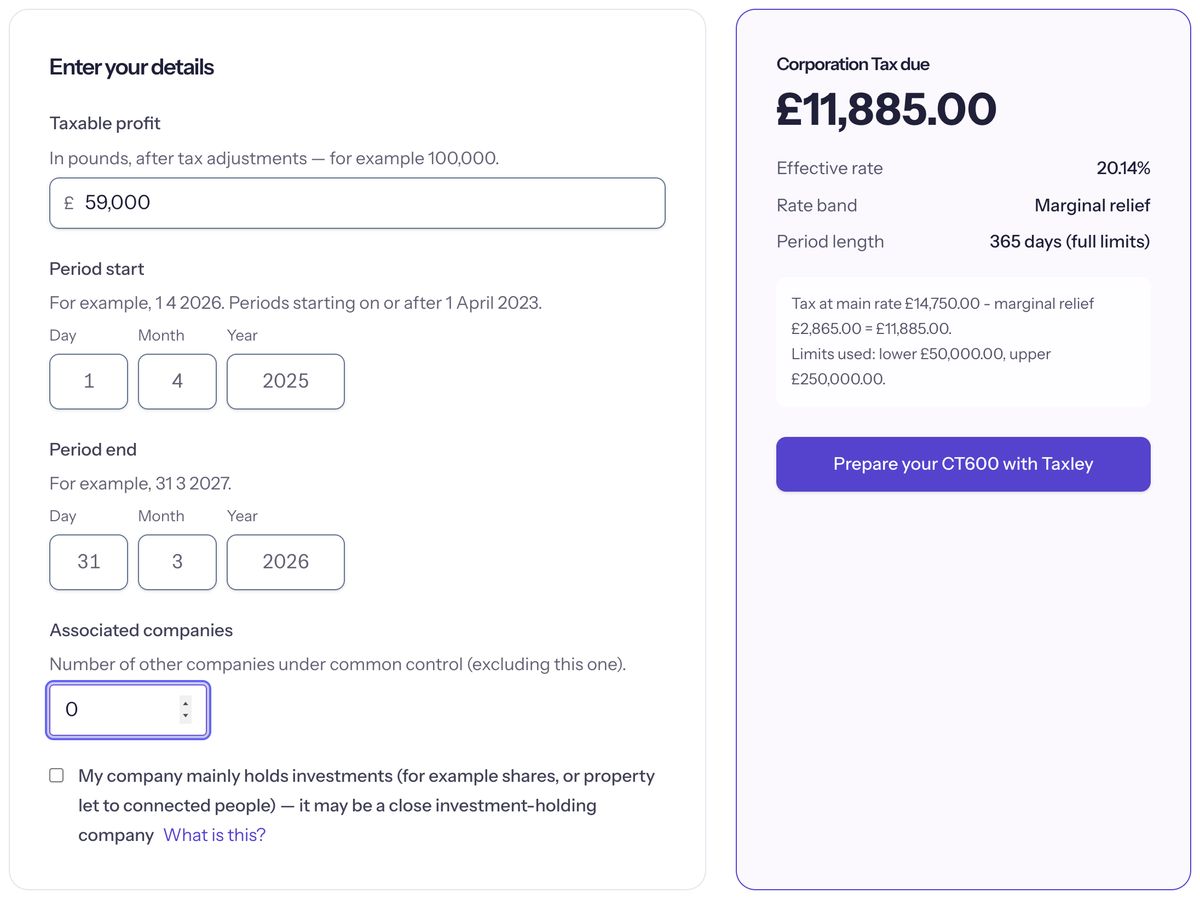 In Taxley: the free Corporation Tax calculator gives the same £11,885 as the worked example (demo company).
What mistakes change the Corporation Tax figure?
Five mistakes change the figure: starting from the wrong profit, missing an add-back, mishandling equipment, ignoring an associated company and forgetting to cut the limits for a short period. The first three change taxable total profits; the last two change the £50,000 and £250,000 limits (GOV.UK: Marginal Relief for Corporation Tax), so the tax moves either way.
The first three mistakes happen between the accounts and taxable total profits. Starting from profit after tax, or from a draft trial balance, gives the wrong base, and the accounting profit to taxable profit bridge shows how each line of the accounts carries through. Missing an add-back understates the profit, and the guide to disallowable expenses and adjustments lists what to add back. Equipment goes wrong in two directions: expensing it and also claiming the annual investment allowance gives relief twice, while depreciating it without claiming any allowance gives no relief at all. The equipment purchases guide separates the invoice, the depreciation and the allowance. The cost of an error is larger than it looks inside the marginal relief band. Each extra pound there bears 26.5%, the 25% main rate plus the 3/200 fraction in the marginal relief formula (CTA 2010 s18B), so leaving out Example Trading Ltd's £5,000 of add-backs would understate its tax by £1,325.
The other two mistakes change the limits rather than the profit. A company that overlooks an associated company uses limits that are too high: with one associate, both limits are divided by 2, to £25,000 and £125,000 (GOV.UK: Marginal Relief for Corporation Tax). For Example Trading Ltd, one associate would raise the tax from £11,885 to £13,760, because marginal relief falls to 3/200 × (£125,000 − £59,000), which is £990. The associated companies guide explains who counts and what information to gather. A period shorter than 12 months needs its limits cut in proportion, and HMRC's manual notes that the strict calculation uses days, not months (CTM03930). The Corporation Tax rates and marginal relief guide covers the rates, the fraction and the short-period limits for each financial year.
Can Taxley work out and file this Corporation Tax computation?
Yes. Taxley (taxley.co.uk), UK online software that prepares and files the Company Tax Return (CT600) with HMRC and the annual accounts with Companies House, works out the computation, including capital allowances, losses, marginal relief and associated companies, and files the CT600.
In Taxley, the steps in this guide happen as you enter the company's figures. Depreciation charged in the accounts is added back for you, and disallowable costs such as client entertaining go in an "Add back: disallowable expenses" row. Taxley calculates capital allowances for most claims, including the annual investment allowance, the main and special rate pools and full expensing. It sets trading losses, UK property business losses and non-trading loan relationship deficits brought forward against profits. It then applies the small profits rate, the main rate and marginal relief, divides the limits for associated companies and reduces them for short accounting periods (GOV.UK: Marginal Relief for Corporation Tax). The return goes to HMRC live under the company's own Government Gateway login, and once the return is paid and the accounts are finished, Taxley files micro-entity, small, abridged or dormant accounts at Companies House at no extra cost. Preparing and previewing is free; a micro-entity return costs £44.50 (promotion price until 31 Dec 2026; £89.00 from 1 Jan 2027), charged only when you choose to file.
Taxley has limits worth checking before you start. It doesn't support quarterly instalment payers, medium-sized or audited companies, R&D tax relief, or a company in a group using losses brought forward. It is software, not an accountant, so it gives no tax advice and doesn't pay the company's Corporation Tax; you still pay HMRC yourself by the payment date. Take the 30-second check to see whether Taxley fits your company, or read what Taxley can't file yet.
Frequently asked questions
Is Corporation Tax charged on turnover or on profit?
On profit. Corporation Tax is charged on the company's taxable total profits for the accounting period, after add-backs, capital allowances and losses, not on its sales or on the profit shown in the accounts (GOV.UK: Company Tax Returns: Overview). Example Trading Ltd pays tax on £59,000, not on its £60,000 accounts profit.
What is the effective Corporation Tax rate on £59,000 of taxable profit?
About 20.14% for a standalone company with a 12-month period: £11,885 divided by £59,000. The same answer comes from 19% on the first £50,000 (£9,500) plus 26.5% on the next £9,000 (£2,385), because 26.5% is the marginal rate inside the band (CTA 2010 s18B).
Do dividends paid to shareholders reduce Corporation Tax?
No. Section 1305 of the Corporation Tax Act 2009 says no deduction is allowed for a dividend or other distribution when working out a company's profits (legislation.gov.uk: CTA 2009 s.1305). Dividends come out of profit after tax, as the guide to dividends and Corporation Tax explains.
How does a 6-month accounting period change the calculation?
Both limits shrink in proportion, so a 6-month period uses roughly £25,000 and £125,000; strictly, HMRC works the reduction by days (CTM03930). The annual investment allowance shrinks the same way. The seven steps are otherwise identical, and the calculator applies the reduction when you enter the dates.
Does a dormant associated company reduce the profit limits?
No. HMRC disregards an associated company that carried on no trade or business at any time in the accounting period, or in the part of it when the companies were associated (CTM03940). A dormant company under the same control therefore leaves the £50,000 and £250,000 limits unchanged.
General information, not personalised tax or accounting advice.
People also ask
Keep reading


Ready to file your Company Tax Return?
Confirm support for your accounting period, accounts and any supplementary pages before paying. Taxley support can answer software questions, not provide a tax opinion.
Questions about your period or accounts? Ask about software support