
Disallowable expenses for Corporation Tax: adjustments explained

Prerequisites at a glance
- Time
- About 10 min
- Difficulty
- Beginner
- Tools you'll use
-
- Taxley's return editor (Simple view)
- Have ready
-
- The year's profit and loss account
- A list of client entertaining and other non-business costs
- Your capital allowances figure
- Losses brought forward from last year's return
- Loan and overdraft interest statements
- The number of associated companies
In short: A limited company's taxable profit starts with profit before tax from its accounts. You add back depreciation and disallowable expenses such as client entertaining, then deduct capital allowances and losses brought forward. For Brightwater Studio Ltd, £30,000 of accounts profit becomes £20,800 of profits chargeable, taxed at the 19% small profits rate (GOV.UK: Corporation Tax rates, expenses and reliefs: Rates): £3,952.
This guide explains each adjustment first, then shows what to type in the "Corporation Tax" section of Taxley's Simple mode and the "Add back" group in Advanced. If you haven't started a return yet, take the 30-second check to see whether Taxley fits your company. For the general idea of why the two profits differ, see accounting profit vs taxable profit.
How is taxable profit worked out for a limited company?
Taxable profit is the profit before tax in the accounts, plus the costs tax doesn't allow (depreciation and disallowable expenses), less the allowances tax gives instead (capital allowances) and less any losses brought forward. The result is "profits chargeable to Corporation Tax", CT600 box 315, and the tax rate applies to that figure, not to the accounts profit.
The worked example uses Brightwater Studio Ltd, a fictional trading company with a year from 1 April 2025 to 31 March 2026, no associated companies and no other income. It bought £2,400 of equipment in the year, charged £600 of depreciation on it and spent £600 on client entertaining. Figures checked on 24 September 2026.
| Line | Brightwater Studio Ltd, year to 31 March 2026 | Why |
|---|---|---|
| Trading profit before tax (from the accounts) | £30,000 | The starting point |
| Add back: depreciation | £600 | Not deductible; Taxley adds it back automatically |
| Add back: disallowable expenses (client entertaining) | £600 | Specifically disallowed |
| Less: annual investment allowance | (£2,400) | 100% relief on the equipment |
| Less: trading losses brought forward | (£8,000) | Unused losses of earlier years |
| Profits chargeable to Corporation Tax | £20,800 | CT600 box 315 |
| Corporation Tax at 19% | £3,952.00 | Small profits rate |
The rate is 19% because £20,800 is below £50,000. GOV.UK sets the small profits rate at 19% for profits of £50,000 or less and the main rate at 25% for profits over £250,000, with marginal relief in between (GOV.UK Corporation Tax rates). Without the four adjustments, Brightwater Studio would be taxed on £30,000 and pay £5,700. Together they reduce the taxable profit by £9,200 and the tax by £1,748.
HMRC expects every adjustment to be shown, not just the answer. Its Company Tax Return guide asks for a calculation of each trade's profit showing the adjustments made to the accounts figures and any capital allowances or balancing charges. That calculation is the tax computation filed with the CT600. On the return itself, trading losses brought forward go in box 160 or box 285, depending on when they arose and how they're used, and box 315 is the company's taxable total profits.
Why is depreciation added back for Corporation Tax?
Depreciation is added back because it spreads the cost of a capital asset through the accounts, and capital costs aren't deductible when working out a trade's profits (CTA 2009 s53). Tax relief for equipment comes from capital allowances instead. Adding back the depreciation and claiming the allowance stops the company getting relief twice.
HMRC's capital versus revenue toolkit says depreciation of capital items is generally not allowable and should be added back even where no capital allowances are claimed. The exception is an asset within the corporate intangible assets regime, such as some goodwill, which Taxley doesn't support. So a company that forgets to claim allowances still adds back its depreciation. It simply gets no relief for the equipment that year.
In Taxley, you never type depreciation twice. The Simple-mode row "Add back: depreciation (tax doesn't allow it)" copies the depreciation line from your profit and loss account, which is £600.00 for Brightwater Studio. In Advanced, the box "Depreciation not in your profit and loss" is only for depreciation or amortisation that isn't in that line. A figure there moves the return out of Simple mode.
The relief usually comes from the annual investment allowance (AIA): 100% of the cost of most plant and machinery, up to £1 million a year, but not cars (GOV.UK annual investment allowance). Brightwater Studio claims £2,400 of AIA on its £2,400 of equipment. See capital allowances and balancing charges for how to enter pools, sales and cars.
What counts as a disallowable expense for Corporation Tax?
A disallowable expense is a cost in the profit and loss account that tax law won't let the company deduct. Either a specific rule blocks it, as with client entertaining, or it isn't wholly and exclusively for the trade, or it is capital. You add back the whole cost, or only the non-business part if the cost had two purposes (CTA 2009 s54).
GOV.UK's Corporation Tax expenses page sets out the two questions for each cost: is it capital or revenue, and does it have only a business purpose? The table below applies those tests, and HMRC's Business Income Manual (BIM), to costs that often appear in a small company's accounts. Treatments checked on 24 September 2026.
| Cost in the accounts | Add it back? | Why |
|---|---|---|
| Client or customer entertaining | Yes, all of it | Disallowed even when a genuine business cost (CTA 2009 s1298, BIM45000) |
| Gifts to customers | Yes, with narrow exceptions | Treated like entertaining (BIM45065) |
| Staff-only entertaining, such as a staff party | Usually no | Allowable for employees if wholly for the business (BIM45033) |
| Fines for breaking the law | Yes | Not incurred wholly and exclusively for the trade (BIM42515) |
| Tax penalties, such as VAT penalties | Yes | Specifically disallowed (CTA 2009 s1303) |
| Political donations | Yes | Almost always made for non-trade purposes (BIM47405) |
| A general provision for possible future costs | Yes | No obligation at the year end (BIM46510, BIM46520) |
| Equipment or other capital items charged as expenses | Yes, then claim capital allowances | Capital, not revenue (CTA 2009 s53) |
| Legal fees for buying property or a long-term contract | Yes | They relate to buying a capital asset (GOV.UK: Corporation Tax rates, expenses and reliefs: Expenses) |
| A director's personal bill paid by the company | Yes, unless taxed on the director as pay or a benefit | Not for the business (BIM47107) |
| Charitable donations | Yes, but not in this box: enter it in box 305 and Taxley adds it back and relieves it there | See the next section |
Staff and client entertaining are treated differently. HMRC says staff entertaining is allowable if it's wholly and exclusively for the trade and isn't merely incidental to entertaining customers (BIM45033). A staff-only Christmas party is normally deductible. A meal where two staff host a client normally isn't. Our guide to client entertaining and staff parties covers the benefit-in-kind side as well.
A director's personal costs depend on how the company treats them. If the cost is taxed on the director as part of their pay or benefits, HMRC allows the company a deduction as a cost of employing the director (BIM47107). If it isn't, the cost is disallowable, and it's usually better charged to the director's loan account so it never reaches the profit and loss account. An overdrawn loan at the year end can bring section 455 tax, and director's loan details move the return out of Simple mode.
Fines follow a similar pattern. A fine the company incurs for breaking the law is disallowable, but HMRC allows an employer's payment of an employee's fine when the employee is taxed on that payment as employment income (BIM42515).
Are charitable donations disallowable expenses?
Not in the usual way. A company gets relief for a qualifying charitable donation by deducting it from its total profits in CT600 box 305, not as a trading expense (GOV.UK: Tax when your limited company gives to charity: Overview). So the donation in the profit and loss account comes out of the trading profit and is relieved once, in box 305. It must never be deducted twice.
HMRC says general charitable subscriptions shouldn't be allowed as deductions in working out a trade's profits (BIM47405). Taxley does that add-back itself. The Advanced "Disallowable expenses" hint says "Not charitable donations — Taxley adds those back itself." Enter qualifying donations in box 305 ("Qualifying donations") on the Full CT600 page instead. A figure entered box by box moves the return out of Simple mode.
A double-counted donation is one of the first things Taxley checks when your own tax figure doesn't match. Its list of likely causes starts with "A charitable donation deducted in your profit and loss and also claimed in box 305 (it must only be relieved once)." HMRC's Company Tax Return guide also says box 305 can't be more than the profits in box 300.
What are specialist tax adjustments in Taxley?
In Taxley's Simple mode, "Specialist adjustments" is a closed box holding two items that change the tax without being ordinary add-backs. They are "Loan and overdraft interest paid" ("Loan and mortgage interest paid" for a property company) and "Associated companies", CT600 box 326. The box's line reads "Loan or mortgage interest the company paid, and companies under the same control."
Open the box only if one of the two applies. Interest is entered here, and not with the other running costs, because tax relieves it under separate rules. Associated companies sit here because they don't change the profit at all, only the rate limits. The hint for associated companies ends "Usually 0.", and the box stays closed until you enter an interest figure or more than 0 associated companies.
Can a limited company deduct loan interest for Corporation Tax?
Yes. A company's interest on loans, overdrafts and mortgages is relieved under the loan-relationship rules in Part 5 of CTA 2009, not the ordinary expenses rules. Interest on borrowing for the trade is a trading debit, deducted in the trading profit even if the loan paid for a capital asset (HMRC CFM32020). Other interest is a non-trading debit.
HMRC's own example shows the split. A loan taken out to buy machinery for a manufacturing trade is a trading loan relationship. If a restaurant company later spends half a loan on shares held as an investment, the interest on that half becomes non-trading from then (CFM32020). A property letting business doesn't count as a trade for this test (CFM32030). So a property company's mortgage interest is a non-trading debit.
A property company is not restricted like an individual landlord. For companies, HMRC says interest is deductible under the loan-relationship regime and isn't an expense of the property business (PIM2052). The basic-rate credit that limits an individual landlord's relief doesn't apply. Non-trading debits are first set against any non-trading interest received, and a net deficit can be set against the company's other profits of the same period or carried forward (CFM32030).
Taxley asks for the interest separately so it can put it in the right place. Enter the year's total in "Loan and overdraft interest paid". Its hint says "don't include it in Other charges", so it's counted once. It's still deducted in the profit before tax, and "your accounts show it within Other charges". For a trading company, Taxley treats all of it as a trading debit inside the trading profit. For a property company, Taxley treats it as a non-trading debit, sets any net deficit against the period's other profits and carries forward what's left.
Simple mode can't split a trading company's interest between trade and non-trade use. If part of the borrowing paid for something outside the trade, such as an investment, that part is a non-trading debit. Confirm the split carefully before you file.
What goes in CT600 box 326 for associated companies?
Box 326 is the number of companies associated with yours at any time in the accounting period, not counting your own company (HMRC's Company Tax Return guide). Two companies are associated when one controls the other, or both are controlled by the same person or persons (CTA 2010 s18E). The count matters because it divides the £50,000 and £250,000 limits.
The limits are divided by the number of associated companies plus one. GOV.UK's own example: with 3 associated companies, the limits are divided by 4, giving £12,500 and £62,500 (GOV.UK marginal relief). An associated company that carried on no trade or business at any time in the period is ignored (CTA 2010 s18E).
For Brightwater Studio, the box 326 figure changes the tax like this:
| Associated companies (box 326) | Lower and upper limits | Tax on £20,800 |
|---|---|---|
| 0 | £50,000 and £250,000 | £3,952.00 (19%) |
| 1 | £25,000 and £125,000 | £3,952.00 (19%) |
| 2 | £16,666.67 and £83,333.33 | £4,262.00 (25% less marginal relief) |
With 2 associated companies, £20,800 sits between the limits. Tax at 25% is £5,200.00, less marginal relief of 3/200 × (£83,333.33 − £20,800) = £938.00, giving £4,262.00, or £310 more. The 3/200 standard fraction is on HMRC's rates and allowances page, and the formula is in CTA 2010 s18B. Our guide to associated companies and the thresholds covers how to count them.
How do you fill in the Corporation Tax section in Taxley's Simple mode?
Work down the Corporation Tax section from top to bottom: losses, then disallowable expenses, capital allowances and specialist adjustments, and finally the results table. The section says it is "Worked out from your saved figures by the same calculation as the rest of Taxley." Each optional box stays closed until you click "Show", unless it already holds a figure, so open only the ones that apply.
Step 1: Enter losses from earlier years, if there are any
Open "Trading losses" ("Property losses" for a property company) only if the company made a loss in an earlier year that hasn't been used yet. Type the unused amount in "Trading losses brought forward". If last year's return was prepared in Taxley, the hint shows the amount it carried forward, and leaving the box blank uses it. The "Use last return's £…" button copies it in. Brightwater Studio enters £8,000. See trading losses brought forward for the rules.
Step 2: Check the profit and add back disallowable expenses
The first row, "Trading profit before tax (from the profit and loss account)", comes from your accounts, so check it against them: £30,000.00 for Brightwater Studio. The next row adds back depreciation automatically. Type the total of your disallowable costs in "Add back: disallowable expenses", here £600 of client entertaining, or leave it blank if there are none. Keep depreciation and loan interest out of this box, because Taxley handles them elsewhere. For a charitable donation, enter it in box 305 ("Qualifying donations") on the Full CT600 page; the return then continues in Advanced.
 In Taxley: profit before tax of £30,000.00, depreciation of £600.00 added back automatically, and £600 of disallowable expenses typed in (demo company).
Step 3: Enter capital allowances and any balancing charges
Open "Capital allowances" if the company bought equipment, vans, machinery or fittings. Type the claim in "Annual investment allowance (AIA)", whose hint reads "100% of what you spent on plant and machinery, vans and fittings (not cars), up to £1,000,000 a year." Brightwater Studio claims £2,400. Open "Balancing charges" only if the company sold or scrapped equipment it had claimed allowances on. Pools, cars and other allowances need Advanced, through the "Claim pools, cars or other allowances in Advanced" link.
Step 4: Open Specialist adjustments for interest and associated companies
Click "Show" on "Specialist adjustments" if the company paid interest on a loan, overdraft or mortgage, or has associated companies. Type the year's interest in "Loan and overdraft interest paid", and check it isn't also in "Other charges". Type the number of associated companies in "Associated companies", without counting your own company. Brightwater Studio has no borrowing and no associated companies, so both stay at 0.
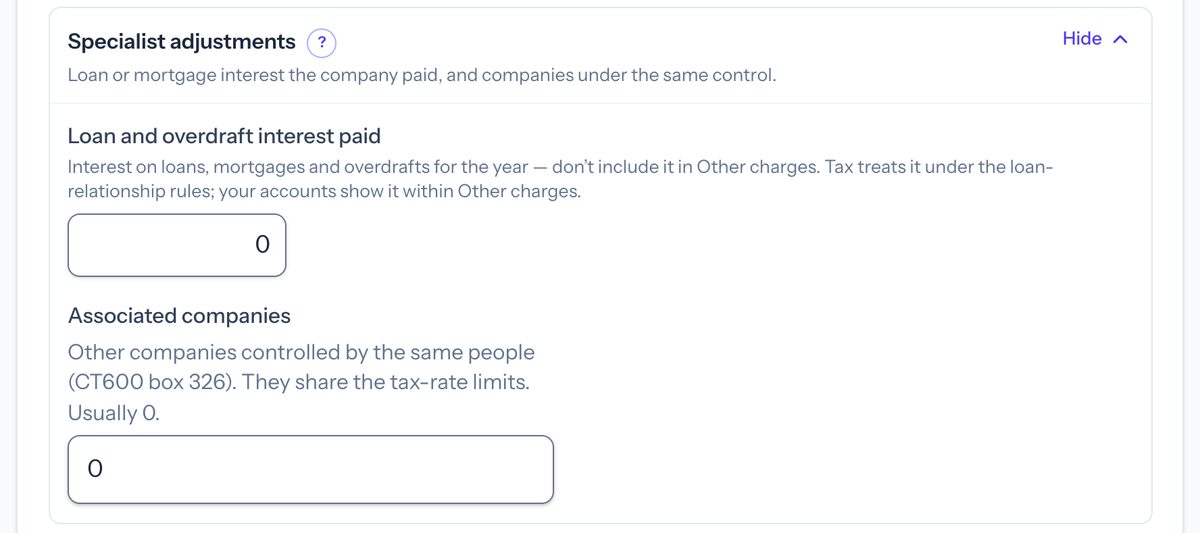 In Taxley: the Specialist adjustments box open, with loan and overdraft interest of 0 and 0 associated companies (demo company).
Step 5: Check the results table against your own workings
Check the results table last. For Brightwater Studio it shows "Less: annual investment allowance" of −£2,400.00, "Less: losses from earlier years used" of −£8,000.00 and "Profits chargeable to Corporation Tax" of £20,800. "Corporation Tax at the rates for the period" and "Corporation Tax payable" are both £3,952.00, because no marginal relief is due. If a figure looks wrong, correct the input above it rather than the result.
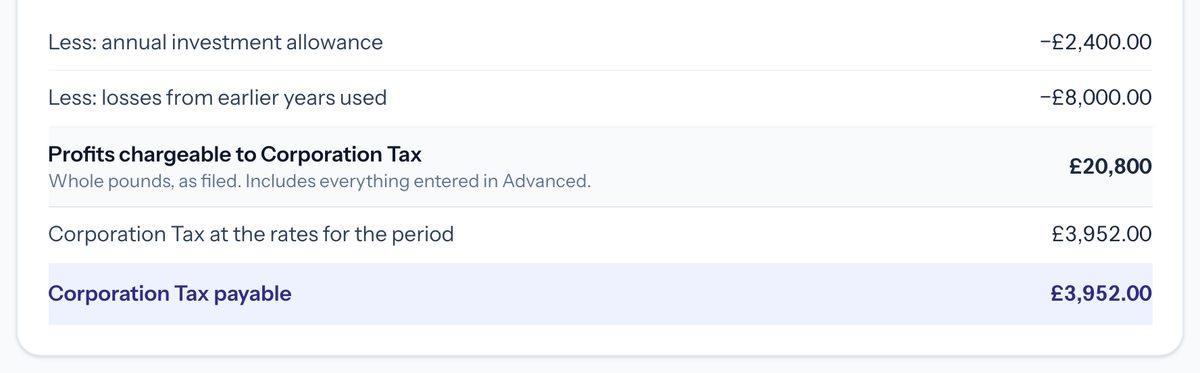 In Taxley: £20,800 of profits chargeable gives £3,952.00 of Corporation Tax at 19%, with no marginal relief (demo company).
What does each line of the Corporation Tax results table mean?
The results table turns your inputs into the figures on the return, and each row appears only when it applies. "Profits chargeable to Corporation Tax" is the figure the rates apply to, CT600 box 315. "Corporation Tax at the rates for the period" is the tax before marginal relief, and "Corporation Tax payable" is the tax after it.
| Row in Taxley | What it shows |
|---|---|
| Less: annual investment allowance | The AIA you entered, deducted from profit |
| Add: balancing charges | Balancing charges you entered, added to profit |
| Less: losses from earlier years used | Losses used this year, never more than the profits available |
| Profits chargeable to Corporation Tax | Box 315, in whole pounds |
| Corporation Tax at the rates for the period | Tax at 19% or 25% before marginal relief |
| Less: marginal relief | Relief for profits between the two limits |
| Corporation Tax payable | The Corporation Tax on these profits |
The note under "Profits chargeable to Corporation Tax" reads "Whole pounds, as filed. Includes everything entered in Advanced." So the figure includes capital allowance pools or other adjustments entered in Advanced. Simple mode lists those under "Also entered in Advanced (included in the tax below)" in the Capital allowances box. You can't change them there.
The losses row uses only what the profits can absorb. Taxley only uses as much loss as the profits can absorb, then shows "Losses carried forward to next year". To check the rate maths yourself, use the Corporation Tax calculator or read Corporation Tax rates and marginal relief. When the figure is final, see how to pay Corporation Tax.
When should you switch from Simple mode to Advanced?
Switch to Advanced when an adjustment has no box in Simple mode. That covers capital allowance pools, cars, full expensing, structures and buildings allowance, "Other adjustments", or depreciation that isn't in the profit and loss account. Under Capital allowances, the "Claim pools, cars or other allowances in Advanced" link opens the right part of the return.
Advanced has the same figures in its "Tax adjustments" section. The "Add back" group is described as "Costs in your accounts that tax doesn't allow — added to your profit." It holds "Depreciation not in your profit and loss", "Disallowable expenses" and "Balancing charges". The "Deduct" group holds the allowances, and "Other adjustments" takes anything else with a note. A disallowable figure typed in Simple mode appears in Advanced, and the other way round.
Some returns can't use Simple mode at all. It's for micro-entity accounts of a trading or property company, for a period of 12 months or less. It isn't available if the return has director's loan details (CT600A), chargeable gains, group relief, foreign income or figures entered box by box. Taxley then shows "Simple mode isn't available for this return because …", followed by "You can finish it here in Advanced."
Taxley applies your adjustments but doesn't decide what's disallowable. The Advanced section says "Taxley applies them but doesn't calculate them". If you're unsure how a cost should be treated, check it carefully before filing. When you're ready, create a free account. Preparing and previewing a return is free, and you pay only when you file.
Frequently asked questions
Is client entertaining ever allowable for Corporation Tax?
Rarely. Entertaining clients is disallowed even when it's a genuine business cost. The exceptions include hospitality a business provides for payment in its normal course of trade, such as a restaurant selling meals, and staff entertaining that isn't incidental to entertaining clients (HMRC BIM45030 and BIM45033).
Should loan interest go in disallowable expenses?
No. Interest on the company's borrowing is relieved under the loan-relationship rules, so it isn't added back. In Taxley's Simple mode, enter it in "Loan and overdraft interest paid" under Specialist adjustments and keep it out of "Other charges", so it's counted once.
Do I add back depreciation if I don't claim capital allowances?
Yes. HMRC's capital versus revenue toolkit says depreciation of capital items should be added back even where no capital allowances are claimed. Not claiming allowances just means the company gets no tax relief for the equipment's cost that year.
Should I count my own company in box 326?
No. HMRC's Company Tax Return guide says the number in box 326 should not include your company. A company with one sister company under the same owner enters 1, which halves the limits to £25,000 and £125,000.
What if I find a disallowable expense after filing?
Amend the return. GOV.UK says you must usually make changes within 12 months of the filing deadline, and the filing deadline is 12 months after the end of the accounting period. Add the cost back, recalculate the tax and pay any extra due.
People also ask
Keep reading


Ready to file your Company Tax Return?
Confirm support for your accounting period, accounts and any supplementary pages before paying. Taxley support can answer software questions, not provide a tax opinion.
Questions about your period or accounts? Ask about software support