
Trading losses brought forward: Corporation Tax and CT600 box 285

Prerequisites at a glance
- Time
- About 10 min
- Difficulty
- Beginner
- Tools you'll use
-
- Taxley's return editor (Simple or Advanced view)
- Have ready
-
- Last year's tax computation or loss memo
- The unused tax loss and the year it was made
- This year's profit and tax adjustments
In short: A trading loss brought forward is a tax loss from an earlier accounting period that the company hasn't used yet. Losses made in accounting periods beginning on or after 1 April 2017 can be claimed against the company's total profits (CT600 box 285); older losses reduce only profits of the same trade (box 160). Both carry forward while the trade continues (GOV.UK: Carry forward Corporation Tax losses).
This guide explains the rules first, then exactly what to type in Taxley's "Trading losses" box, with a worked example from Brightwater Studio Ltd, a fictional company. It covers losses from earlier years only: for the year the company makes the loss, see Company made a loss? Your CT600 still needs a loss schedule. If you haven't started a return yet, take the 30-second check to see whether Taxley fits your company.
What is a trading loss brought forward?
A trading loss brought forward is the unused part of a tax-adjusted trading loss from an earlier accounting period. It is not the loss in the accounts: the tax loss is the accounts result after the usual tax adjustments, such as capital allowances. The unused part carries into the next period while the company carries on the same trade.
A loss only becomes "brought forward" when it wasn't relieved another way first. In the loss year the company can set the loss against other profits of the same period or carry it back to the previous 12 months, and a company in a group may surrender it as group relief. Whatever is left is carried forward (HMRC: calculating and claiming a loss). Section 45A of the Corporation Tax Act 2010 calls that leftover "the unrelieved amount" and carries it to the next accounting period, provided the company continues to carry on the trade (legislation.gov.uk, s.45A).
HMRC asks companies to keep separate records of carried-forward trading losses made before 1 April 2017 and those made on or after that date, so you know how much of each type is left (GOV.UK: Carry forward Corporation Tax losses). The two types are relieved differently, as the next section shows.
How does Corporation Tax relief for losses brought forward work in 2026?
It depends on when the loss was made. A trading loss made in an accounting period beginning on or after 1 April 2017 can be claimed against the company's total profits, including rent and interest, under section 45A. A loss made before then reduces only profits of the same trade, automatically, under section 45. Either way, the company can choose to use less.
Section 45A relief needs a claim, and the claim can be for the whole unrelieved amount "or for any part of it specified in the claim". The relief is a deduction from the company's total profits of the later period, and the claim must be made within two years after the end of that period (s.45A(5)–(7)). A few post-2017 losses can't use section 45A, for example where the trade became small or negligible in the loss-making period. Those fall under section 45B, which works like the old rules: the loss reduces profits of the same trade only (s.45B).
Pre-April 2017 losses carried forward under section 45 reduce the profits of the trade automatically, so long as the company continues to carry it on. For accounting periods beginning on or after 1 April 2017, the company can claim that a period's profits are not reduced by the loss, or not by more than a stated amount, within two years of the end of that period (s.45(4A)–(4C)). HMRC's summary is the same for both types: use the full amount, enter less, or put 0 to use none this period (GOV.UK: Carry forward Corporation Tax losses).
| Loss brought forward | Set against | CT600 box | Where in Taxley |
|---|---|---|---|
| Trading loss made on or after 1 April 2017 | Total profits, on a claim | 285 | Simple or Advanced |
| Trading loss made before 1 April 2017 | Profits of the same trade | 160 | Advanced only |
| UK property business loss | Total profits, on a claim | 250 | Simple (property company) or Advanced |
| Capital loss | Later chargeable gains only | 215 | Advanced only |
Rules and box numbers checked on 24 September 2026 against HMRC's Company Tax Return guide and carry-forward guidance.
Which CT600 boxes do losses brought forward go in: 160 or 285?
Box 160 is for trading losses brought forward that can only be set against profits of the same trade, which includes every loss made before 1 April 2017. Box 285 is for carried-forward trading losses the company claims against total profits, which generally covers losses made since. UK property business losses brought forward go in box 250 instead.
The two trading-loss boxes sit at different points on the form. Box 160 comes straight off trading profits (box 155) to give net trading profits (box 165), and HMRC says that if the losses are more than the profits you should enter only enough to cover the trading profit. Box 285 comes further down, after other income is added, as one of the deductions and reliefs. HMRC's instruction for it is to enter the total carried-forward trading losses you are setting against total profits (Company Tax Return guide). Taxley's CT600 box guide lists every loss box in order.
The return alone doesn't show the balance left over. HMRC requires the computation filed with the return to identify unused losses carried forward from earlier periods, split between losses from before and after 1 April 2017. It must also show how they were used this period and how much is carried to the next (Company Tax Return guide). Box 780 is different again: it is the trading loss arising in the period of the return, not a loss brought forward.
Does the £5 million loss restriction affect a small company?
Only through one formality. A company can use carried-forward losses in full against profits up to its deductions allowance (up to £5 million a year), plus 50% of the profits above it. But every company using carried-forward losses must state its deductions allowance in the return, usually in the computation; if it doesn't, HMRC restricts relief to 50% of profits (HMRC CTM05230).
HMRC describes the restriction as, broadly, an allowance of up to £5 million plus 50% of remaining profits after the allowance (GOV.UK: Work out and claim relief from Corporation Tax trading losses). The law sets a stand-alone company's deductions allowance at £5,000,000, proportionally reduced for a period shorter than 12 months (CTA 2010 s.269ZW). For a group, the "group deductions allowance" is £5,000,000 for each accounting period of the nominated company, and it is allocated among the members; no single company can have more than £5,000,000 (s.269ZS and s.269ZR).
In a group, the allowance exists only if the group nominates a company and files a group allowance allocation statement; a company allocated nothing has a nil allowance. Taxley states the deductions allowance for you. When a return uses losses brought forward, the computation Taxley files with it shows the company's allowance (£5,000,000, or less for a shorter period) and how much of it the losses used. This works for a company that isn't in a group. If the company is in a group, or the losses used are more than the allowance, Taxley can't file this yet. If you've entered associated companies but haven't said whether the company is in a group, Taxley warns you to check first.
Where do you find the losses brought forward figure?
Last year's Corporation Tax computation is the place to look, because HMRC requires it to show the unused losses carried forward. If an accountant prepared last year's return, their computation or loss memo has the figure.
If the company's latest earlier return was prepared in Taxley, Taxley suggests its carried-forward figure. Check that the return is last year's and was the one actually filed, then leave the box blank to use it.
Without a computation, rebuild the figure year by year from the returns. Start with the losses brought forward into last year, add any trading loss that arose (box 780), then take off what was used (boxes 160 and 285), set against other profits of that year (box 275), carried back or surrendered as group relief. The result is last year's closing balance. Keep the working with your records, because HMRC can ask about the use of a loss in a future return, for example to check the same trade is still carried on (GOV.UK: Work out and claim relief from Corporation Tax trading losses).
In Taxley, "the previous return" means the company's latest earlier return prepared in Taxley. Typing last year's profit and loss into the "Last year" column doesn't create a loss brought forward: those comparatives are accounts figures only, so a returning company that first used Taxley this year enters the loss by hand. Last year's figures: how to enter comparatives covers that column.
Why isn't the balance-sheet deficit the same as your tax loss?
The deficit on the balance sheet is an accounting total, and a tax loss is a tax figure for one trade. Retained earnings net off every profit, loss and dividend since the company started. A tax loss starts from one year's accounts result and then changes with the tax adjustments: depreciation and disallowable costs added back, capital allowances deducted.
GOV.UK is direct about it: the profit or loss for Corporation Tax "is different from the profit or loss shown in your annual accounts" (GOV.UK: Company Tax Returns). HMRC's loss guidance says capital allowances increase a trading loss and balancing charges reduce it (GOV.UK: Work out and claim relief from Corporation Tax trading losses). So a company that bought a van in its loss year can have a tax loss bigger than its accounts loss. History matters too: a company whose earlier profits exceed a later loss can show positive retained earnings and still have an unused loss, if it didn't carry the loss back. And a loss already set against other profits or carried back stays in the deficit but is no longer available.
In the Brightwater example the two figures happen to agree. Last year's balance sheet shows retained earnings of minus £8,000 and the tax loss is £8,000, because that was the company's first period and there were no tax adjustments. That match is a coincidence, not a rule, so check the computation rather than the balance sheet. Accounting profit vs taxable profit shows the bridge between the two.
Keep each figure in its own place. The deficit stays on the balance sheet: last year's closing profit and loss account goes in its "Last year" box, negative for a deficit, and this year's retained earnings brought forward equals it. Company accounts comparatives: how to enter last year's figures explains those boxes. The tax loss goes only in the losses box. Taxley's editor says so beside both: the balance sheet row reads "From your accounts' balance sheet — not a tax loss", and the losses section reads "These are tax losses from your Corporation Tax computations — not the retained-earnings deficit on your balance sheet, which is often a different figure."
How do you enter trading losses brought forward in Taxley?
Open the "Trading losses" box in the Corporation Tax section, type the unused tax loss into "Trading losses brought forward", then check the tax table below it. If last year's return was prepared in Taxley, leave the box blank to use what that return carried forward. Losses made before April 2017 go in the Advanced view instead.
Step 1: Find the unused tax loss from last year
Start from last year's tax computation, not the accounts. HMRC requires the computation to identify the unused losses carried forward, split between losses made before and after 1 April 2017, so the figure should be written there. If an accountant prepared last year's return, ask them for the loss memo. Otherwise work it out: losses brought forward into last year, plus the loss arising (box 780), minus anything used, carried back or surrendered. Note the year each loss was made.
Step 2: Open the Trading losses box and enter the figure
In Simple mode, the "Corporation Tax" section starts with a "Trading losses" box, marked "Only if the company made a loss in an earlier year that hasn't been used yet." Click Show, then type the loss into "Trading losses brought forward". Only enter losses made in accounting periods beginning on or after 1 April 2017; older losses go in Advanced. If there are none, leave it blank. When last year's return was prepared in Taxley, the hint reads "Your last Taxley return carried forward £X. Leave this blank to use it…", and the "Use last return's £X" button copies the figure into the box.
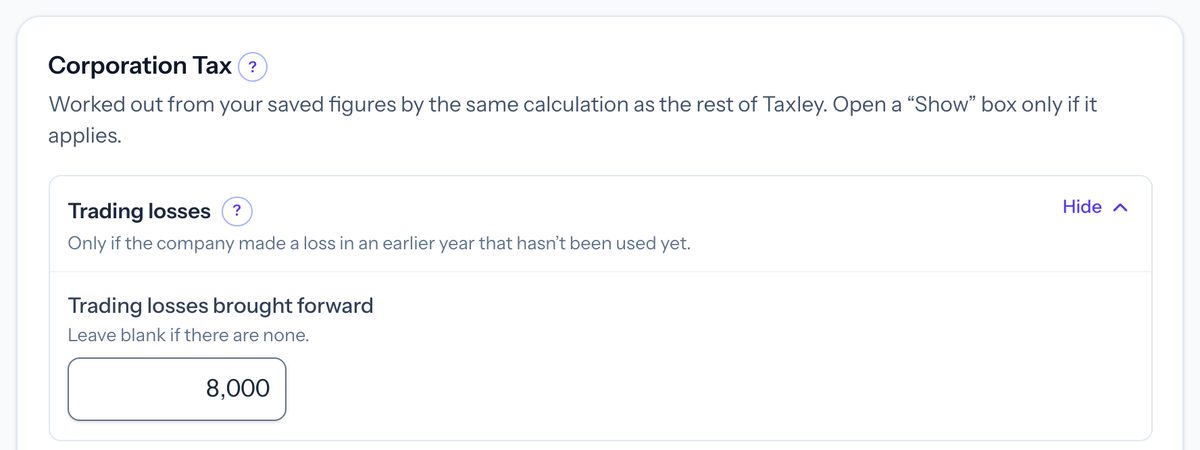 In Taxley: the "Trading losses" box opens at the top of the Corporation Tax section, here with an £8,000 loss from last year (demo company).
Step 3: Use Advanced for older losses and other kinds of loss
Simple mode takes one figure: trading losses made from 1 April 2017 for a trading company, or property business losses for a property company. Everything else goes in the Advanced view, under "Losses from earlier periods". That group includes "Trading losses brought forward — before 1 April 2017" (box 160), "Loan interest deficits brought forward" and "Capital losses brought forward", plus "Property business losses brought forward" (box 250) when the company has property income. If the return has one of these other kinds of loss, Simple mode isn't available for it and you finish it in Advanced.
Step 4: Check the tax and the carried-forward figure
Check the tax table below the box. It shows "Less: losses from earlier years used", then "Profits chargeable to Corporation Tax" and "Corporation Tax payable". Taxley never uses more loss than there is profit to cover. If some loss is left over, the box shows "Losses carried forward to next year", and that amount feeds the company's next Taxley return automatically. The loss used plus the amount carried forward should equal the figure you entered.
What does an £8,000 loss brought forward do to the tax bill?
In the Brightwater Studio Ltd example, an £8,000 trading loss brought forward cuts profits chargeable from £28,800 to £20,800, and the Corporation Tax from £5,472 to £3,952. That is a saving of £1,520, or £8,000 at the 19% small profits rate. The whole loss is used, so nothing is left to carry forward.
Brightwater Studio Ltd is a fictional micro-entity with one trade, no associated companies and a year end of 31 March. In its first period, to 31 March 2025, turnover was £30,000 and costs £38,000: a loss of £8,000. There were no tax adjustments, so the tax loss was also £8,000, and it had no other profits to set it against. This year, 1 April 2025 to 31 March 2026, it made a profit before tax of £30,000 on turnover of £72,000.
| Line | Year to 31 March 2026 |
|---|---|
| Profit before tax (turnover £72,000 less costs £42,000) | £30,000 |
| Add back: depreciation | £600 |
| Add back: disallowable expenses | £600 |
| Less: annual investment allowance | (£2,400) |
| Trading profits (box 155) | £28,800 |
| Less: trading losses brought forward (box 285) | (£8,000) |
| Profits chargeable to Corporation Tax (box 315) | £20,800 |
| Corporation Tax at 19% | £3,952.00 |
| Losses carried forward to next year | £0 |
Figures checked on 24 September 2026. Profits of £50,000 or less pay the small profits rate of 19% (GOV.UK: Corporation Tax rates, expenses and reliefs: Rates), and £20,800 × 19% = £3,952. The loss goes in box 285 because it was made in a period beginning after 1 April 2017. Filling in the Corporation Tax section in Simple mode explains the add-backs, and capital allowances and balancing charges explains the allowance line. Our rates and marginal relief guide covers profits above £50,000.
When the loss is bigger than the profit, the rest carries forward. Suppose Brightwater's first-period loss had been £40,000 instead. Taxley would set £28,800 of it against this year's total profits (box 285), leaving profits chargeable of £0 and no Corporation Tax to pay. The box would then show "Losses carried forward to next year: £11,200.00", and the computation would list the same £11,200 as trading losses carried forward. That £11,200 becomes next year's loss brought forward, and Taxley uses it on the next return unless you enter a different figure.
Can a company use less than the full loss, and does Taxley support that?
Yes in law, but not in Taxley. Section 45A lets a company claim all or any part of a post-2017 loss, and HMRC says you can enter less than the full amount or 0. Taxley always claims as much of the loss as the profits allow. If you need a smaller claim, Taxley can't file that return yet.
Typing a smaller figure into the box isn't a partial claim in Taxley. Taxley treats the figure you type as the whole loss available, so any part you leave out drops out of its records. In the Brightwater example, typing £5,000 instead of £8,000 would give Corporation Tax of £4,522 this year and show nothing to carry forward, even though £3,000 of loss would still exist in law. Enter the full unused loss and let Taxley work out how much is used.
Some loss claims are outside what Taxley calculates. Its published list of unsupported items includes "terminal loss claims" and "losses brought forward used by a company in a group, or above the deductions allowance" (Taxley's llms.txt). Carrying a loss forward, the subject of this guide, is supported for trading losses, UK property business losses, loan interest deficits, capital losses and overseas property losses, and Taxley can also carry a trading loss back 12 months.
How do property business losses brought forward work?
A UK property business loss that isn't used in the year it arises is carried forward to the next period and, on a claim, set against the company's total profits there, provided the property business continues. The claim can cover all of the loss or part of it, made within two years of the end of that next period. It goes in box 250.
The rule is in section 62 of the Corporation Tax Act 2010: the unused amount is carried forward and treated as a property loss of the next period, and relief there is given "only on the making by the company of a claim" (legislation.gov.uk, s.62). HMRC confirms that property losses made before or after 1 April 2017 both go against total profits. The exception is a loss from a period when the company paid Income Tax on its UK property profits, which can only be used against UK property profits (GOV.UK: Carry forward Corporation Tax losses).
If a company with investment business stops its UK property business, section 63 still carries the loss forward, but as a management expense, on a claim (s.63). In Taxley, a property company's Simple box is titled "Property losses", with the field "Property business losses brought forward". Left blank, it uses what the last Taxley return carried forward, and it claims as much as the profits allow, like the trading box. See Corporation Tax for a property rental company for the rest of a property return.
What mistakes should you avoid with losses brought forward?
Four mistakes change the tax: entering the accounts loss instead of the tax-adjusted loss, counting the same loss twice, using a loss from a different trade, and missing a change of ownership that stops losses being carried forward. HMRC can ask about the use of a loss in a future return, so a mistake can come back in a later year.
Entering the accounts loss. The figure in the box is the unused tax loss from the computation, not the loss in the profit and loss account or the deficit on the balance sheet. The two differ whenever there were add-backs or capital allowances in the loss year.
Counting a loss twice. In Taxley, a figure you type replaces what the last Taxley return carried forward; it isn't added to it. So don't add the two together, and don't include losses already set against other profits, carried back or surrendered as group relief.
Using a loss from a different trade. Pre-2017 losses and section 45B losses only reduce profits of the same trade, and section 45A needs the company to carry on the loss-making trade in the next period. If the company stopped one trade and started another, the old trade's losses don't carry across. HMRC wants a calculation for each trade where a company has more than one (Company Tax Return guide); Taxley assumes one trade, so Taxley can't file this yet.
Missing a change of ownership. If the company changes owner and, within a five-year period starting up to three years before the change, the nature or conduct of the trade changes in a major way, losses from before the change can't be carried forward against profits after it. The same applies if the change happens while the trade is small or negligible (CTA 2010 s.673 and s.674). Get advice if the company was sold.
This guide is general information about UK Corporation Tax, not advice on a particular company's losses. When your loss figure is ready, start your return in Taxley.
Frequently asked questions
Do trading losses brought forward expire?
No fixed number of years applies. HMRC says a company can carry trading losses forward to future profits as long as the trade continues. Losses stop being available when the trade ends, apart from terminal loss relief, which Taxley doesn't calculate.
Can a company carry a loss back instead of forward?
Yes. A trading loss can be set against profits of the previous 12 months if the same trade was carried on then, with a claim usually made within two years of the end of the loss-making period. Taxley works out the 12-month claim and ticks box 45, but not terminal loss claims; HMRC repays or sets off the earlier tax.
Are capital losses brought forward treated the same way?
No. Capital losses carried forward can only be set against later chargeable gains, never trading or rental profits, and HMRC says the company can't choose to limit how much is used. They go in box 215 and have their own Advanced field in Taxley.
Does the company need to send HMRC a separate loss claim?
Not for a carried-forward loss used in the return. HMRC says a claim for trading losses forms part of the Company Tax Return, and the computation must show the losses used and carried forward. Taxley's computation lists the loss used and any balance carried forward.
Can a loss brought forward reduce profits to nil?
Yes, where the deductions allowance, stated in the return, covers the profits. A loss can cover the whole of the period's profits, leaving no Corporation Tax to pay, and anything still unused carries forward again. In the Brightwater example, a £40,000 loss would leave profits chargeable of £0 and £11,200 to carry forward.
People also ask
Keep reading


Ready to file your Company Tax Return?
Confirm support for your accounting period, accounts and any supplementary pages before paying. Taxley support can answer software questions, not provide a tax opinion.
Questions about your period or accounts? Ask about software support