
Retained earnings movement: dividends paid and other reserves

Prerequisites at a glance
- Time
- About 10 min
- Difficulty
- Beginner
- Tools you'll use
-
- Taxley's return editor (Advanced or Simple view)
- Have ready
-
- Last year's closing retained earnings
- This year's profit after Corporation Tax
- Dividend vouchers and board minutes
- This year's closing balance sheet
In short: Closing retained earnings equal last year's closing figure, plus this year's profit after Corporation Tax, minus dividends, plus or minus any other reserve movement. For example, £36,300 + £41,970 − £30,000 = £48,270. Dividends are not a business cost for Corporation Tax (GOV.UK: Taking money out of a limited company), so they reduce retained earnings, not taxable profit.
This guide explains each part of that calculation first, then shows exactly what to type in Taxley's "Retained earnings movement" box and what each retained earnings warning means. If you haven't started a return yet, take the 30-second check to see whether Taxley fits your company. For why dividends never lower the tax bill, see are dividends a Corporation Tax expense?
What are retained earnings, and how do they roll forward each year?
Retained earnings, shown as the "profit and loss account" in UK company accounts, are the profits a company has kept since it started: profits after tax, less losses and dividends. Each year the figure rolls forward: closing retained earnings equal the brought-forward figure, plus profit after tax, minus dividends, plus or minus any other reserve movement.
The worked example below uses Brightwater Design Ltd, a fictional micro-entity with a year from 1 April 2025 to 31 March 2026, no associated companies and no earlier-year adjustments. Figures checked on 24 September 2026.
| Line | Brightwater Design Ltd, year to 31 March 2026 |
|---|---|
| Retained earnings brought forward (last year's closing) | £36,300 |
| Profit before tax | £52,000 |
| Less Corporation Tax (£13,000 at 25%, less £2,970 marginal relief) | (£10,030) |
| Profit after tax | £41,970 |
| Less dividends paid | (£30,000) |
| Other reserve movements | £0 |
| Retained earnings carried forward | £48,270 |
The Corporation Tax line uses the rates for the financial year starting 1 April 2025: 25% main rate, with marginal relief for profits between £50,000 and £250,000 at a standard fraction of 3/200 (GOV.UK rates and allowances). The relief is 3/200 × (£250,000 − £52,000) = £2,970, so the tax is £13,000 − £2,970 = £10,030. Our rates and marginal relief guide shows the full method.
Retained earnings are not a bank balance, but they must agree with the rest of the balance sheet. Brightwater's debtors of £9,500 plus cash of £55,900, less creditors of £17,030 (including the £10,030 of tax), give net assets of £48,370: share capital of £100 plus retained earnings of £48,270.
How do dividends affect retained earnings?
A dividend reduces retained earnings by the amount paid out, pound for pound, but it never reduces profit or Corporation Tax. Dividends come out of profits that have already been taxed. In the example, profit after tax takes retained earnings to £78,270, and the £30,000 dividend brings them down to £48,270 at the year end.
GOV.UK is direct on the tax point: "You cannot count dividends as business costs when you work out your Corporation Tax" (taking money out of a limited company). The accounting standard treats a dividend the same way: FRS 102 paragraph 22.17 says a company "shall reduce equity for the amount of distributions to its owners" (FRC, FRS 102). So a dividend sits below profit after tax, in the retained earnings movement, and never in the expenses.
A company can only pay a dividend out of profits available for it. Section 830 of the Companies Act 2006 defines those as "accumulated, realised profits" not already distributed or capitalised, less accumulated, realised losses (legislation.gov.uk, s.830). Retained earnings are the usual starting point, but unrealised gains don't count. If a shareholder knew, or had reasonable grounds to believe, that a dividend broke these rules, section 847 makes them liable to repay it (legislation.gov.uk, s.847).
Keep the paperwork behind every dividend figure you enter. GOV.UK says the directors must hold a meeting to declare the dividend and keep minutes, "even if you're the only director". They must also write up a voucher for each payment showing the date, the company name, the shareholders being paid and the amount (GOV.UK: Taking money out of a limited company).
Which dividends count in the year to 31 March 2026: paid or declared?
For the accounts, count an interim dividend when it is paid, because the directors can vary or cancel it until then, and a final dividend when the shareholders declare it, even if it is payable later. A dividend declared after the year end is not a liability at the year end, so it belongs in next year's figures. The payment date decides which tax year the shareholder is taxed in.
HMRC's Savings and Investment Manual sets out the tax timing. Dividends are treated as paid "on the date when they become due and payable" (Corporation Tax Act 2010 s.1168). A final dividend with no payment date creates "an immediately enforceable debt" on declaration; with a date, it becomes due when that date arrives. An interim dividend "can be varied and rescinded at any time before payment", so it is due only when paid. The leading case is Potel v CIR (1970) (HMRC manual SAIM5040).
The accounting standards agree on the year-end cut-off. FRS 102 paragraph 32.8 says that if a company declares dividends after the end of the reporting period, it "shall not recognise those dividends as a liability" at the year end, "because no obligation exists at that time". FRS 105, used by micro-entities, says the same in paragraph 26.10 (FRC, FRS 105).
In practice, for a year ending 31 March 2026, include interim dividends paid by 31 March 2026, plus any final dividend declared by then. Leave out a dividend declared in April 2026, even if it was paid out of this year's profits. If a declared dividend was still unpaid at the year end, the amount owed to shareholders belongs in creditors: ask whoever prepares your accounts if you're unsure.
What counts as an other reserve movement?
An other reserve movement is any change in retained earnings that isn't this year's profit after tax or a dividend. Most small companies never have one. Genuine examples are a transfer between retained earnings and another reserve, such as a capital redemption reserve, and an adjustment to opening reserves for an earlier-year error or a change of accounting policy.
A share buy-back is the clearest example of a transfer. When a company buys back its own shares wholly out of profits, the Companies Act 2006 says the reduction in share capital "must be transferred to the capital redemption reserve" (legislation.gov.uk, s.733). Retained earnings fall by the whole price the company paid for the shares; of that, the nominal value of the cancelled shares goes to the capital redemption reserve and appears in the balance sheet's "Other reserves" line. Enter the whole price as a negative other reserve movement. A buy-back has further legal steps, so check the entries carefully.
A prior-period adjustment is usually made through last year's figures, not this year's movement. FRS 102 paragraph 10.21 corrects a material earlier-year error by "restating the comparative amounts". Only when that is impracticable does paragraph 10.22 restate opening balances, which "may be the current period" (FRC, FRS 102). If your accounts restate last year, enter the restated figures in the "Last year" column. If they adjust this year's opening reserves instead, enter that adjustment as an other reserve movement.
The sign matters: "Positive increases retained earnings, negative decreases it." A transfer to a capital redemption reserve is negative; an adjustment that adds back profit is positive. Any figure other than zero needs a note of up to 255 characters, such as "Purchase of own shares: 20 £1 shares bought back for £12,000 out of profits; £20 transferred to capital redemption reserve".
What should never go in other reserve movements?
Never use other reserve movements as a balancing figure, and never put last year's Corporation Tax there. Both make Taxley's check go quiet while leaving the accounts wrong. Last year's tax was charged in last year's profit and loss account, so paying it this year moves cash and creditors, not retained earnings.
Last year's unpaid tax is the most common mix-up. If it is still owed at this year end, it belongs in creditors, and the Corporation Tax payable figure holds this year's charge only: Taxley's list of likely causes includes "last year's unpaid tax included in Corporation Tax payable (enter this year's tax only)". A balancing figure hides the real error, which is usually a missing dividend, profit entered before tax, or a sign typed the wrong way round. Our guide to a company balance sheet that doesn't balance shows how to trace it.
Money a director took that was never declared as a dividend is not a reserve movement either. GOV.UK says that if you take more money out of a company than you've put in, "and it's not salary or dividend", it is a director's loan (GOV.UK: Taking money out of a limited company). It sits in debtors or creditors: see director's loan accounts: who owes whom.
Where do retained earnings go on a company tax return?
The CT600 form itself has no retained earnings box and no box for dividends the company pays. Retained earnings appear in the balance sheet of the company's annual accounts, which go to HMRC with the Company Tax Return. Since 1 April 2026 you file both through commercial software.
GOV.UK says that from 1 April 2026 "you should use commercial software to file annual accounts and Company Tax Returns with HMRC" (GOV.UK: Closure of HMRC's file-your-accounts-and-tax-return service). HMRC's Company Tax Return guide mentions dividends only as income the company receives, such as box 180. Taxley prepares the accounts and tax computation in iXBRL and files them with the CT600 to HMRC, and can file the accounts at Companies House too. See the CT600 box-by-box reference for the boxes you do fill in.
How do you fill in the retained earnings movement in Taxley, step by step?
In Advanced, open "Retained earnings movement" under the balance sheet, type dividends as a positive figure and leave other reserve movements at 0 unless there is a genuine movement with a note. In Simple, fill in the "How retained earnings are worked out" table. Then check that the retained earnings total matches your accounts.
Step 1: Enter the closing retained earnings from your accounts
In Advanced, the balance sheet's "Capital and reserves" section has "Retained earnings brought forward" and "Current year earnings", which add up to "Profit and loss account (retained earnings)". The total must be the closing figure in your accounts after tax and dividends: £48,270 for the demo company. Brought forward normally equals last year's closing figure, and Taxley warns if they differ ("They're normally the same.") with a "Use last year's closing figure" button. If your bookkeeping shows dividends on a separate equity line, take them off Current year earnings so the total still agrees.
Step 2: Open Retained earnings movement and enter dividends paid
Below the balance sheet totals, find "Retained earnings movement". It stays closed unless it holds a figure, and its summary reads "Only if the company paid dividends, or its reserves moved for another reason, during the year." Choose Show. In "Dividends paid", type the total for the year as a positive number, such as 30,000; the hint is "Dividends paid or declared from retained profits during the year." Despite the words "or declared", include an interim dividend only if it was paid by the year end. Leave it blank or 0 if there were none. The ? beside the title opens this guide in a new tab.
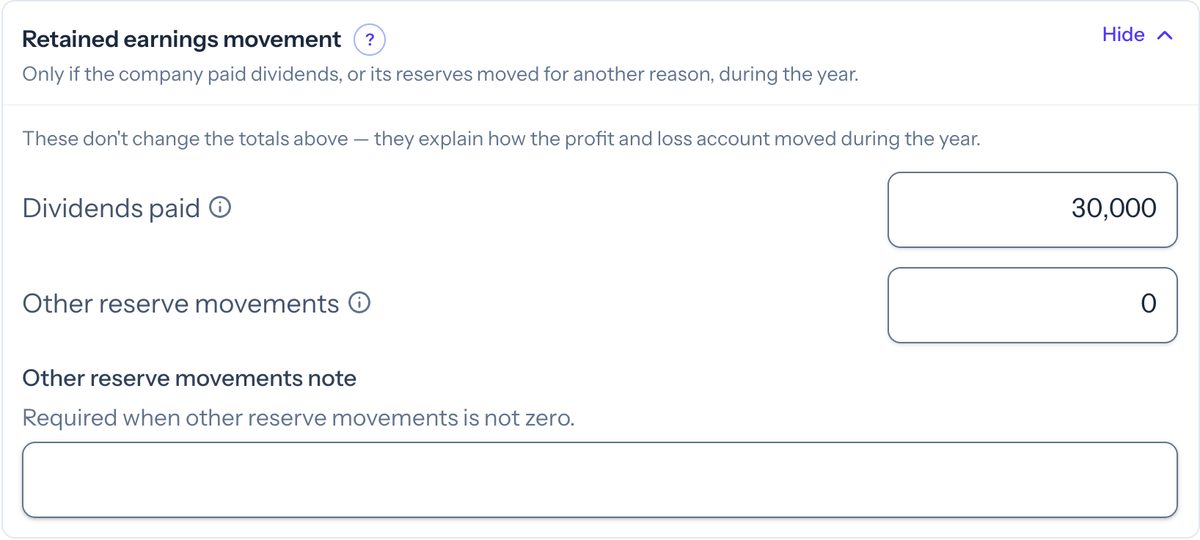 In Taxley: you enter dividends in Retained earnings movement, and the totals above don't change (demo company).
Step 3: Enter any other reserve movement, with its note
Leave "Other reserve movements" at 0 unless there was a genuine movement, such as a transfer to a capital redemption reserve. Its hint reads: "Use only for genuine reserve movements that are not profit after tax or dividends. Positive increases retained earnings, negative decreases it." If you enter anything other than zero, fill in "Other reserve movements note" with a short, factual description of what the movement was. If the note is missing, Taxley asks you to "Say what the other reserve movements are". Don't use this box for last year's unpaid tax or a balancing figure.
Step 4: In Simple, use the How retained earnings are worked out table
In Simple, Taxley works out retained earnings for you, marked "Worked out by Taxley". Open "How retained earnings are worked out", or use the "How it's worked out, and dividends" link under the Retained earnings line. The table shows "Retained earnings brought forward" (£36,300.00 in the demo) and "Profit for the year" after Corporation Tax (£41,970.00). Type dividends in "Less: dividends paid", any genuine movement in "Other reserve movements", and a description in "What the other reserve movements are" if that figure isn't zero.
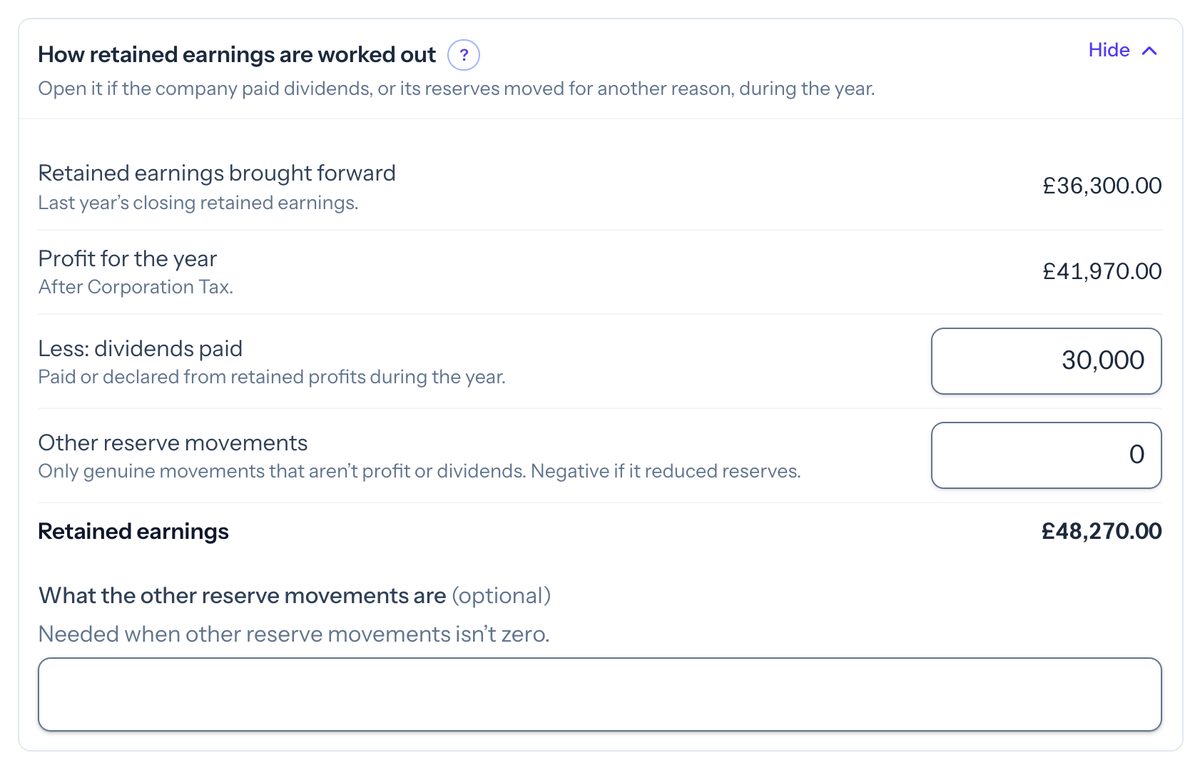 In Taxley: Simple view adds up brought forward, profit after tax and dividends to give closing retained earnings of £48,270.00 (demo company).
Step 5: Check the retained earnings total matches your accounts
The "Retained earnings" line at the bottom of the table should match the closing figure in your accounts: £48,270.00 in the demo. If you typed your own figure into the balance sheet, an amber box compares the two. In the demo the director typed £78,270.00, a figure that ignores the £30,000 of dividends: "Your balance sheet has your own retained earnings figure, £78,270.00. Worked out from the figures above it would be £48,270.00." Choose "Use the worked-out figure" only if your accounts agree with it. If they show a different number, find the cause first, using the checks in the next section.
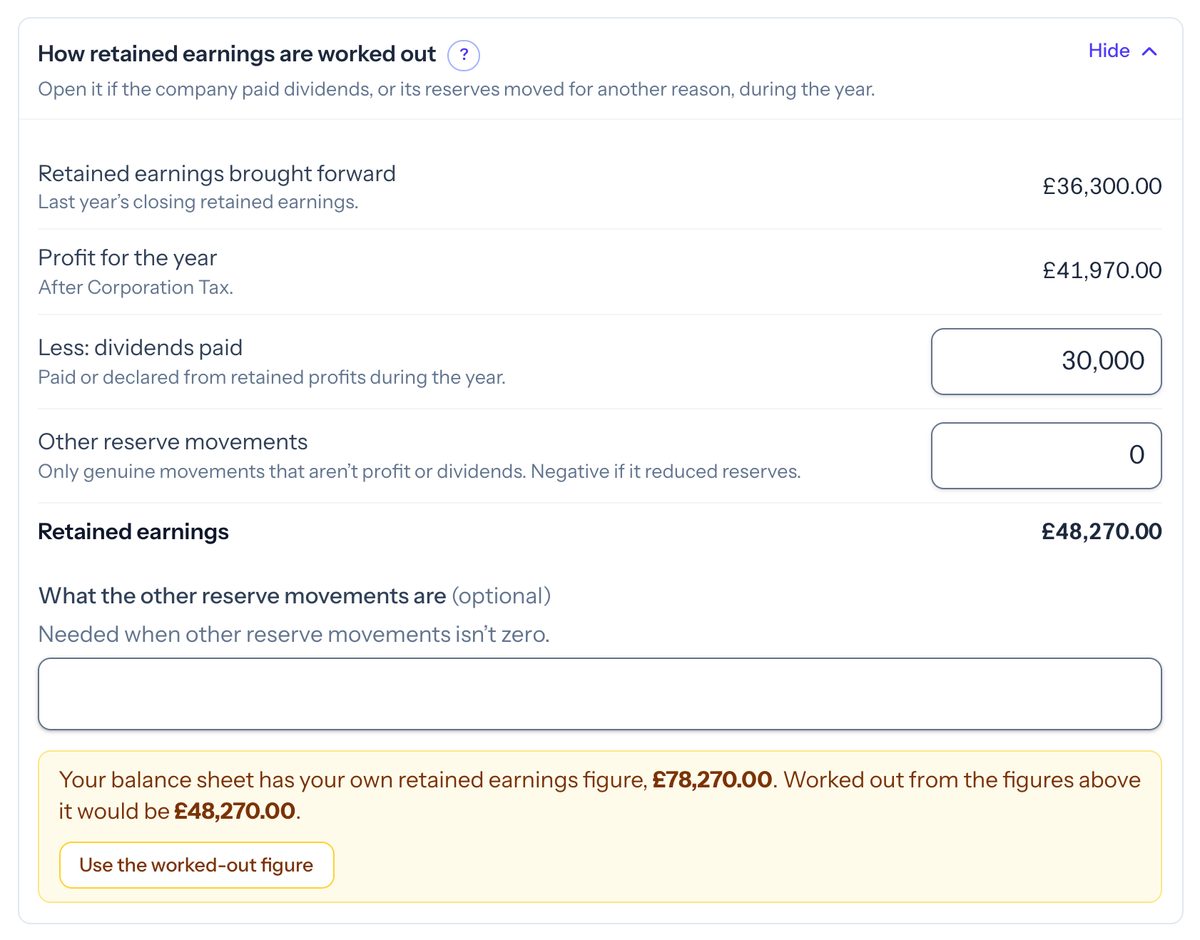 In Taxley: when your own retained earnings figure differs from the worked-out one, Simple view shows both and offers to use the worked-out figure (demo company).
Why doesn't my retained earnings figure match what Taxley expects?
Taxley expects closing retained earnings to equal last year's closing figure, plus profit after tax, minus dividends, plus other reserve movements. It first compares any difference with the Corporation Tax charge, then with common patterns such as missed dividends. Differences up to £1, or £5 when every figure is in whole pounds, are treated as rounding.
The check appears as a card in the Tax & review step, and "Show the workings" sets out every figure in the calculation. Each card or message points to a different cause:
| What you see | What it usually means | How to fix it |
|---|---|---|
| "Add the tax charge to your accounts" | This year's Corporation Tax isn't in creditors or retained earnings | Press "Apply adjustment to this draft", or enter your own tax figure |
| "Your retained earnings are the same as last year…" | The balance sheet wasn't updated, or dividends are missing | Enter dividends, or update the closing figure |
| "…of this year's profit isn't in retained earnings" | Dividends were probably paid but not entered | Enter them, but only if they were actually paid |
| "…the same amount with the opposite sign" | A deficit typed as a positive figure, or the reverse | Enter a deficit as a negative figure |
| "Your retained earnings are £… away from what the figures add up to" | Pence rounded differently, up to £10 | Check the pence; confirm the figures if they're right |
| "Record the £X rounding difference" | £1 or less out (£5 in whole pounds) | Press "Record as rounding difference" |
| "Explain the retained earnings difference" | None of the patterns above fits | Correct a figure, or confirm the reason |
| "Tax charge reconciled ✓" | Everything agrees | Pay the filing fee |
Corporation Tax not recorded. If Brightwater's closing retained earnings had been typed as £58,300 (before tax) with no tax in creditors, the difference would be exactly the £10,030 charge. The card says: "We'll add £10,030.00 to creditors due within one year and take it off retained earnings, then recalculate and refresh your documents automatically." "Undo adjustment" reverses it. If your own tax figure differs from Taxley's by more than rounding, the card becomes "Check the Corporation Tax in your balance sheet" and lists likely causes first.
Dividends missed. If the dividends box was never filled in and retained earnings fall short by no more than this year's profit after tax, Taxley suggests dividends. For the demo company, leaving out the £30,000 gives: "£30,000.00 of this year's profit isn't in retained earnings. If the company paid dividends of about £30,000.00, enter them only if they were actually paid."
Sign flipped. If this year's retained earnings are last year's figure with the opposite sign, Taxley asks you to "Check whether one of them is entered the wrong way round (a deficit is a negative figure)." Type accumulated losses with a minus sign.
Rounding. "Record as rounding difference" puts a difference of £1 or less (£5 in whole pounds) into other reserve movements with the note "Rounding difference in supplied figures". The button replaces any figure and note already in other reserve movements, so record a genuine movement only after using it. A difference of up to £10, once the tax is accounted for, gets a message asking you to "check the pence in your balance sheet and profit and loss".
Anything else. If no pattern fits, the card says: "Explain this movement in the balance-sheet form using dividends paid or other reserve movements. Other reserve movements need a short note." If the difference is dividends, enter them in Dividends paid instead of confirming. If a director took money that wasn't declared as a dividend, record it as a director's loan, because it may carry section 455 tax. Confirm a reason ("A prior-year adjustment", or "Something else…" with a note) only when it can't be entered as a figure. Until you correct or confirm it, the difference holds up paying and filing.
When the figures agree, register to prepare your return in Taxley and file the CT600 with its iXBRL accounts and computation.
Frequently asked questions
Should retained earnings brought forward equal last year's closing figure?
Yes, normally. This year's opening retained earnings are last year's closing figure from the filed accounts. Taxley warns when the two differ by £1 or more. They should differ only if last year's figures were restated, for example to correct a material error under FRS 102 paragraph 10.21.
Can retained earnings be negative?
Yes. A company whose losses and dividends have exceeded its profits has an accumulated deficit, entered in Taxley as a negative figure. A deficit usually means no profits are available for a dividend, because Companies Act 2006 section 830 allows distributions only out of accumulated realised profits less realised losses.
What if a director took money that wasn't declared as a dividend?
Don't enter it as a dividend after the event. GOV.UK says money taken out of a company that isn't salary or a dividend, beyond what the director put in, is a director's loan. It belongs in the director's loan account, and may affect the company's tax through form CT600A.
What happens if dividends were more than the available profits?
The dividend breaks Companies Act 2006 section 830. Under section 847, a shareholder who knew, or had reasonable grounds to believe, that it was unlawful must repay it to the company. Take care to correct this before filing, because it affects the accounts and possibly the director's loan account.
People also ask
Keep reading


Ready to file your Company Tax Return?
Confirm support for your accounting period, accounts and any supplementary pages before paying. Taxley support can answer software questions, not provide a tax opinion.
Questions about your period or accounts? Ask about software support