
How to pay a dividend from a limited company, step by step

Prerequisites at a glance
- Time
- About 1 hour
- Difficulty
- Beginner
- Tools you'll use
-
- The latest annual accounts or management accounts
- The company bank account
- Have ready
-
- The register of members (share register)
- The articles of association
- Each shareholder's name and bank details
In short: To pay a dividend, check the company has enough accumulated realised profits, have the directors decide an interim dividend or recommend a final one for shareholders to approve, and minute the decision (GOV.UK: Taking money out of a limited company). Then give each shareholder a voucher and pay by shareholding. In 2026/27, shareholders pay no tax on their first £500 of dividends.
Once the dividend is paid, record it with the retained earnings movement guide, or take the 30-second check to see whether Taxley fits your company.
Key facts (checked on 29 September 2026)
| Fact | Detail | Source |
|---|---|---|
| What a dividend can come from | Accumulated realised profits, less accumulated realised losses | CA 2006 s830 |
| Who approves it | Directors (interim); shareholders by ordinary resolution (final) | Model articles, art 30 |
| What a voucher must show | Date, company name, shareholders' names, amount | GOV.UK: Taking money out of a limited company |
| Dividend allowance, 2026/27 | £500 | GOV.UK: Tax on dividends |
| Dividend tax rates from 6 April 2026 | 10.75%, 35.75%, 39.35% (2025/26: 8.75%, 33.75%, 39.35%) | GOV.UK: Income Tax rates and allowances: current and past years |
| Unlawful dividend | Repayable if the shareholder knew or had reasonable grounds | CA 2006 s847 |
The steps at a glance:
- Check the company has enough distributable profits.
- Decide whether the dividend is interim or final.
- Hold a board meeting and minute the decision.
- Get shareholder approval for a final dividend.
- Issue a dividend voucher to each shareholder.
- Pay the dividend and record it in the books.
- Check the dividend in the year-end accounts and shareholders' 2026/27 tax.
Can a limited company pay a dividend if it made a loss?
Yes, if its profits available for distribution are still positive. Those are its accumulated realised profits from every year so far, less its accumulated realised losses (CA 2006 s830). For example, a company that lost £10,000 this year, after building up £48,270 of retained profits, can still pay up to £38,270.
| Illustration | Reserves at last year end | This year's result | Can it pay a dividend? |
|---|---|---|---|
| Company A | £48,270 of profits | £10,000 loss | Yes, up to £38,270 |
| Company B | £25,000 deficit | £20,000 profit | No: still £5,000 in deficit |
| Company C | £12,000 of profits | £12,000 loss | No: nothing left to distribute |
The test for a lawful dividend is the company's accumulated position, not one year's result and not its bank balance. GOV.UK puts it plainly: a company must not pay out more in dividends than its available profits from current and previous financial years (GOV.UK: Taking money out of a limited company). Section 830 of the Companies Act 2006 adds that profits count only if they are realised, and only so far as they haven't already been distributed or capitalised. HMRC's Company Taxation Manual notes that a gain from revaluing an asset is unrealised, so a revaluation reserve cannot fund a dividend (CTM15205). In the illustration, company B made £20,000 this year and may have the cash, but its reserves are still £5,000 in deficit, so it cannot lawfully pay until later profits clear that deficit. Company A made a loss, but its earlier profits still leave £38,270 available.
Directors measure the profits available for a dividend in the relevant accounts, which section 836 of the Companies Act 2006 says are normally the company's last annual accounts (CA 2006 s836). Under section 837, the last annual accounts count only once they have been sent to the shareholders. If they don't show enough profit, the company can rely on interim accounts instead, and a company in its first accounting period can use initial accounts. For a private company, interim accounts only need to enable a reasonable judgment of profits, losses, assets, liabilities, provisions, share capital and reserves, which well-kept management accounts can do (CA 2006 s838). Section 840 then adds every earlier dividend justified by the same accounts to the one proposed, so two £30,000 dividends against £48,270 of profits fail the second time. An accountant is worth paying to confirm the figure when the accounts include revaluations, the company has more than one share class, or the last accounts are not finished.
An unlawful dividend has to go back if the shareholder knew, or had reasonable grounds to believe, that it broke the Companies Act's distribution rules: section 847 makes that shareholder liable to repay it to the company (CA 2006 s847). An innocent shareholder doesn't have to repay. HMRC's manual, however, expects section 847 to apply in most private companies whose directors are also the shareholders, because they ought to know the position (CTM15205). The tax follows the company law. HMRC treats a knowingly unlawful dividend as held on trust for the company, so it is not the shareholder's dividend income. In a close company, HMRC treats it as a loan to the shareholder, charged to section 455 tax, with relief once it is repaid. The director's loan account guide shows how that balance is tracked.
Step 1: Check the company has enough distributable profits
Take the retained earnings from the company's last annual accounts, the set already sent to the shareholders, and take out anything unrealised, such as a revaluation gain (CA 2006 s830). Deduct any dividend already paid on the strength of the same accounts. For an interim dividend part-way through the year, read up-to-date management accounts too: HMRC's manual says directors must be satisfied that the company's financial position warrants the payment (CTM15205). In Taxley's worked example, Brightwater Design Ltd, a fictional company whose two directors each own 50 of its 100 ordinary shares, has £48,270 available and plans a £30,000 dividend in November 2026.
| Line | Amount | Where it comes from |
|---|---|---|
| Retained earnings at 31 March 2026 | £48,270 | Last annual accounts, sent to shareholders |
| Less unrealised profits, such as revaluations | £0 | None in these accounts |
| Less dividends already paid on these accounts | £0 | Board minutes since 31 March 2026 |
| Profits available for distribution | £48,270 | CA 2006 s830 and s840 |
| Proposed interim dividend | (£30,000) | £300 on each of 100 shares |
| Available profits left afterwards | £18,270 | Must not fall below £0 |
| Profit after tax, 1 April to 31 October 2026 | £21,400 | Management accounts: no losses since |
Step 2: Decide whether the dividend is interim or final
Choose the type first, because it decides who approves the dividend and when it counts. Under the model articles for private companies, the directors may decide to pay interim dividends, while shareholders declare final dividends by ordinary resolution, never above the amount the directors recommend (model articles, art 30). Read your own articles, because they can say something different. An interim dividend can be varied or cancelled until it is paid, and the shareholder is taxed when it is paid. A final dividend is taxed when it becomes due and payable (SAIM5040). Brightwater's directors choose an interim dividend, paid mid-year.
| Point | Interim dividend | Final dividend |
|---|---|---|
| Who decides | The directors | Shareholders, by ordinary resolution |
| Upper limit | Profits available for distribution | Directors' recommendation, within available profits |
| Can it be cancelled? | Yes, until it is paid | No: declaring it creates a debt |
| When the shareholder is taxed | When it is paid | When it is due and payable |
| When the accounts show it | When it is paid | When it is declared |
Step 3: Hold a board meeting and minute the decision
Hold a directors' meeting to declare the dividend and keep minutes of it: GOV.UK says you must, even if you're the only director (GOV.UK: Taking money out of a limited company). The minutes should record which accounts the directors relied on, the profits available, the amount per share, the payment date and the date for identifying shareholders on the register of members. For a final dividend, the directors minute a recommendation instead of a decision to pay. Keep minutes of directors' meetings for at least 10 years (CA 2006 s248). The template below follows Brightwater's meeting on Tuesday 10 November 2026; replace everything in square brackets with your own details.
MINUTES OF A MEETING OF THE DIRECTORS OF [COMPANY NAME] LIMITED
Company number: [number]
Held at [place, or by video call] on [date] at [time]
Present: [names of the directors]

1. Accounts. The directors reviewed the [last annual accounts to
   (date), sent to the shareholders on (date)] and management
   accounts to [date].
2. Profits. The directors noted profits available for distribution
   of £[amount], after any dividends already paid on those accounts,
   and were satisfied that the company's financial position
   warrants the payment.
3. Dividend. It was resolved that the company pay an interim
   dividend of £[amount] per [ordinary] share, £[total] in all, on
   [payment date] to shareholders on the register of members at
   [record date].
   [Final dividend: It was resolved to recommend a final dividend of
   £[amount] per share for approval by ordinary resolution.]
4. Vouchers. It was resolved to issue a dividend voucher to each
   shareholder.

Signed: ______________________ [name], Chair    Date: [date]
Step 4: Get shareholder approval for a final dividend
Skip this step for an interim dividend. For a final dividend, the shareholders pass an ordinary resolution declaring no more than the directors recommended. Under section 281 of the Companies Act 2006, a private company can pass it at a general meeting or as a written resolution. A written ordinary resolution passes once members holding a simple majority of the total voting rights have agreed (CA 2006 s282). Unless the articles set another period, it lapses if not passed by the end of 28 days beginning with the circulation date (CA 2006 s297). Section 355 requires the company to keep a copy of every written resolution for at least 10 years. Use this template for the written route.
WRITTEN RESOLUTION OF [COMPANY NAME] LIMITED
Company number: [number]
Circulation date: [date]

The directors propose the following ordinary resolution as a written
resolution under Chapter 2 of Part 13 of the Companies Act 2006.

ORDINARY RESOLUTION
THAT a final dividend of £[amount] per [ordinary] share, as
recommended by the directors, be declared for the year ended [date],
payable on [payment date] to shareholders on the register of members
at [record date].

To agree, sign and date below and return this document to the
company. Agreement cannot be revoked once given. This resolution
lapses if it is not passed by [date: the end of 28 days beginning
with the circulation date, or the period in the articles].

I, the undersigned, entitled to vote on this resolution on the
circulation date, agree to it.

Signed: ______________________ [shareholder name]    Date: [date]
Step 5: Issue a dividend voucher to each shareholder
Write up a dividend voucher for each shareholder for every dividend payment. GOV.UK says it must show the date, the company name, the names of the shareholders being paid and the amount of the dividend. Give a copy to each recipient and keep a copy for the company's records (GOV.UK: Taking money out of a limited company). The other lines in this template are common practice rather than a GOV.UK requirement, but they help each shareholder fill in a tax return. Brightwater issues two vouchers, each for £15,000: 50 shares at £300 a share. Prepare the vouchers when the dividend is paid, not months later at the year end.
DIVIDEND VOUCHER                                       No. [number]

* Company name:       [COMPANY NAME] LIMITED
  Company number:     [number]
  Registered office:  [address]

* Date:               [payment date]
* Shareholder:        [full name]
  Address:            [shareholder's address]
  Shares held:        [50] [ordinary £1] shares at [record date]
  Dividend:           [Interim / Final] dividend, year ending [date]
  Rate:               £[amount] per share
* Amount paid:        £[amount]

Signed for the company: ______________________ [name], Director

* The four items GOV.UK says a dividend voucher must show.
Step 6: Pay the dividend and record it in the books
Pay each shareholder on the payment date, in line with their rights and by reference to the shares they held on the date of the decision, unless the minute sets another record date. Every share of the same class then gets the same amount (model articles, art 30). The model articles allow payment by transfer to a bank account the shareholder names (art 31). In the books, charge the dividend to retained earnings, not to expenses, because dividends are not a business cost for Corporation Tax: see are dividends a Corporation Tax expense? Brightwater pays £15,000 to each director on Friday 13 November 2026.
| Entry on 13 November 2026 | Debit | Credit |
|---|---|---|
| Dividends paid (retained earnings, not expenses) | £30,000 | |
| Bank: director A, 50 shares at £300 | £15,000 | |
| Bank: director B, 50 shares at £300 | £15,000 |
Step 7: Check the dividend in the year-end accounts and the shareholders' 2026/27 tax
Check that the accounts for the year containing the dividend show it in the retained earnings movement: closing retained earnings equal the opening figure, plus profit after tax, minus dividends paid. Success looks like Brightwater's accounts to 31 March 2027 showing dividends paid of £30,000, with no retained earnings difference left to explain (retained earnings movement guide). Then check each shareholder's tax. In 2026/27 the dividend allowance is £500 and dividends above it are taxed at 10.75%, 35.75% or 39.35% (GOV.UK: Tax on dividends); more than £10,000 of dividends means a Self Assessment return (GOV.UK: How to report tax on dividends). The salary or dividends guide compares the two ways to pay yourself.
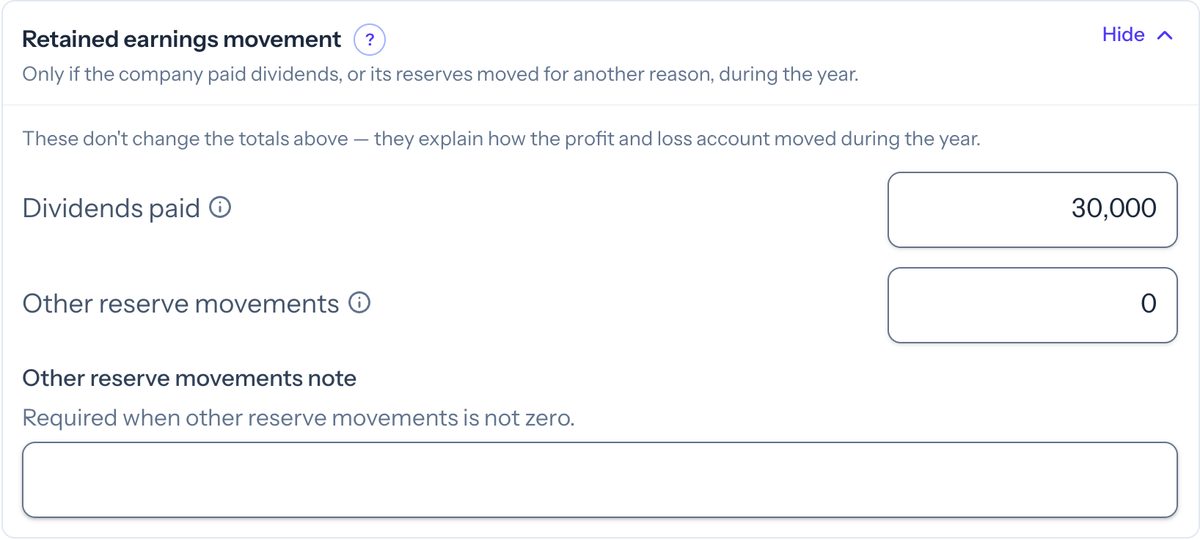 In Taxley: dividends paid go in Retained earnings movement, not in expenses (demo company).
| Each director, 2026/27 | Amount | Rule |
|---|---|---|
| Salary | £12,570 | Covered by the Personal Allowance |
| Other income | None | Assumed, with the standard Personal Allowance |
| Dividend received on 13 November 2026 | £15,000 | Paid in the 2026/27 tax year |
| Total income | £27,570 | Below the £50,270 basic rate limit |
| Covered by the dividend allowance | £500 | No tax (GOV.UK: Tax on dividends) |
| Taxed at the dividend basic rate | £14,500 | 10.75% |
| Dividend tax | £1,558.75 | Due 31 January 2028 (Self Assessment) |
| Payments on account for 2027/28 | Half of £1,558.75, twice | Due 31 January and 31 July 2028 (GOV.UK: Self Assessment payments on account) |
What are the most common mistakes when paying a dividend?
The most common mistake is taking money with no minutes or voucher. GOV.UK treats money a director takes that isn't salary, a dividend or an expense repayment as a director's loan (GOV.UK: Director's loans: Overview). If it is still owed 9 months after the year end, the company owes section 455 tax at 35.75% on loans made from 6 April 2026 (CTM61505).
Dividend paperwork written months after the money left the company causes a timing problem. HMRC's manual says an interim dividend is paid only when the money is placed unreservedly at the shareholder's disposal, for example when it is credited to their current account with the company in the books. If those entries are made only after the year end, the dividend falls into the later accounting period (CTM15205). A director who drew £2,000 a month and calls it a dividend at the year end may therefore have an overdrawn loan account at that year end. The balance goes on form CT600A, part of the Company Tax Return (CT600), and is taxed under section 455 if it isn't repaid within 9 months of the year end (GOV.UK: Director's loans: If you owe your company money). Make the decision, minute it and issue the vouchers before or when the money leaves the company. The director's loan account guide shows how to work out who owes whom.
Paying shareholders unequally is another common dividend mistake. GOV.UK says you must usually pay dividends to all shareholders (GOV.UK: Taking money out of a limited company), and the model articles require every dividend to follow shareholders' respective rights. Two people with 50 ordinary shares each therefore get the same amount. Different amounts need share classes with their own dividend rights, or a formal waiver made before the dividend is paid: HMRC's Company Taxation Manual (CTM15205) says a shareholder cannot waive a dividend after payment. HMRC may challenge a waiver under the settlements rules. It looks especially at cases where the profits could not pay the same rate on every share, or where the shareholder who benefits, such as a spouse, pays less tax (TSEM4225). Get advice before using either route.
What does Taxley do when a company pays a dividend?
Taxley (taxley.co.uk), UK online software that prepares and files the Company Tax Return (CT600) with HMRC and the annual accounts with Companies House, records a dividend in one box: Dividends paid, in the Retained earnings movement. Brightwater's £30,000 goes in as 30,000. Taxley doesn't pay dividends, write minutes or vouchers, or keep the register of members.
Taxley keeps dividends out of the expenses, because GOV.UK says dividends cannot count as business costs when working out Corporation Tax (GOV.UK: Taking money out of a limited company), and checks them against the rest of the accounts before the return can be paid for and filed. It expects closing retained earnings to equal last year's closing figure, plus profit after tax, minus dividends, plus any other reserve movement. If about £30,000 of profit is missing from retained earnings and the dividends box is empty, it says: "£30,000.00 of this year's profit isn't in retained earnings. If the company paid dividends of about £30,000.00, enter them only if they were actually paid." A balance sheet that doesn't balance, or a retained earnings difference that hasn't been corrected or explained, stops the return being paid for and filed. Taxley doesn't test whether a dividend was lawful under section 830, so the profits check in Step 1 stays with the directors.
Once the retained earnings and the balance sheet agree, Taxley files the CT600 with its iXBRL accounts and computation to HMRC. It then files micro-entity, small, abridged or dormant accounts at Companies House at no extra cost, once the return is paid and the accounts are finished, as it has since 28 September 2026. Take the 30-second check to see whether Taxley fits your company.
Frequently asked questions
Does a sole director still need board minutes for a dividend?
Yes. GOV.UK says you must keep minutes of the meeting that declares the dividend even if you're the only director (GOV.UK: Taking money out of a limited company). Keep them with copies of the vouchers for at least 10 years, the period the Companies Act sets for minutes of directors' meetings (CA 2006 s248).
Do dividend minutes or vouchers go to Companies House?
No. They stay in the company's own records. Only resolutions listed in section 29 of the Companies Act 2006, such as special resolutions, must be sent to Companies House within 15 days (CA 2006 s30). An ordinary resolution declaring a dividend is not one of them.
When is a dividend taxed: when it's declared or when it's paid?
It depends on the type. An interim dividend is taxed when it is paid, because the directors can change or cancel it until then. A final dividend is taxed when it becomes due and payable: the date set in the resolution or, if none is set, the date it is declared (SAIM5040).
Can a dividend be cancelled after the directors decide it?
An interim dividend can be varied or cancelled at a later board meeting at any time before it is paid. A declared final dividend cannot, because it creates a debt owed to the shareholders. Once any dividend has been paid, a shareholder can no longer waive it (CTM15205).
How often can a company pay dividends?
As often as the directors or shareholders decide, provided each dividend passes the profits test. Company law sets no fixed number, but section 840 counts every earlier dividend justified by the same accounts, so frequent dividends need a running total (CA 2006 s840).
Does the company pay tax on a dividend it pays out?
No. GOV.UK says the company does not need to pay tax on dividend payments, and it cannot deduct them from its profits either (GOV.UK: Taking money out of a limited company). The shareholders may pay Income Tax on dividends above their £500 dividend allowance.
General information, not personalised tax or accounting advice.
Update history
- Companies House filing live since 28 September 2026; limits clarified
Spotted something out of date? See how we handle corrections.
People also ask
Keep reading


Ready to file your Company Tax Return?
Confirm support for your accounting period, accounts and any supplementary pages before paying. Taxley support can answer software questions, not provide a tax opinion.
Questions about your period or accounts? Ask about software support