
How to claim capital allowances for a limited company in 2026

Prerequisites at a glance
- Time
- About 15 min
- Difficulty
- Intermediate
- Tools you'll use
-
- Taxley's return editor (Simple or Advanced view)
- Have ready
-
- Invoices for equipment bought in the year
- Last year's tax computation with pool balances
- Records of assets sold or scrapped
- The depreciation figure in your accounts
In short: A limited company claims capital allowances in its Company Tax Return instead of deducting depreciation. The annual investment allowance gives 100% relief on most plant, machinery and vans, up to £1,000,000 a year. Cars, and spending the AIA doesn't cover, go into pools, and the main-pool rate fell from 18% to 14% on 1 April 2026 (GOV.UK: Work out your writing down allowances: Rates and pools).
This guide explains the allowances and balancing charges first, then shows what to type in Taxley's "Capital allowances" and "Balancing charges" boxes. For the records to keep behind a claim, see company equipment: expense or capital allowance? If you haven't started a return yet, take the 30-second check to see whether Taxley fits your company.
What are capital allowances, and why isn't depreciation deductible?
Capital allowances are the tax relief a company gets for things it buys to keep and use in the business, such as equipment, machinery and vans. They replace depreciation in the tax computation. Depreciation is an accounting estimate that tax doesn't allow, so the computation adds it back to profit and deducts capital allowances instead.
GOV.UK is direct on the first half of that rule: "Capital expenses cannot be deducted for Corporation Tax purposes. However, the company may be able to claim capital allowances" (GOV.UK company expenses). HMRC's toolkit adds that depreciation of capital items "is generally not an allowable expense for tax purposes", and should be added back "even where capital allowances have not been claimed" (HMRC capital v revenue toolkit). The exception is the corporate intangible assets regime, where amortisation can be deductible.
Plant and machinery covers items the company keeps for use in the business, including cars, integral features of a building and some fixtures. Land, buildings and structures such as roads don't qualify as plant, and neither do items the company leases rather than owns, unless it has a hire purchase contract or a long funding lease (GOV.UK what you can claim on). A company must include a separate capital allowances calculation with its return (GOV.UK how to claim).
Timing matters. The annual investment allowance (AIA) and first-year allowances can only be claimed in the accounting period the item was bought. GOV.UK treats an item as bought when the contract is signed if payment is due within 4 months, or on the date payment is due, if that is more than 4 months later. Under hire purchase, the claim starts when the company starts using the item.
Which capital allowances can a small company claim in 2026?
A small company can claim five main allowances in 2026: the annual investment allowance of up to £1,000,000 a year, full expensing on new main-rate plant, a 50% first-year allowance on new special-rate plant, writing-down allowances on its pools, and the structures and buildings allowance. Each cost gets one allowance, so pick the best fit.
| Allowance | Relief | What it covers | Dates |
|---|---|---|---|
| Annual investment allowance (AIA) | 100%, up to £1,000,000 a year | Most plant, machinery and vans, new or used; not cars | £1,000,000 in CAA 2001 s.51A, with no end date |
| Full expensing | 100% | New, unused main-rate plant bought by a company; not cars | Bought from 1 April 2023 |
| 50% first-year allowance | 50%; the rest joins the special rate pool next period | New, unused special-rate plant; not cars | Bought from 1 April 2023 |
| 40% first-year allowance | 40%; writing-down allowances on the other 60% next period | New, unused main-rate plant, including most plant leased to UK businesses; not cars | Bought on or after 1 January 2026 |
| Main pool writing-down allowance | 14% a year of the pool | Other main-rate items, including cars up to 50 g/km | 14% from 1 April 2026; 18% before |
| Special rate pool writing-down allowance | 6% a year of the pool | Integral features, long-life assets, solar panels, thermal insulation, cars over 50 g/km | Unchanged |
| Small pools allowance | The whole pool | A main or special rate pool of £1,000 or less | Unchanged |
| Zero-emission car allowance | 100% | New, unused electric or 0 g/km cars | Spending up to 31 March 2027 |
| Structures and buildings allowance (SBA) | 3% a year | Non-residential buildings and structures, not land | 3% from 1 April 2020 |
Figures checked on 24 September 2026 against GOV.UK's capital allowances guide, the Capital Allowances Act 2001 and the Finance Act 2026.
The AIA does the work for most small companies. GOV.UK says simply: "The AIA amount is £1 million." It covers second-hand items too; the exclusions are business cars, items the business owned before using them, and gifts (GOV.UK AIA). The limit is pro-rated for a period that isn't 12 months: a 9-month period gets 9/12 × £1,000,000 = £750,000. Companies in the same group share one AIA. Companies that are only controlled by the same person share one only if they work from the same premises or do mainly the same kind of business (CAA 2001 s.51E); they then choose how to split it.
Full expensing gives the same 100%, but only for companies and only on new, unused items. It can't be used on cars, gifts, plant bought to lease out (except background plant in a let building) or items bought in the period the business stops (GOV.UK full expensing check). Below £1,000,000 of spending, the practical difference is on a sale: the whole sale price of a full-expensed asset becomes a balancing charge, even when the pool has a balance.
The main pool rate is 14% for accounting periods starting on or after 1 April 2026. Finance Act 2026 section 28 replaced 18% with 14% in CAA 2001 section 56. A period that straddles 1 April 2026 uses a hybrid rate, rounded up to 2 decimal places; HMRC's example for 1 January to 31 December 2026 is 14.99% (GOV.UK hybrid rate). A year ending 31 March 2026 still uses 18%. GOV.UK's worked example: an opening pool of £9,000, plus a £1,200 machine, less a £200 desk sale, gives £10,000, so the allowance is £1,400 at 14% and £8,600 carries forward (GOV.UK work out what you can claim).
The 40% first-year allowance is new, from 1 January 2026. Finance Act 2026 section 29 added it for new, unused main-rate plant, and unlike full expensing it also covers most plant leased to UK businesses (GOV.UK 40% first-year allowance). For a company buying equipment for its own use, full expensing or the AIA gives 100% on the same items.
Smaller pools and buildings have their own rules. If a main or special rate pool is £1,000 or less before the allowance is worked out, the company can claim the whole balance (the £1,000 is reduced for a period shorter than 12 months, for example £750 for 9 months). The SBA gives 3% a year for 33⅓ years on non-residential buildings where every construction contract was signed on or after 29 October 2018, and the company needs an allowance statement (GOV.UK SBA).
How do capital allowances work for company cars?
Cars never get the AIA, full expensing or the 40% first-year allowance. A company claims on a car through writing-down allowances at a rate set by its CO2 emissions, unless the car is new and zero-emission, when a 100% first-year allowance applies. Vans, lorries and trucks are not cars, so they can get the AIA.
A double-cab pick-up bought from 1 April 2025 counts as a car for Corporation Tax, so it gets writing-down allowances instead (HMRC CA23510).
| Car bought from April 2021 | Allowance | Rate each year |
|---|---|---|
| New and unused, 0 g/km or electric | 100% first-year allowance | 100% in the first year |
| Second-hand electric | Main rate pool | 14% (18% before April 2026) |
| New or used, 50 g/km or less | Main rate pool | 14% (18% before April 2026) |
| New or used, over 50 g/km | Special rate pool | 6% |
Source: GOV.UK business cars, checked 24 September 2026.
Private use by a director doesn't reduce the company's claim. GOV.UK says that if a business provides a car for an employee or director, it can claim capital allowances on the full cost. The director may instead be taxed on a company car benefit, and the company may need to tell HMRC about it. The private-use restriction applies to sole traders and partnerships, not companies.
The zero-emission car allowance now runs to 31 March 2027, but HMRC's form guidance doesn't match yet. Finance Act 2026 section 30 extended the 100% allowance to company spending up to 31 March 2027 (legislation.gov.uk, CAA 2001 s.45D), and GOV.UK's first-year allowances page agrees. On 24 September 2026, HMRC's Company Tax Return guide still said the allowance isn't available from 1 April 2026 and that box 726 is not in use for accounting periods beginning on or after that date. If the company buys a new electric car in such a period, check the legislation carefully to show the claim until HMRC updates its guide.
What is a balancing charge, and when does a company pay one?
A balancing charge is an amount added to taxable profit when the company sells, scraps or gives away an asset it has claimed allowances on, and the disposal value is more than what's left in the pool. It takes back relief the company didn't need. The disposal value is usually the sale price, capped at the original cost.
GOV.UK sets out the steps (GOV.UK selling an asset). Take the disposal value off the pool the item was in. If the item was claimed in full through the AIA or a first-year allowance and that pool is empty, the whole value is a balancing charge. If the pool has a balance, the value reduces it, and only any excess is a charge. A gift uses market value, and "You can only deduct the original cost of the item even if you sell it for more". Any profit above cost may be a chargeable gain instead.
Full-expensed assets are different. If the company claimed full expensing on the whole cost, "the balancing charge is the same amount as the disposal value", and that value must not also come off the pool. For the 50% first-year allowance on the whole cost, half the disposal value is a charge and half comes off the special rate pool (GOV.UK disposals after full expensing).
A balancing allowance, the opposite of a charge, only arises on the main and special rate pools when the business closes; a single-asset pool can give one when the asset is sold. A charge can arise in any year. The Capital Allowances Act 2001 puts it in one line: if disposal receipts exceed the pool, "the person is liable to a balancing charge" (s.55).
Worked example (illustrative figures). A company bought new camera kit for £1,600 in its year to 31 March 2024 and claimed it all through the AIA, leaving its main pool at £0. The accounts depreciated the kit to a carrying amount of £400. In the year to 31 March 2026 it sold the kit for £500.
| Line | Accounts | Tax computation |
|---|---|---|
| Profit on disposal (£500 − £400) | £100 profit | Removed: not taxable |
| Disposal value against a £0 main pool | Not shown | £500 balancing charge |
| Effect on taxable profit | Not applicable | £400 more than the accounts profit |
The £100 profit in the accounts isn't taxed as such: HMRC's toolkit says "any profit or loss on disposal should be deducted or added back in the computation". The £500 charge replaces it. If the company had £3,000 left in its main pool from other equipment, the £500 would come off the pool instead, leaving £2,500 for writing-down allowances and no charge. Had the kit been full-expensed, the whole £500 would be a charge regardless of the pool.
Where do capital allowances go on the CT600?
Capital allowances go in the CT600's capital allowances section: boxes 688 to 730 for a trade, and boxes 733 to 755 for allowances outside trading profits, such as a property business. The AIA goes in box 690, full expensing in box 688, and main-pool allowances in box 705, which includes any AIA. Each balancing charge has a matching box.
| Box | What goes in it |
|---|---|
| 688 and 689 | Full expensing claimed; balancing charges on full-expensed assets |
| 690 | Annual investment allowance |
| 693 and 694 | 50% special-rate first-year allowance; its balancing charges |
| 695 and 700 | Special rate pool allowances, including AIA on that pool; its balancing charges |
| 705 and 710 | Main pool allowances, including any AIA; main pool balancing charges |
| 711 | Structures and buildings allowance |
| 725 and 730 | Other allowances; other balancing charges |
| 726 and 727 | Zero-emission cars; not in use for periods starting from 1 April 2026 and 1 April 2025 |
Source: HMRC's Company Tax Return guide, checked 24 September 2026.
Taxley fills these boxes from your figures. When you type the AIA yourself, Taxley files it in box 690 and adds it to the main pool total in box 705, even AIA on special-rate items such as integral features, which HMRC's guide puts in box 695; the tax is the same, but use the calculator if that applies to you. A balancing charge you type yourself is filed as one figure in box 730; the calculator files each charge in its own box, such as 689 or 710, and the tax is the same either way. Our CT600 box-by-box reference covers the rest of the form.
How much tax does a £2,400 AIA claim save a small company?
At the 19% small profits rate, a £2,400 AIA claim saves £456 of Corporation Tax, because it takes £2,400 off taxable profit in the year of purchase. In Taxley's demo company, Brightwater Studio Ltd, the claim brings taxable profit to £20,800 and the tax to £3,952.00 for the year to 31 March 2026.
Brightwater Studio Ltd is fictional: a trading company with no associated companies that bought a £2,400 laptop and desk during the year and charged £600 of depreciation on them in its accounts.
| Line | Brightwater Studio Ltd, year to 31 March 2026 |
|---|---|
| Profit before tax, from the accounts | £30,000 |
| Add back: depreciation | £600 |
| Add back: disallowable expenses (client entertaining) | £600 |
| Less: annual investment allowance (laptop and desk) | (£2,400) |
| Trading profit (box 155) | £28,800 |
| Less: trading losses brought forward | (£8,000) |
| Taxable total profits (box 315) | £20,800 |
| Corporation Tax at 19% | £3,952.00 |
Profits of £50,000 or less pay the 19% small profits rate (GOV.UK Corporation Tax rates), so £20,800 × 19% = £3,952.00. Without the AIA, taxable profit would be £23,200 and the tax £4,408.00: the claim saves £456, which is 19% of £2,400. The accounts spread the cost at £600 a year, while the AIA gives all of it in the first year. In later years the depreciation on these items is still added back, but no allowance is left to claim on them.
The £600 of disallowable expenses and the £8,000 of losses are explained in our guides to Corporation Tax adjustments in Simple mode and trading losses brought forward.
How do you enter capital allowances in Taxley, step by step?
In Simple, type the AIA in the "Capital allowances" box and any balancing charge in "Balancing charges". For pools, cars, full expensing or buildings, use Advanced: either let Taxley's calculator work the allowances out from what the company bought and sold, or type your own figures under Tax adjustments. Then check the working before you file.
Step 1: Enter the annual investment allowance in Simple
In Simple's "Corporation Tax" section, find "Capital allowances" below the add-backs. Its summary reads "Only if the company bought equipment, vans, machinery or fittings." Choose Show. In "Annual investment allowance (AIA)", type the total cost of qualifying items bought in the period, not cars. The hint reads "100% of what you spent on plant and machinery, vans and fittings (not cars), up to £1,000,000 a year." Leave out VAT the company can reclaim. The demo company enters 2,400, and the tax table below shows "Less: annual investment allowance". The ? beside the title opens this guide in a new tab.
Step 2: Enter any balancing charge in Simple
Open "Balancing charges", whose summary reads "Only if the company sold or scrapped equipment it had claimed allowances on." The hint says a charge is "Added to the taxable profit when an asset is sold for more than its tax written-down value." Type the charge worked out as in the camera kit example, such as 500, or leave it at 0. The tax table then shows "Add: balancing charges". If the accounts show a profit or loss on selling the asset, finish the return in Advanced, which has a line for it.
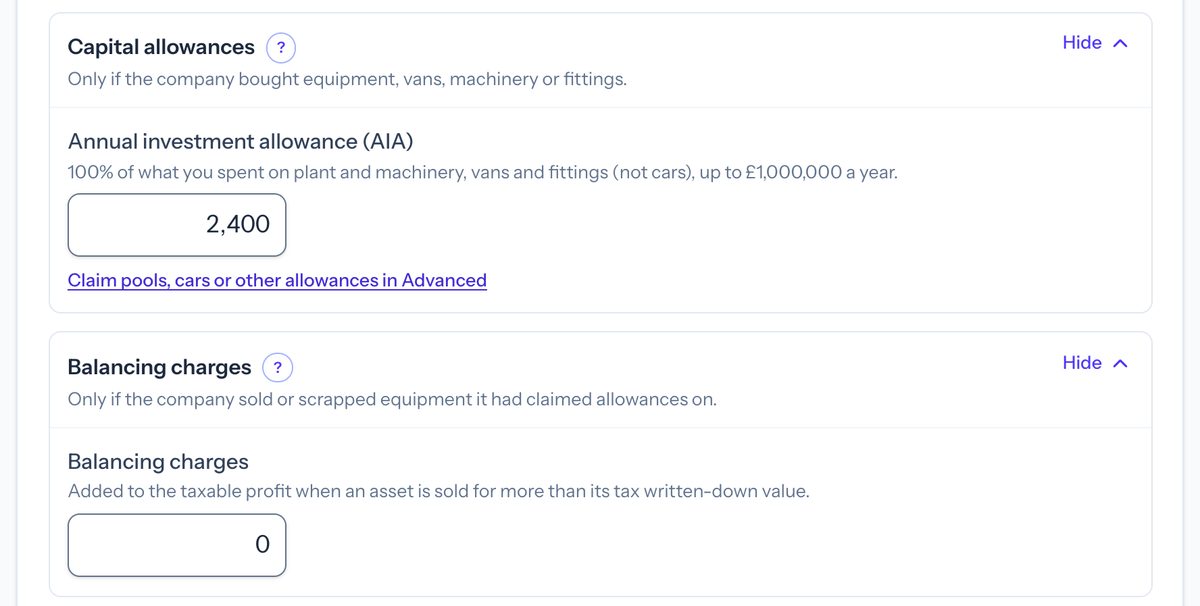 In Taxley: Simple view takes the AIA and any balancing charge as two single figures, here £2,400 and £0 (demo company).
Step 3: For pools or cars, choose how to do capital allowances in Advanced
Select "Claim pools, cars or other allowances in Advanced". In Advanced, the "Capital allowances" section, headed "Tax relief on what the company bought for the business — instead of depreciation.", asks "How do you want to do capital allowances?". Choose "Let Taxley work them out from what the company bought and sold", which suits most companies, or "I'll enter the figures myself (e.g. from my accountant) under Tax adjustments below." A new return starts with the second option, unless Taxley worked out last year's allowances. Once the calculator is on, Simple isn't available for that return.
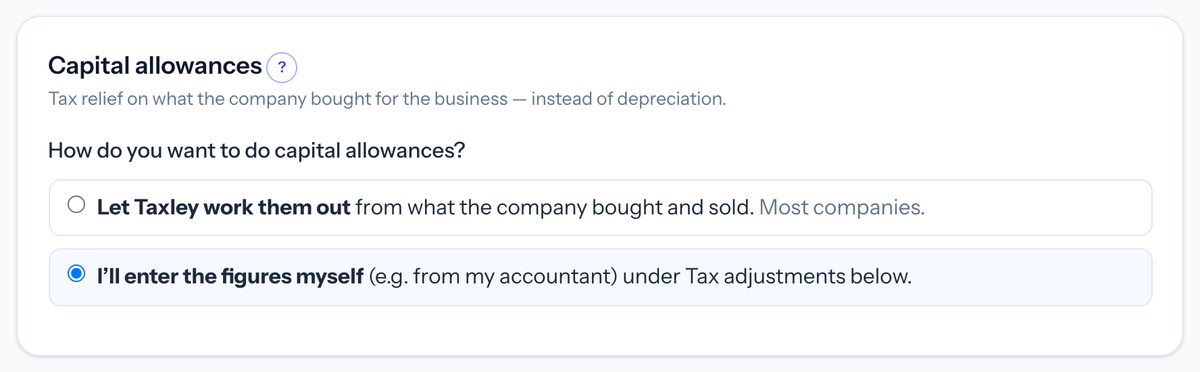 In Taxley: Advanced asks whether Taxley works out the allowances or you enter your own figures (demo company).
Step 4: If Taxley works them out, list balances, purchases and sales
Under "Starting balances", enter the "Main pool £" and "Special rate pool £" carried forward on last year's tax computation, or 0 for a new company. If Taxley worked out last year's allowances, the balances come from that return; otherwise type them from last year's tax computation. Choose "+ Add something the company bought" for each item, with its date, cost "(without VAT you can reclaim, less any grant)", type and whether it was new or used; a car also needs its CO2 g/km. Record sales with "+ Add something sold, scrapped, lost or given away", and buildings with "+ Add a building".
Step 5: If you enter the figures yourself, use Tax adjustments
Open "Tax adjustments (optional)". Under "Deduct", type each allowance once: "Annual investment allowance (AIA)", "Full expensing", "Capital allowances — main pool", "Capital allowances — special rate", "Structures and buildings allowance" and the rest. The AIA hint warns "don't also include it in the main pool", so the main pool box holds the writing-down allowance only. Type balancing charges under "Add back", in "Balancing charges". Whatever capital allowances computation you're using should give every figure, and the pools it carries forward. A return covering more than 12 months shows one column for each accounting period: put each allowance in its own period's column.
Step 6: Check the working and the pools carried forward
With the calculator, read "What Taxley works out": each allowance, any balancing charges, "Total deducted" and the main and special rate pools "Carried forward". Open "See the full working" to see every line, and read any message about items not claimed. The carried-forward pools become next year's starting balances, so compare them with your records. In Simple, check "Profits chargeable to Corporation Tax" in the tax table. For the demo company, taxable profit is £20,800 and the tax £3,952.00.
What doesn't Taxley's capital allowances calculator cover?
Taxley's calculator covers most small-company claims: the AIA, the main and special rate pools, full expensing, the 50% special-rate allowance, the zero-emission car allowance and the structures and buildings allowance. It doesn't cover leasing, freeports or the VAT capital goods scheme, and it doesn't claim the 40% first-year allowance. For those, work out and enter your own figures.
The calculator also stops, and says why, in cases it can't work out safely. The calculator only works out accounting periods starting on or after 1 April 2023; Taxley still files older returns, back to periods that started on 1 April 2020, with the allowances entered yourself. Assets used by both a trade and a property business aren't calculated automatically, and nor are items bought from a director, shareholder, their family or a related company. For a sold asset claimed under the super-deduction, or where you don't know how it was claimed, it says: "Taxley can't work this one out — enter the figures yourself." Land is rejected outright ("Land never qualifies for capital allowances"), and items for use in a let house or flat are refused under CAA 2001 section 35.
In any of these cases, choose "I'll enter the figures myself" and type the figures from your own computation. When the figures are ready, register to prepare your return in Taxley and file the CT600 with its iXBRL accounts and computation.
Frequently asked questions
Can a company claim the AIA on a second-hand van?
Yes, unless it is a double-cab pick-up bought from 1 April 2025, which counts as a car. A van isn't a car, and GOV.UK's AIA exclusions are cars, items the business owned before using them, and gifts. Second-hand plant qualifies for the AIA, although full expensing and the 50% and 40% first-year allowances need items to be new and unused.
Can two companies with the same owner each claim £1,000,000 of AIA?
Not always. Companies in the same group share one AIA. Companies only controlled by the same person share one if they work from the same premises or do mainly the same kind of business. In Taxley's calculator, answer the group question under Options and enter this company's share.
Does a company have to claim the full AIA?
No. GOV.UK says a company can claim writing-down allowances instead, or part AIA and part writing-down allowances, for example when profits are low. The unclaimed cost stays in the pool for later years. The AIA itself can only be claimed in the period the item was bought.
Can a company claim capital allowances on a car a director also uses privately?
Yes, on the full cost. The rate depends on the car's CO2 emissions, and a new electric car can get 100%. The director may be taxed on a company car benefit, and GOV.UK says the company may need to tell HMRC about it.
What happens to capital allowances when the company stops trading?
The company can't claim the AIA or any first-year allowance on items bought in its final accounting period. Those items go into the pools, the remaining assets are treated as disposed of at market value, and each pool is closed with a balancing charge or a balancing allowance on the final return.
People also ask
Keep reading


Ready to file your Company Tax Return?
Confirm support for your accounting period, accounts and any supplementary pages before paying. Taxley support can answer software questions, not provide a tax opinion.
Questions about your period or accounts? Ask about software support